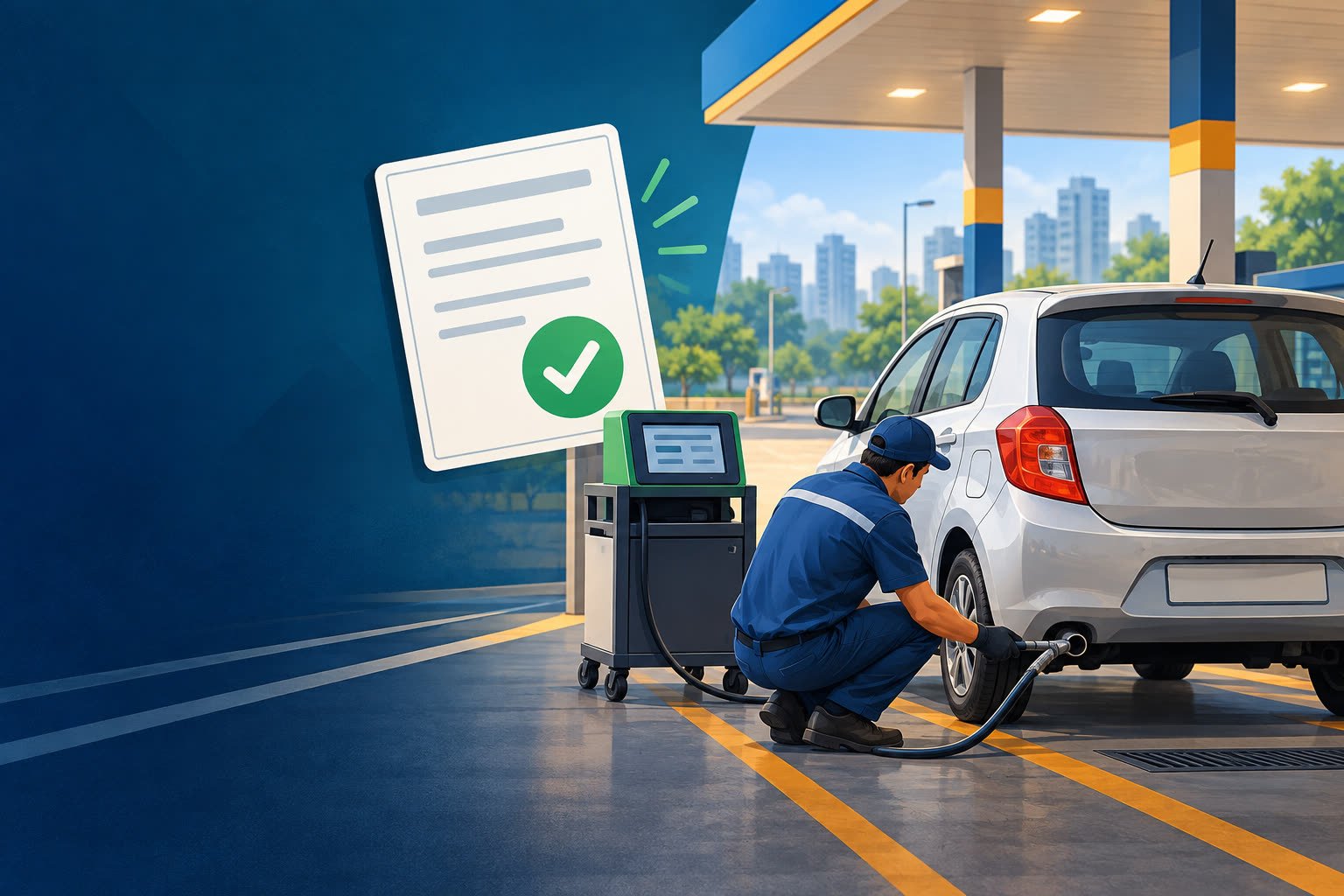
A Pollution Under Control (PUC) certificate confirms that a petrol, diesel, CNG or LPG vehicle’s measured emissions are within the applicable limits. This guide explains how to check the certificate online, renew it at an authorised centre and read the validity date that matters at a fuel station. The need to do that is more immediate in Delhi-NCR: CAQM Direction No. 101 envisages restricting fuel to vehicles without a valid PUCC from 01 Oct 2026, but the underlying PUC process remains a nationwide vehicle-owner task.
Key takeaways
- The central rule quoted by the Ministry of Road Transport and Highways starts the PUC requirement after the vehicle’s first registration year; the validity reference is six months generally and 12 months for BS-IV and BS-VI vehicles.
- The date printed as “valid upto” on the certificate and the record linked to the vehicle registration are more important than a remembered renewal interval.
- Online services let you check or download a PUC record. The emissions test itself still happens at a state-authorised PUC centre.
- For an online lookup, keep the registration number, the last five characters of the chassis number and the security code ready.
- From 01 Oct 2026, a valid PUCC is a fuel-access condition across the NCR under CAQM’s direction. Delhi’s rollout has focused on about 500 ANPR-equipped fuel stations, according to independent reports.
What a PUC certificate actually proves
PUC is an emissions certificate, not a general vehicle-health certificate. At an authorised centre, equipment measures the vehicle’s exhaust output and the system records the vehicle details, fuel type, emission norm, test result, fee and validity date. The standardised Form 59-A published through the Parivahan system also includes a vehicle photograph and a certificate number.
That distinction prevents a common mistake: a valid PUC does not replace a registration certificate, insurance policy, fitness certificate or driving licence. It only answers the pollution-compliance question. The Ministry’s 22 Jul 2021 release says the common PUCC format is linked with VAHAN data and that implementation of the Motor Vehicles Act and Central Motor Vehicle Rules sits with the relevant state or Union Territory authorities.
The certificate can therefore be checked online, but it is not normally “renewed” by filling in a web form alone. A physical test at an authorised centre produces the result; the government-linked record then makes that result available for checking and download.
PUC validity: the dates to understand
As of Oct 2026, the national reference most clearly stated by MoRTH is Rule 115(7) of the Central Motor Vehicle Rules, as quoted by the Press Information Bureau on 22 Jul 2021. After the first year from registration, every vehicle must carry a valid PUC certificate. The same release says the certificate is valid for six months, with a 12-month validity for vehicles manufactured to BS-IV or BS-VI norms.
Local transport systems can change the way a certificate is issued, displayed or checked. That is why the printed “valid upto” date, the vehicle’s emission norm and the latest state transport notice should be checked together. A driver travelling between states should not assume that an old paper slip or a previous centre’s verbal assurance overrides the live record.
| Situation | Dated reference | What to check |
|---|---|---|
| After the first registration year | A valid PUCC is required; the general validity reference is 6 months | Read the exact “valid upto” date on the certificate |
| BS-IV or BS-VI vehicle | MoRTH’s 22 Jul 2021 explanation states 12 months | Confirm the emission norm recorded against the vehicle |
| NCR fuel access | CAQM Direction No. 101 sets the restriction from 01 Oct 2026 | Check the live PUCC record before a fuel stop |
| Delhi enforcement footprint | Reports on 30 Sep–03 Oct 2026 described about 500 ANPR-equipped fuel stations | Do not treat a quiet pump as proof that the rule is inactive |
The table is a compliance guide, not a substitute for the certificate itself. It also explains why two owners may remember different intervals: emission category, state implementation and the date printed by the authorised centre all matter.
How to check your PUC certificate online
The official Parivahan PUC lookup asks for the vehicle registration number, the last five characters of the chassis number and a security code. The result can be used to confirm whether the record is present and what validity date is attached to it.
- Open the official Parivahan PUC certificate service rather than a third-party lookup page.
- Enter the registration number exactly as it appears on the RC, including the state and series letters.
- Enter the last five characters of the chassis number and complete the security code.
- Check the registration number, fuel type, emission norm, certificate number and “valid upto” date in the result.
- Download or save the certificate record before a long trip, especially when the vehicle will be refuelled in Delhi-NCR.
If the record does not load, first recheck the chassis characters and registration format. If a fresh test was completed but the result is missing, retain the payment slip or centre receipt and ask the authorised centre to confirm that the test was uploaded against the correct registration. Day-one reporting from Delhi on 02 Oct 2026 recorded cases of delays between an on-site test and the central record appearing, so a successful test and a visible database record should not be assumed to be the same moment.
Before setting out, the FuelPrice fuel-price hub can help separate the live pump-price question from the PUC compliance question. The PUC record does not change the price of petrol, diesel or CNG; it determines whether a vehicle can complete the fuel transaction where the restriction is being enforced.
How PUC renewal works at an authorised centre
Take the vehicle to a PUC centre authorised by the state transport department. The operator identifies the vehicle, connects the appropriate probe or analyser, records the measured emissions and generates the certificate if the readings comply. The MoRTH Form 59-A rejection slip lists two clear failure reasons: the malfunction-indicator lamp may be on, or an emission value may exceed the limit prescribed under the Central Motor Vehicle Rules.
Before the test
- Check the dashboard for an illuminated malfunction-indicator lamp and have the cause examined before relying on a PUC test.
- Confirm that the registration number and fuel type displayed by the centre match the vehicle being tested.
- Ask for the result and validity date to be checked before leaving the centre.
- Keep the receipt when the certificate is issued, particularly if the trip to a fuel station is time-sensitive.
If the vehicle fails
A failed test is not a valid certificate. The official rejection form advises the owner to resubmit the vehicle after service or repair. The useful next step is to identify the emission-related fault, repair it and return to an authorised centre; obtaining another certificate without a genuine test is not a safe workaround. Also verify that the centre’s authorisation and machine status are current, because the Ministry has advised states to calibrate equipment and check centres for malpractice.
What the Delhi-NCR no-PUC, no-fuel rule changes
CAQM’s official 15 May 2026 release says Direction No. 101 was approved with a plan to dispense fuel in the entire NCR only after production of a valid PUCC from 01 Oct 2026. The rule is therefore an access check at the fuel outlet, not a new petrol or diesel price. The direction also calls for technology-enabled identification, which is why ANPR cameras and vehicle-record lookups are central to the rollout.
Independent reporting gives the practical context. NDTV described a mission-mode campaign at around 500 ANPR-equipped fuel stations in Delhi, while Hindustan Times reported on 03 Oct 2026 that cameras, scanners and public announcements were operating at many stations but field enforcement and camera coverage were not uniform across NCR cities. The reports describe implementation conditions, not a suspension of the rule.
FuelPrice’s Delhi-NCR rollout report covers the first-day experience. For this evergreen guide, the more important lesson is procedural: check the certificate before arriving, allow time for a new result to appear in the government-linked record and keep the receipt available if the displayed status does not match the test just completed.
PUC cost: use dated local figures, not a national guess
There is no single all-India PUC price that applies to every vehicle and state. As a dated Delhi reference, reports on the July 2024 revision quoted ₹80 for petrol, CNG or LPG two- and three-wheelers, ₹110 for petrol, CNG or LPG four-wheelers and ₹140 for diesel vehicles. Hindustan Times and The Indian Express reported those revised amounts independently on 11–12 Jul 2024. These are reference figures from that Delhi revision, not a promise of the fee at every centre in Oct 2026; confirm the displayed tariff and any applicable tax before testing.
A simple budgeting example makes the distinction clear. If a Delhi petrol four-wheeler is charged the reported ₹110 for one test, the test budget is ₹110. If the same owner makes two paid visits in a year, the arithmetic is ₹110 × 2 = ₹220. That example does not assume that a second visit is always required or that a centre must charge exactly the same amount; it only shows how to budget from the local, dated tariff instead of multiplying an old national number.
PUC checklist before a commute or road trip
- Look at the certificate’s “valid upto” date today, not on the morning of a long journey.
- Check that the registration number, chassis characters, fuel type and emission norm match the vehicle.
- Use the official online lookup and save the current result.
- If the certificate has expired, visit an authorised PUC centre early enough for a retest or database-update issue.
- Keep the test receipt until the new status is visible and the next fuel stop is complete.
- For Delhi-NCR travel, assume a fuel station may use ANPR or a database check even if another station did not visibly stop vehicles.
- Estimate the fuel needed with the FuelPrice fuel-cost calculator, using the vehicle’s measured mileage and a dated local fuel price.
- Use the FuelPrice road-trip planner to schedule fuel stops and allow extra time for an authorised test if the certificate is close to expiry.
PUC certificate FAQ
Is a PUC certificate required for a new vehicle?
The central rule quoted by PIB begins the requirement after one year from the vehicle’s first registration. The certificate or vehicle record remains the controlling evidence, so check the displayed validity date rather than relying only on the purchase date or a dealer’s verbal explanation.
Can I renew PUC completely online?
No. The online service is for checking and downloading the record. The emissions measurement and certificate generation happen at a state-authorised PUC centre.
What should I do if the PUC is valid on paper but not showing online?
Recheck the registration and chassis details, keep the centre receipt and ask the issuing centre to verify the upload. If the mismatch continues, contact the relevant state transport authority before assuming that a pump scanner will accept the paper certificate.
Is PUC the same as vehicle fitness or insurance?
No. PUC covers measured emissions. Fitness, registration and insurance are separate compliance documents, each with its own validity and authority. A valid PUC cannot cure an expired insurance policy or an unrelated vehicle defect.
Sources
- Commission for Air Quality Management, “Direction No-101 dt 15.05.2026 – Imposing restriction on fueling of vehicles without valid PUCC in NCR”, 15 May 2026.
- Commission for Air Quality Management, “CAQM reviews enforcement measures across key sectors”, 15 May 2026.
- Press Information Bureau, “Government standardises the Pollution Under Control Certificate (PUCC) form to a common format to be issued across the country”, 22 Jul 2021.
- Parivahan Sewa, “PUC Certificate” lookup service, accessed 03 Oct 2026.
- Ministry of Road Transport and Highways, “Form 59-A: Pollution Under Control Rejection Slip”, accessed 03 Oct 2026.
- NDTV, “‘No PUC, No Fuel’ Rule To Be Enforced Across Delhi-NCR From October 1”, 30 Sep 2026.
- NDTV, “Delhi’s ‘No PUC, No Fuel’ Day 1: Cameras On, But No Officials At Pumps”, 02 Oct 2026.
- Hindustan Times, “‘No PUC, no fuel’ drive hits staffing, tech snags in Delhi”, 03 Oct 2026.
- Hindustan Times, “Delhi government increases rates for pollution certificates for vehicles; check new prices”, 11 Jul 2024.
- The Indian Express, “Delhi government increases PUC certificate charges after 13 years”, 12 Jul 2024.
This article is for general information only and is not financial, insurance or legal advice.