India's electric-vehicle supply chain may be approaching a less visible bottleneck: the power semiconductors that control energy between the battery, motor and charger. In an interview published on 21 Oct 2026, HORIBA India identified an opportunity in silicon-carbide (SiC) and other compound semiconductors, while flagging gaps in raw materials, supporting suppliers and skilled manpower. For EV owners, this is not an immediate change to a model's range or a charging tariff; it is a longer-term industrial development that could influence efficiency, component availability and the pace of local manufacturing.
The practical distinction matters. HORIBA is an equipment and measurement company, not a carmaker announcing a new EV or a chipmaker promising a production launch. Its assessment describes what India needs around semiconductor manufacturing, and why the quality of power electronics may matter more as EV adoption grows.
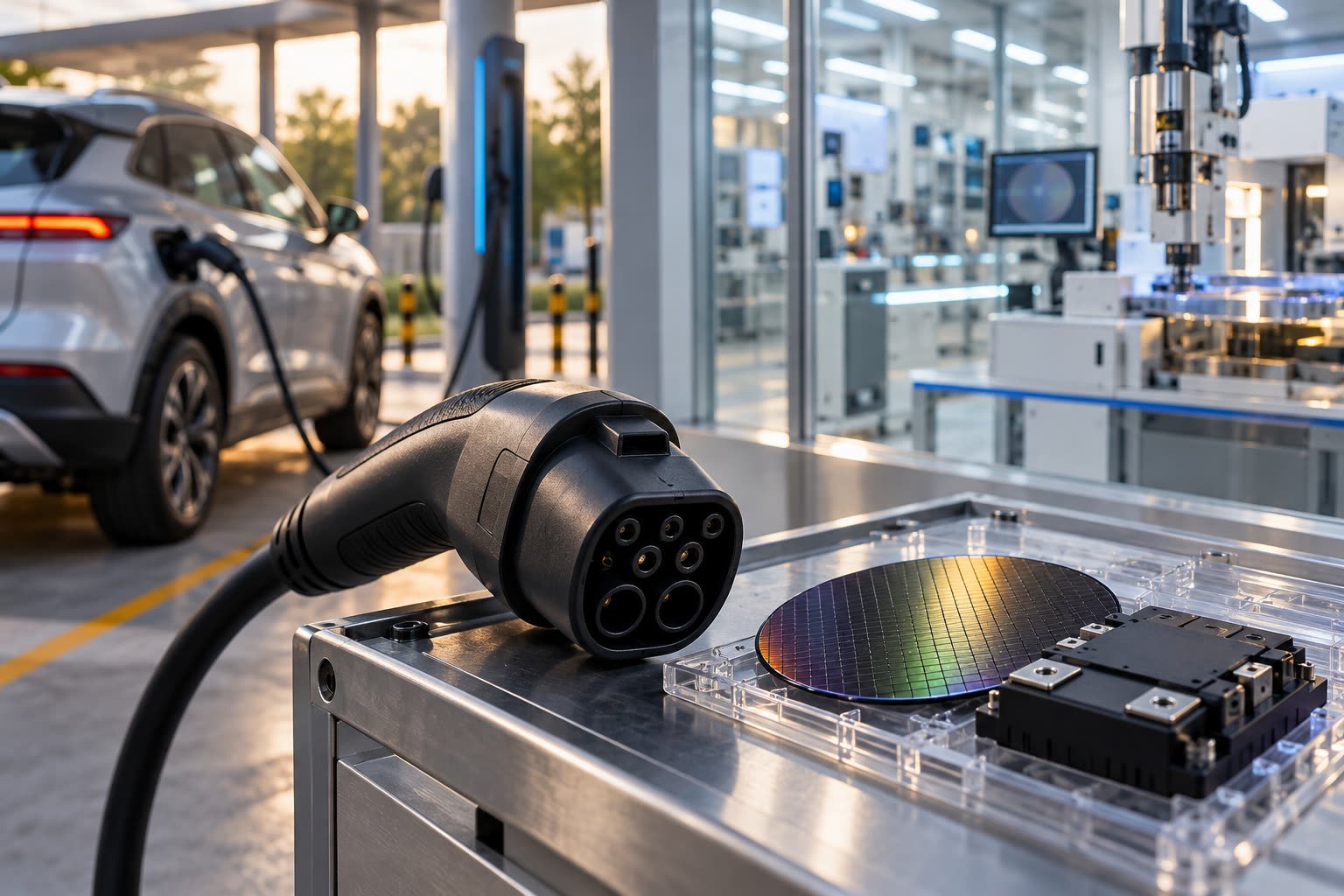
Illustration: an EV charging connector, semiconductor wafer and power module shown as an editorial representation of the EV supply-chain link; not an official HORIBA product photograph.
Key takeaways
- HORIBA India sees domestic SiC and compound-semiconductor capability as an opportunity linked to electric-vehicle power electronics.
- The company told Autocar Professional that raw-material processing, supply-chain localisation and skilled talent remain important gaps.
- SiC is used in areas such as traction inverters and charging systems, where higher heat and voltage tolerance can support more efficient power conversion.
- India's semiconductor roadmap includes compound semiconductors for automotive and energy applications, but the policy direction is not the same as a completed local EV-chip supply chain.
- Existing EV buyers should continue to compare real-world range, charging access and warranty terms for the specific vehicle; this industrial development does not change those specifications today.
What HORIBA India said
Autocar Professional reported on 21 October that HORIBA India sees an opening as India builds semiconductor manufacturing capabilities for automotive power electronics. The interview covered SiC and other compound materials, which are relevant to the high-power systems used in electric vehicles rather than to the infotainment chips that receive more public attention.
HORIBA India's position was that the difficult part is not only access to fabrication technology. The country also needs the upstream chain that sources, processes and purifies the required materials, along with suppliers that can deliver consistent inputs to manufacturing plants. The company also pointed to workforce development: fabs, equipment suppliers and quality-control operations need people who understand both semiconductor processes and the applications they serve.
That is a reported industry assessment, not an official government deadline or a confirmed production timetable. The same interview said HORIBA already carries out some manufacturing activity in Pune and is technically prepared to expand local production when domestic semiconductor volumes are sufficient. That statement describes a conditional business possibility, not a new factory order or a guaranteed supply arrangement for Indian EV makers.
Why silicon carbide matters to an EV
An EV's battery stores direct-current electricity, while the motor and the charging system rely on power electronics to control and convert that energy. The traction inverter is one of the key links: it regulates the flow from the battery to the motor and helps turn electrical energy into motion. Charging equipment also contains conversion hardware, whether the vehicle is taking power from an AC wallbox or a faster DC system.
Silicon carbide can tolerate higher temperatures and voltages than conventional silicon in some power-electronics applications, and it can switch quickly. The US Department of Energy describes those characteristics as reasons SiC can reduce conversion losses and enable smaller or less heat-intensive equipment. HORIBA and Autocar Professional place the same material in the context of EV traction inverters and charging systems.
That does not mean a vehicle with SiC hardware automatically has a longer range, charges faster in every situation or costs less to run. Battery size, motor calibration, charging limits, temperature, tyres, traffic and the electricity tariff still shape the driver's experience. The potential benefit is at the system level: better power conversion can give engineers more room to manage heat, packaging and efficiency when a vehicle or charger is designed around it.
India's supply-chain question
NITI Aayog's 2026 semiconductor-industry roadmap places electric vehicles and energy among the sectors driving demand for specialised chips. It also identifies SiC and gallium nitride as compound-semiconductor areas that can support automotive and other high-power applications. The roadmap's message is broader than one company: India's opportunity depends on materials, design, packaging, process control and workforce capability being developed together.
HORIBA India's own account of its “lab to fab” work provides a useful example of that wider ecosystem. The company says its capabilities span material characterisation, process monitoring, fluid control, contamination management and cleanroom solutions. These are enabling systems around chip production. They help measure and control a process, but they do not by themselves create a locally made chip or guarantee that an EV manufacturer will source it in India.
For the automotive sector, the distinction affects resilience more than a single vehicle launch. If local suppliers can eventually provide reliable power devices, packaging and testing, automakers may have more options when global logistics or geopolitical disruptions affect imported components. That is an expected benefit of localisation, not a confirmed saving or a promise that future EV prices will fall.
What this means for EV owners today
Nothing in the HORIBA interview changes the certified range, charging time, battery warranty or service schedule of an EV already on sale. Those remain model-specific facts that should be checked in the manufacturer's technical sheet and written purchase documents. A future improvement in power-electronics supply should not be treated as a reason to assume a current vehicle will receive a hardware upgrade.
For a planned electric trip, the useful checks remain practical: identify charging stops, allow for charging time, consider a route with a backup station and use the state-wise EV charging station directory to review available locations. The road-trip planner can help separate distance and stop planning from optimistic range claims. If an EV is being compared with a petrol or diesel vehicle, the fuel cost calculator can show the conventional-fuel side of the comparison, while charging cost needs the applicable electricity tariff and vehicle consumption data.
The right reader takeaway is therefore measured: the chip story is about the foundations behind future EV performance and manufacturing resilience, not about a new owner obligation or an immediate change at a charging station.
What to watch next
More than a fab announcement
The next meaningful signs will be projects that connect semiconductor materials, device fabrication, packaging, testing and automotive demand. A headline about a proposed plant is not the same as commercial output. Readers should look for a confirmed project status, the type of device being made, qualification by vehicle or charger suppliers and a clear production timeline.
Skills and quality control
Power devices must perform consistently under heat, voltage and repeated switching. Training and measurement capability are therefore part of the supply story, not side issues. HORIBA's comments suggest that equipment, analytical services and process expertise could become important alongside wafer and packaging capacity.
Benefits that reach the vehicle
For consumers, the eventual test will be visible in product specifications and ownership data: energy use under comparable conditions, charging performance, serviceability and the availability of replacement parts. Until manufacturers publish those details, any claim of a specific range gain, faster charging time or lower price would be an expectation rather than a confirmed result.
FuelPrice takeaway
HORIBA India's latest assessment puts the spotlight on a part of the EV transition that drivers rarely see: the materials, measurement systems and skilled workforce behind power electronics. India has a policy and industrial push toward compound semiconductors, but raw-material processing and supply-chain depth still need to catch up. For today's EV owner or buyer, the sensible reading is to track confirmed vehicle specifications and charging access while treating local SiC manufacturing as a longer-term development that could strengthen future EV efficiency and supply resilience.
Sources
- Autocar Professional, “Exclusive: HORIBA Sees EV Chip Opportunity, Flags India's Semiconductor Supply Gaps”, 21 Oct 2026
- HORIBA India, “HORIBA India Showcases Advanced Lab to Fab Solutions at SEMICON India 2026”, 18 Sep 2026
- NITI Aayog, “Future of India's Semiconductor Industry”, May 2026
- US Department of Energy, “Silicon Carbide in Integrated Energy”, 2 Mar 2026
- HORIBA, “HORIBA India”, accessed 21 Oct 2026