Germany's federal cabinet approved a draft law on 11 Nov 2026 to create a 24 TWh strategic gas reserve, with the government targeting additional resilience from winter 2027/28. The buffer is meant for extraordinary supply crises, not normal seasonal storage or a cap on gas prices, and the proposed system would recover costs through gas customers.
Key takeaways
- The measure is a draft, so Germany's parliament still has to consider and approve the legal framework.
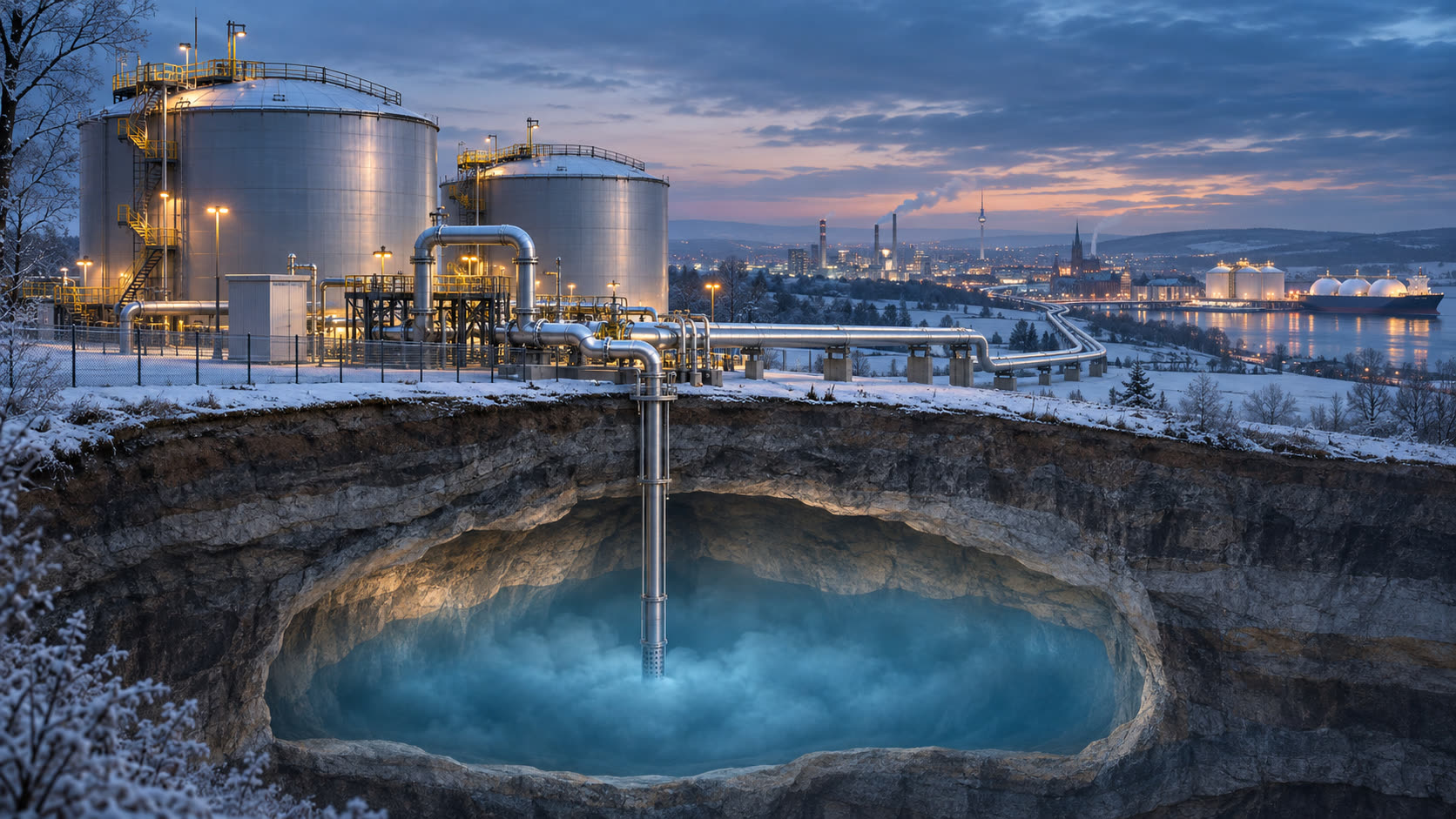
- The proposed reserve would hold 24 TWh of physical gas, about 10% of Germany's storage capacity, for use only in a declared crisis.
- Trading Hub Europe would build the stock, while the Federal Network Agency would decide when an emergency justified its release.
- The government estimates a levy equivalent to 0.03–0.05 euro cents per kWh, or 0.3–0.5% on household gas costs.
What Germany approved
The cabinet decision creates the legal basis for a strategic natural-gas buffer. It does not yet create an operating reserve: the draft now goes to parliament, and the final design, financing details and timetable can still change. Germany's government says the current gas supply for homes and businesses remains secure, but it wants a separate tool for a severe disruption that normal market storage cannot absorb.
S&P Global Energy reported on 11 Nov 2026 that the draft is intended to protect Europe's largest economy against acute energy-security shocks. Reuters reporting carried by gCaptain on the same date said the reserve would be funded through user surcharges and would not replace suppliers' normal winter-preparation duties. The distinction matters: this is a proposed crisis policy, not a new seasonal fill target or an immediate change to retail energy prices.
A crisis buffer, not a routine stockpile
The German government's published questions and answers put the planned volume at 24 TWh of additional physical gas, roughly 10% of the country's gas-storage capacity. The same document says that quantity could secure nationwide gas supply for 30 days if the main import infrastructure were to fail completely. Clean Energy Wire's account of the earlier draft described the same 30-day crisis purpose, while Reuters also reported that the stock is intended for severe disruptions such as sabotage.
That design is deliberately narrow. The reserve would sit outside ordinary market inventories and would not be used to soften normal price swings. Gas companies would still be responsible for meeting their contracts, managing winter demand and maintaining the supplies needed for a cold season. This is why the announcement should not be read as a promise that household gas bills, electricity prices or petrol and diesel prices will fall.
How the reserve would work
Trading Hub Europe, the operator responsible for Germany's gas market area, is expected to procure and build the reserve. The government says the full stock should be assembled as quickly as possible from 2027, but the build-up can be spread over up to three years so that purchases are made in a market- and price-conscious way. The stated readiness target is winter 2027/28, subject to the parliamentary process.
Release would require a formal gas emergency. Germany's Federal Network Agency, acting as the national load distributor, would decide when the reserve should be used. The government says the purpose is to avoid more disruptive interventions, such as shutting industrial facilities or directing private storage and building temperatures, once an acute shortage has been declared.
That operating model also makes clear what the announcement does not mean. Germany is not taking a fixed quantity of gas off the market for everyday use, and the reserve is not a substitute for pipeline imports, liquefied natural gas cargoes or commercial storage. It is an insurance layer for a low-probability, high-impact event.
What it may cost gas customers
The draft proposes financing the reserve through a levy on gas suppliers that would ultimately be passed to customers. The German government estimates an addition of 0.03–0.05 euro cents per kWh, equivalent to 0.3–0.5% of household gas costs. S&P Global Energy and Reuters reported the same estimated household impact. Those figures are proposals attached to a draft, not a bill that has already appeared on customer invoices.
The cost question is politically important because the reserve is being planned while German storage levels are below the government's earlier seasonal target. A levy would make the resilience benefit visible on gas bills, while spreading procurement over several years is intended to reduce the chance that the state buys the full volume during a price spike. The final charge will depend on the law, procurement method and market conditions.
Why this matters beyond Germany
Germany is a central part of Europe's gas system and has the European Union's largest gas-storage capacity, according to S&P Global Energy. A dedicated emergency stock could give Berlin another response option during a regional supply shock, but it could also change how much gas is held back from ordinary trading. The wider market effect is an inference, not a forecast: it will depend on where the reserve is stored, how quickly it is filled and whether other European countries adopt similar arrangements.
The plan also points to a broader policy shift. Governments are increasingly treating storage, import diversity and infrastructure protection as parts of the same energy-security problem. Germany says it will pursue a supplier obligation linked to a future European Union framework, so the next stage may involve rules that reach beyond one national reserve.
For readers tracking market-sensitive energy updates, the fuel-price pages remain the practical place to check local pump data. Natural gas policy and road-fuel prices are linked through broader energy costs, but they are not the same market and should not be conflated.
What it means for drivers and fleets
There is no direct petrol or diesel-price change in this cabinet decision. Road users may still feel the effects of wider energy shocks through logistics, electricity or industrial costs, especially if a supply crisis affects several fuels at once. For a trip-specific view of how fuel costs move a household or fleet budget, use the fuel cost calculator rather than applying the gas-reserve levy to a road-fuel estimate.
Fleet operators should watch the final law, not the headline alone. The useful questions are whether the levy is approved, when collection begins, how the reserve is procured, and whether the emergency rules coordinate with neighbouring European markets. None of those details is final yet.
What happens next
Parliament must consider the draft before the reserve can be established. The government is also expected to refine the customer-financing mechanism and the rules for supplier winter obligations. The Federal Network Agency's emergency threshold and the geographic distribution of the stock will determine how useful the reserve is in practice.
Until those steps are complete, the announcement is best understood as a proposed resilience measure. It gives Germany a planned backstop for a major gas-supply failure, while leaving routine winter preparation with suppliers and the market. Follow the worldwide fuel news archive for further decisions on European gas security, LNG flows and related fuel-market effects.
Sources
- German Federal Government — Neue Gasreserve zur Krisenvorsorge — 11 Nov 2026
- German Federal Government — Regierungspressekonferenz vom 11. November 2026 — 11 Nov 2026
- S&P Global Energy — German cabinet approves gas reserve draft law — 11 Nov 2026
- Reuters, via gCaptain — Germany to Set Up State Gas Reserve After Missing Winter Storage Targets — 11 Nov 2026
- Clean Energy Wire — Energy industry welcomes plans for national gas crisis reserve for Germany, calls for better design — 14 Oct 2026
This article is for general information only and is not financial, insurance or legal advice.