HPCL is expanding its electric-vehicle charging network towards commercial transport and highway use, according to reports published on 6 Oct 2026. The shift matters because an EV charging point that is useful for a city car is not automatically a dependable stop for an inter-city bus, freight truck or a private EV planning a long route.
One current report placed HPCL’s operational EV-charging network at 5,826 facilities. That figure is reported rather than a new government notification: HPCL’s own charging information confirms a focus on key cities and major highways, while Mahindra’s 20 Mar 2026 partnership release separately said HPCL was running more than 5,400 charging stations.
Key takeaways
- Reports say HPCL is steering its charging expansion towards buses, trucks and logistics routes.
- The reported network count is 5,826 facilities as of 6 Oct 2026; HPCL’s own public material confirms the broader highway-focused strategy.
- For EV travellers, a station listing is only the starting point: connector, access, payment, uptime and queue conditions still need checking.
- Fleet operators need route-level confidence, including vehicle compatibility, charging time, depot fallback and a plan for a busy or unavailable station.
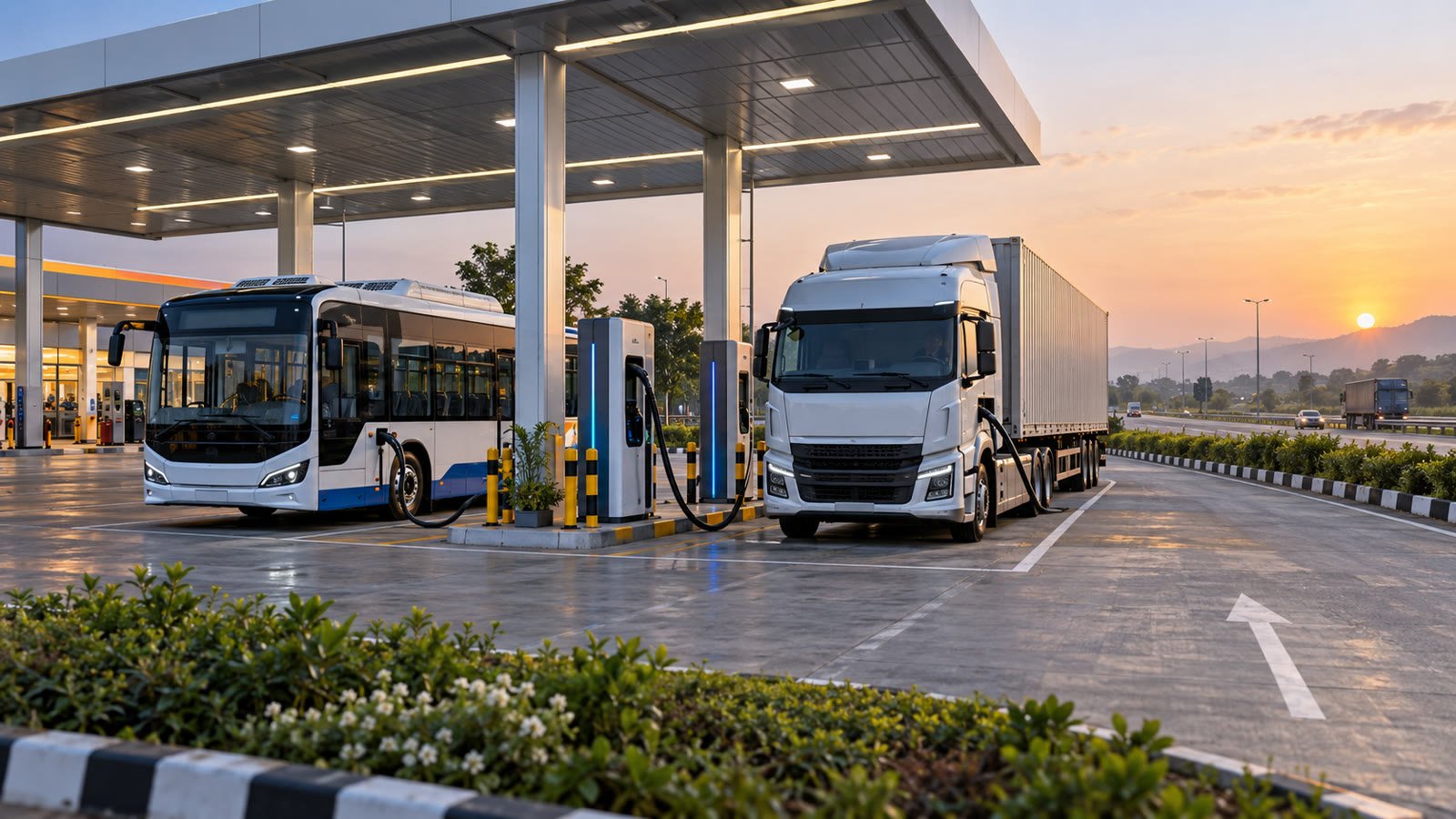
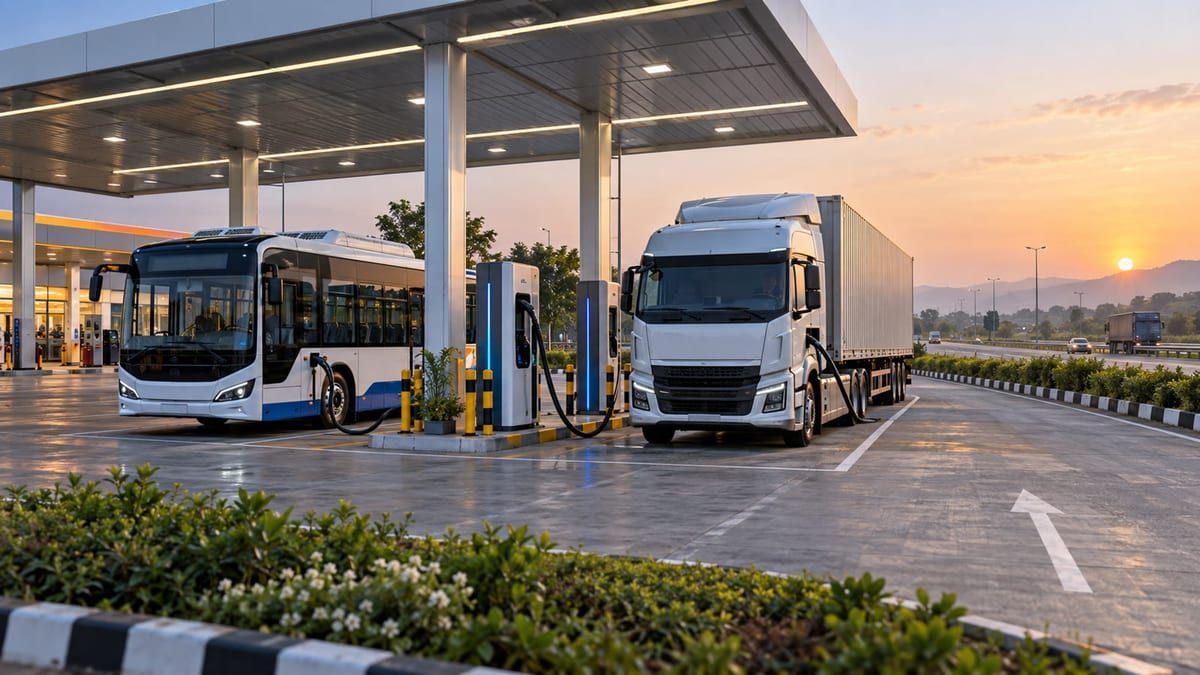 Illustration: FuelPrice / AI-generated representative highway EV-charging scene; not an HPCL photograph.
What HPCL is reported to be changing
HPCL’s charging push is moving beyond the idea of placing a charger beside an urban fuel station. The 6 Oct report described a logistics-facing strategy that uses existing retail locations and partnerships to support commercial vehicles. Whalesbook said the network had reached 5,826 operational facilities, while a separate market-news listing carried the same reported count and described the focus on trucks and buses across highway corridors.
The direction is consistent with HPCL’s published EV-charging information, which lists chargers across urban and highway locations and describes a plan to build infrastructure in key geographies and along major routes. Mahindra’s 20 Mar 2026 announcement of its Charge_iN partnership with HPCL also shows how the company is using its retail footprint to add charging access rather than treating EV charging as a stand-alone city business.
For readers, the important distinction is between network scale and route reliability. A larger network can improve the chance of finding a charging point, but it does not mean every listed site has the same connector, power availability, operating hours or vehicle access.
Why commercial charging changes the highway equation
A private electric car can often plan around a short top-up, a home charger or a second station nearby. A bus or loaded truck has tighter timing, greater energy demand and less flexibility if a charger is occupied or out of service. Depot charging, turnaround time, parking geometry and the ability to handle a larger vehicle can therefore matter as much as the number of stations on a map.
This is why the reported HPCL move is relevant to more than fleet managers. It can improve the number of potential stops on inter-city routes, but it also makes accurate station information more important. Before leaving, an EV driver can use the state-wise EV station directory to build a shortlist, then confirm the station’s current status through the operator’s app or helpline.
What EV users should check before relying on a station
1. Connector and vehicle compatibility
Check whether the charger supports the vehicle’s connector and charging protocol. A station can be publicly listed and still be unsuitable for a particular car, bus or truck. Also check whether the location has the required charging speed, rather than assuming that every point at the same site offers the same service.
2. Access, queue and payment
Confirm opening hours, whether the charger is inside a fuel-station forecourt, how payment is handled and whether a separate app or account is required. During weekends, holidays and freight peaks, queue time can turn a technically short charging stop into a longer delay.
3. A route backup
Do not plan a long journey around a single unverified stop. Keep a second location within practical range and account for traffic, weather, payload and the difference between claimed and real-world range. The road-trip planner can help organise the route, while the station check should be done close to departure.
How this affects running-cost comparisons
More charging points can reduce the planning burden, but they do not by themselves prove that an EV is cheaper for every route or fleet duty cycle. Electricity tariff, charging speed, waiting time, tolls, payload, maintenance and vehicle financing all change the calculation. For an ICE-versus-EV comparison, use the fuel-cost calculator for the petrol or diesel baseline and keep the electricity, charging and time assumptions separate.
That separation is especially important for operators. A truck that loses a delivery slot waiting for a charger may face a cost that does not appear in a simple energy-per-kilometre comparison. A private driver may value a dependable stop more than a marginally lower charging tariff if the alternative adds a large detour.
What has not changed yet
The reported HPCL expansion is an infrastructure update, not a new nationwide toll, fuel-price or EV-owner rule. It does not guarantee that every HPCL location is open to every vehicle type, nor does it set a uniform charging tariff or promise a particular charging time. Those details remain site- and operator-specific.
For now, the practical change is a broader network to check, not a reason to remove route backups. EV owners should treat the reported count as a sign of continued infrastructure investment and verify the actual station before making it the only stop on a trip. Fleet operators should compare the route, vehicle duty cycle and charging access together before changing an operating plan.
Sources
- Whalesbook — “HPCL Expands EV Network to 5,826 Units Targeting Logistics” — 06 Oct 2026
- Kotak Neo — “HPCL EV charging network grows 8% to 5,826, targets trucks and buses on 50 highway corridors” — 06 Oct 2026
- Hindustan Petroleum Corporation Limited — “EV Charging” — accessed 07 Oct 2026
- Mahindra Auto — “Charge_iN by Mahindra Signs Strategic Agreement with HPCL to develop EV Charging Infrastructure at HPCL Retail Outlets” — 20 Mar 2026