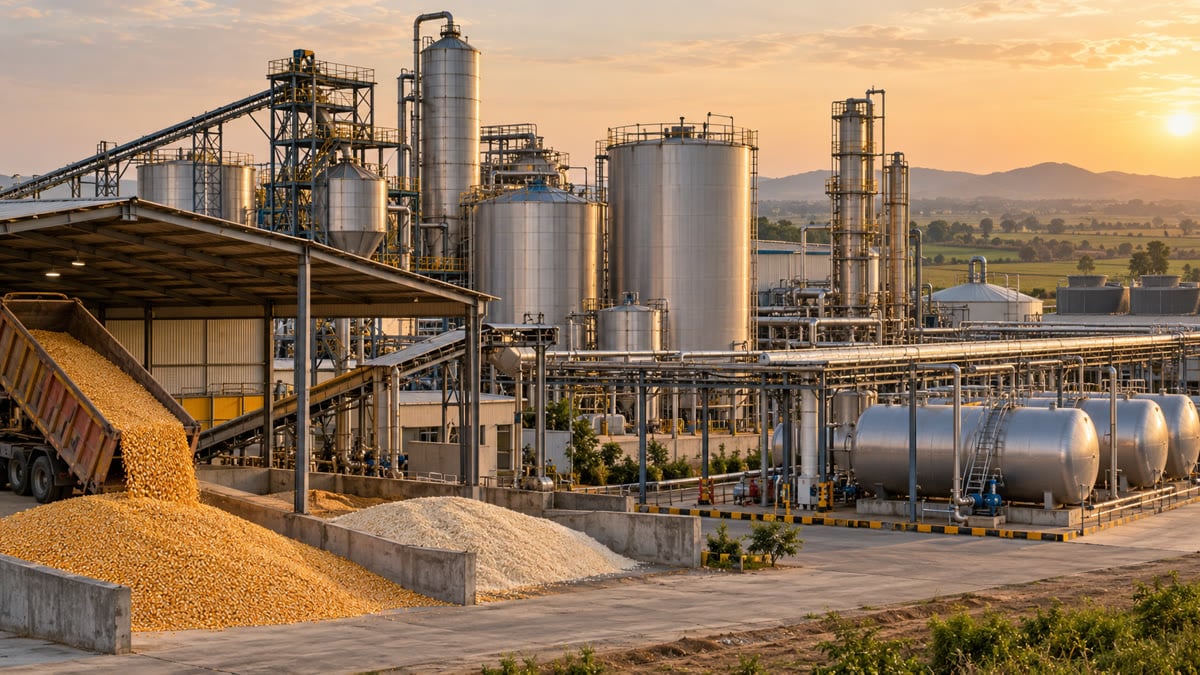
SunBridge BioEnergy has started commercial production at a grain-based, fuel-grade ethanol plant in Seoni, Madhya Pradesh, according to reports published on 6 Oct 2026. The 300 kilolitres-per-day (KLD) facility adds domestic ethanol-making capacity, but the announcement does not change petrol pump prices, the national E20 blending level or the fuel available at a particular city station.
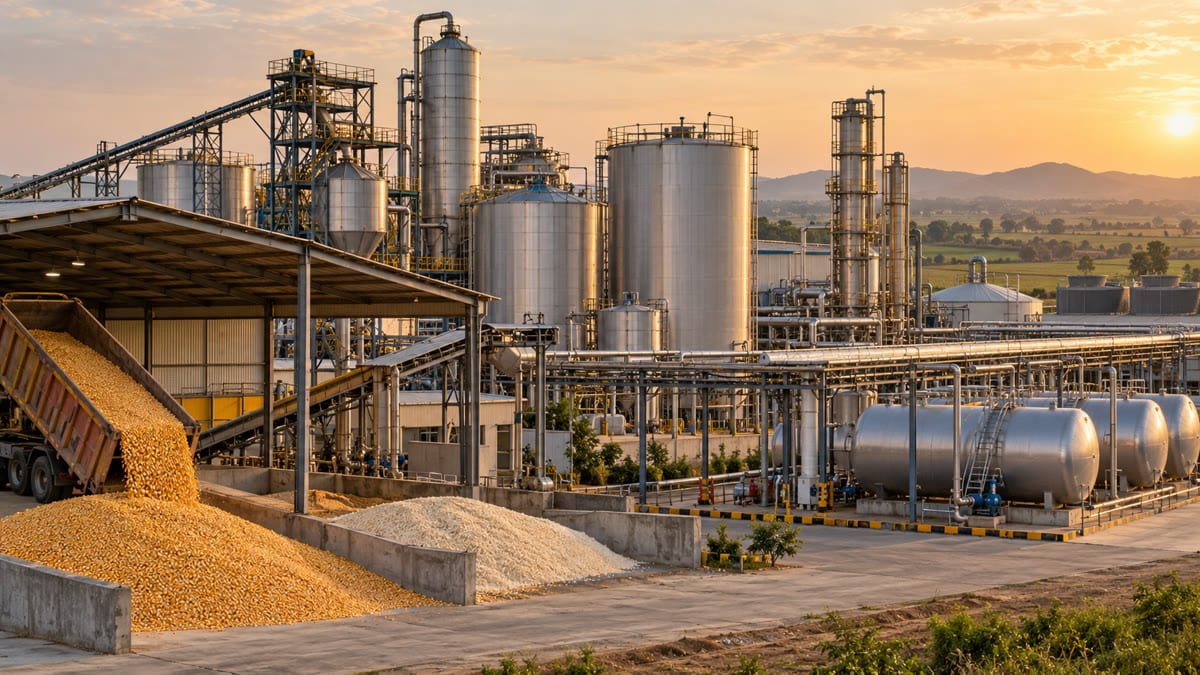 Illustrative editorial image of a grain-based fuel-ethanol facility; it is not a photograph of SunBridge BioEnergy's Seoni plant. Credit: FuelPrice, AI-generated illustration.
Key takeaways
- The Seoni unit is rated at 300 KLD and has reported storage capacity of 11,000 kilolitres, according to Economic Times and Indian Chemical News reports dated 6 Oct 2026.
- Reports put the project investment at about ₹350 crore.
- The company's expected combined capacity would reach 700 KLD after a planned 400 KLD Raipur facility becomes operational; that is a future target, not current Seoni output.
- The Press Information Bureau said on 23 Jul 2026 that India had achieved 20% ethanol blending in Ethanol Supply Year 2025-26; no new blend level is announced by this plant.
What started in Seoni
The Economic Times reported on 6 Oct 2026 that SunBridge BioEnergy had begun commercial production at its Seoni facility after an investment reported at about ₹350 crore. Indian Chemical News independently reported the same plant scale and said the unit is designed for 300 KLD of fuel-grade ethanol, with storage capacity of 11,000 kilolitres. Energetica India also reported the commissioning of the Madhya Pradesh facility.
The reported feedstock is damaged maize and broken rice that is not intended for human consumption. That matters because the plant is positioned as a fuel-supply project using industrial grain inputs, rather than as a retail fuel-price announcement. The feedstock description is based on company information carried by the industry reports.
How much capacity is being added
At its rated level, 300 KLD represents up to 300,000 litres of ethanol production per day. Actual output can vary with operating conditions, maintenance and feedstock availability, so the rated number should not be read as a guaranteed daily dispatch.
SunBridge has also said its overall capacity is expected to reach 700 KLD once a 400 KLD facility in Raipur, Chhattisgarh, becomes operational. The Raipur figure is a planned addition reported by the company and the media reports; it is not evidence that the second facility is already producing. For readers tracking the fuel market, the distinction is important: Seoni's commercial start is confirmed in the reports, while the larger combined-capacity figure remains dependent on the future Raipur commissioning.
Why the project matters for petrol users
More domestic ethanol capacity can add flexibility to the supply chain used for petrol blending. It may support procurement over time, but a plant's rated capacity does not set the price printed on a petrol-pump display. Retail prices also reflect crude-oil costs, taxes, exchange rates, marketing decisions and local conditions. No price cut or city-wise retail change was announced with the Seoni commissioning.
The policy context is also unchanged. In a PIB release dated 23 Jul 2026, the Ministry of Petroleum and Natural Gas said India had achieved 20% ethanol blending in petrol during Ethanol Supply Year 2025-26, covering November 2025 to June 2026. The same release said there was no decision to move the nationwide base blend above 20%, and that E85 is intended for vehicles designed and certified as flex-fuel vehicles.
That means drivers should not read the Seoni announcement as a new E20 mandate or as a signal that regular cars can use E85. Readers can check current rates on the live fuel prices page, but a new ethanol plant does not automatically change those displayed prices.
What the plant produces besides ethanol
Indian Chemical News and Energetica India reported that the facility will also produce dried distillers grains with solubles (DDGS) and distillers corn oil (DCO) as co-products. The reports also described water-recovery and zero-liquid-discharge features. These details come from company disclosures carried by the industry outlets, so they describe the project's stated design rather than an independent operating audit.
For the broader fuel system, co-products can matter because they improve the use of the grain input and create additional output beyond ethanol. They do not, however, provide a basis for estimating a near-term change in petrol mileage, pump price or local fuel availability.
What changes now — and what does not
- Confirmed: SunBridge has started commercial production at the Seoni grain-based ethanol facility, according to reports dated 6 Oct 2026.
- Reported current scale: The plant is rated at 300 KLD, with 11,000 kilolitres of storage reported by the company and industry media.
- Expected later: A 400 KLD Raipur facility could take the company's combined capacity to 700 KLD after commissioning.
- Not announced: There is no accompanying announcement of a petrol-price cut, a higher nationwide blend, an E85 rollout for ordinary vehicles or a plant-specific change at a particular fuel station.
For a practical view of the compatibility question, read the guide to E20 petrol compatibility in India. FuelPrice's earlier report on E20 vehicle checks and damage concerns also explains why blend changes and vehicle certification should be considered separately from a new ethanol plant.
What drivers and fleet operators should watch
The next useful signals are official updates on ethanol procurement, blending targets and oil-marketing-company supply arrangements. Those notices will say more about how additional production enters the national system than the plant's rated capacity alone.
For private motorists, the immediate checklist is limited: continue using the blend specified for the vehicle, check the manufacturer's compatibility guidance, and do not assume that an ethanol-production announcement changes the fuel sold at a nearby station. Fleet operators can compare trip costs using the fuel cost calculator when a verified retail-price or mileage change is announced; there is no such plant-specific change in this report.
FAQ
Does the Seoni plant mean every petrol station now sells a new blend?
No. The commissioning adds production capacity. The blend sold at a station depends on policy, oil-company supply and the applicable fuel specification; the reports do not announce a new retail blend.
Will petrol become cheaper because of the project?
No immediate price change was announced. Ethanol supply is one input in the fuel system, while retail prices depend on several market, tax and marketing factors.
Can every car use E85?
No. The PIB's 23 Jul 2026 release says E85 is for flex-fuel vehicles designed and certified for it. A standard petrol vehicle's compatibility should be checked against the manufacturer's guidance.
Sources
- The Economic Times — SunBridge BioEnergy starts commercial production at Rs 350 crore ethanol plant (6 Oct 2026)
- Indian Chemical News — SunBridge BioEnergy begins commercial ethanol production at 300 KLD Seoni plant (6 Oct 2026)
- Energetica India — SunBridge BioEnergy commences ethanol production at 300 KLD plant in Madhya Pradesh (6 Oct 2026)
- Press Information Bureau — Government highlights safety, performance and national benefits of ethanol-blended petrol (23 Jul 2026)