HPCL’s official September 30 disclosure listed 5,880 EV charging stations, while an interview published on 10 Nov put its network at about 5,981 facilities as of 1 Nov. The company is focusing on highway and commercial-vehicle charging, including planned 240 kW units, but the practical benefit for an EV driver depends on connector compatibility, live status and route coverage—not the headline count alone.
Key takeaways
- HPCL’s official results release recorded 5,880 EV charging stations as of 30 Sep 2026.
- An EVreporter interview with an HPCL executive cited about 5,981 charging facilities as of 1 Nov, including roughly 2,180 AC slow chargers and 3,627 DC fast chargers.
- HPCL says it is targeting around 6,000 chargers by the end of FY27 and higher-power infrastructure across 50 highway corridors.
- The same interview reported more than 176 battery-swapping stations, but the sources do not clearly establish whether those are included in the 5,981 figure. Drivers should not add the numbers without checking the operator’s definition.
What changed in HPCL’s latest count
HPCL’s newsroom update on 22 Oct, covering the quarter and half year ended 30 Sep, listed 5,880 EV charging stations. The disclosure also recorded 25,245 HPCL retail outlets on that date. This is the company’s dated primary disclosure and is the clearest official baseline for its charging network.
EVreporter’s 10 Nov interview with Kushal Kumar Banerjee, HPCL’s chief general manager for retail strategy and business development, gave a newer snapshot: about 5,981 EV charging facilities as of 1 Nov. It described the mix as roughly 2,180 AC slow chargers and 3,627 DC fast chargers, with DC units predominantly compatible with the CCS2 standard. The interview also said HPCL operated more than 176 battery-swapping stations with partners.
Those figures show expansion, but they should not be treated as a perfectly comparable month-on-month increase. HPCL’s official release uses “EV Charging Stations”, while the interview uses “facilities” and separately discusses battery swapping. The published material does not make the counting boundary fully clear, so 5,981 should be read as the latest reported network figure rather than as 5,880 plus 176.
Why HPCL is shifting towards highway charging
The expansion is moving beyond simply adding chargers at urban fuel stations. EVreporter said HPCL is prioritising high-traffic retail outlets, major cities, highway corridors and freight routes, using the company’s existing network of more than 25,000 retail outlets as a base for new energy services.
HPCL’s stated plan includes higher-capacity 120 kW and 180 kW chargers, along with about 100 planned 240 kW chargers on strategic routes. The company told EVreporter that it is participating in the PM E-DRIVE programme and targeting 50 major highway corridors, with electric trucks and buses among the intended users. The Financial Express reported the same broad direction in October, including HPCL’s target of around 6,000 chargers by the end of FY27 and its plan to support commercial vehicles on 50 corridors.
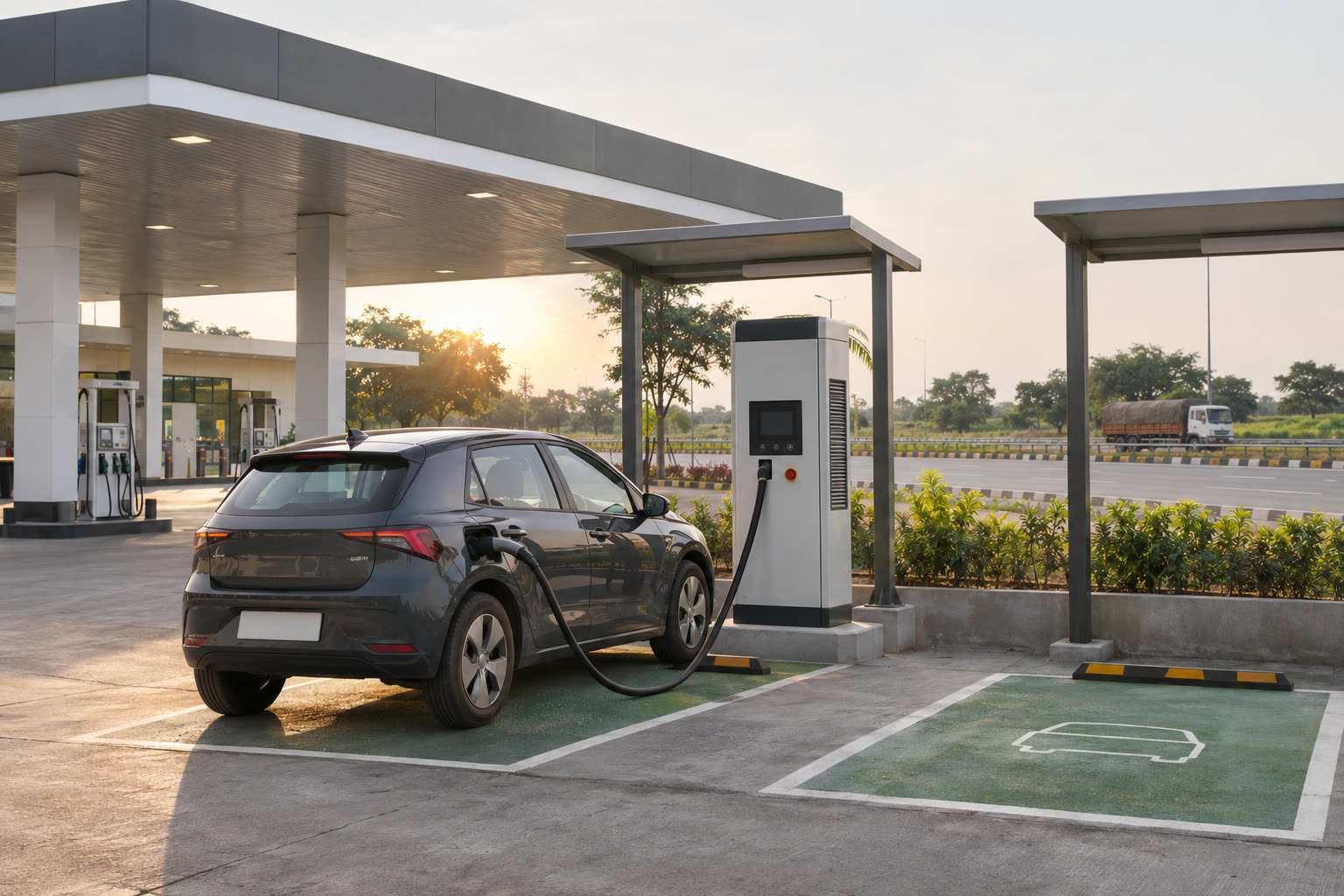
For a private EV owner, this matters because highway charging is different from overnight home charging. A corridor site can reduce the need to detour into a city, while higher-power equipment may shorten a stop for vehicles that can accept it. However, the charger’s advertised power is a site capability, not a guarantee that every car will charge at that rate. The vehicle’s onboard system, connector, battery temperature, current demand and the charger’s live condition still affect the stop.
Why a bigger network is not a trip guarantee
In the interview, HPCL acknowledged that uptime and customer experience remain industry-wide challenges. It said it is using the HP e-Charge platform for central monitoring and has developed an offline charger-tracking portal for functional-status visibility, ticket creation and follow-up. The Financial Express also reported HPCL’s concern about low utilisation and the need for supportive electricity tariffs, demand charges and power connections to make public charging commercially viable.
That distinction is useful for readers: an installed site count tells you how much infrastructure exists, but not whether a particular connector is available when you arrive. Before a long drive, check the charger’s current status, connector type and access rules in the relevant app or directory. Keep a second charging option within practical range, especially on a route where the next site may be far away.
Drivers can use the state-wise EV station directory to identify charging locations, then check the operator’s live information before leaving. The public EV charging guide explains the practical checks around connectors, payment and backup planning.
What EV owners and fleet operators should check
- Connector match: HPCL’s interview says its DC network is predominantly CCS2-compatible, but confirm the exact connector shown for the site and the vehicle before travelling.
- Live availability: Treat a directory listing as a location reference, not proof that the charger is working or free. Check the latest status and any access restrictions.
- Charging time: Use the vehicle’s own charging limits when estimating a stop. A 240 kW charger can be useful for compatible vehicles, but it will not make every car charge at 240 kW.
- Backup route: Add a second charging stop before the battery reaches the minimum level at which a diversion would become difficult. The road-trip planner can help compare route distance and timing.
- Fleet suitability: Battery swapping and high-power chargers may be more relevant to high-utilisation two-wheelers, three-wheelers, trucks and buses than to every private car. Operators should check vehicle compatibility, operating hours and the partner’s service terms.
- Total trip cost: Charging is only one part of an intercity journey. Use the toll-charge calculator separately when comparing highway routes and budgets.
What to watch through FY27
The immediate milestones are targets, not new rules or a guaranteed completion schedule. HPCL has said it wants to approach 6,000 chargers by the end of FY27, deploy higher-power equipment on 50 highway corridors and build a more commercially sustainable EV business by March 2030. The next useful signals will be whether those sites become operational, how consistently they remain available and whether the company reports charger definitions and uptime more clearly.
For drivers, the quality of the network will matter as much as its size. A reliable corridor with a working connector, clear payment process and a nearby alternative is more useful than a larger headline number that combines different kinds of facilities. That is why the latest HPCL count is encouraging infrastructure news, but not a reason to plan a long trip without a live-status check.
Reader takeaway
HPCL’s reported charging footprint is close to 6,000 facilities, with the company now highlighting highway corridors, commercial vehicles and battery swapping alongside passenger-car charging. For an EV journey, use the count as a starting point, then verify the connector, operating status, access conditions and a backup stop for the specific route and vehicle.
Sources
- Hindustan Petroleum Corporation Limited — Q2 and half-year FY27 financial results, including EV charging stations as of 30 Sep 2026 — 22 Oct 2026
- EVreporter — HPCL Expands EV Charging Network to 5,981 Facilities, including 176 Battery-Swapping Stations — 10 Nov 2026
- The Financial Express — HPCL seeks tariff reforms to improve EV charging viability — 15 Oct 2026