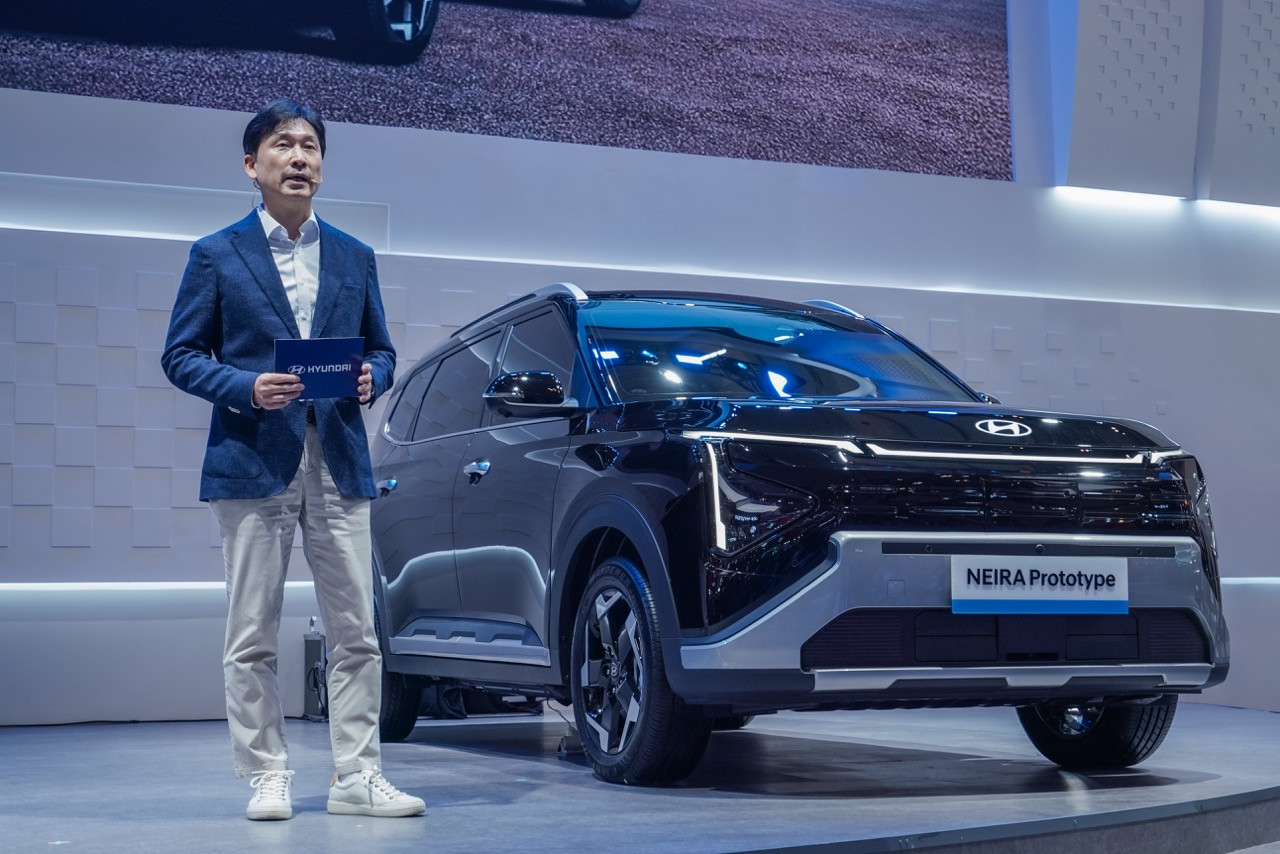
Hyundai has shown the production-ready Neira electric MPV ahead of its 20 Nov debut in Indonesia. For Indian family-car buyers, the important caveat is that a 2027 India arrival is being reported, but Hyundai has not published an Indian price, launch date or final India specification sheet.
Key takeaways
- CarWale and TOI Auto reported the production-ready Neira ahead of its 20 Nov 2026 debut in Indonesia; this is not an India launch announcement.
- Hyundai’s official Indonesia page describes the Neira prototype as a seven-seat electric vehicle and says local production is planned in Indonesia.
- Reports link the model to 42 kWh and 51.4 kWh battery options with claimed ranges of 404 km and 490 km, but those figures are not confirmed India-market specifications.
- CarWale and TOI Auto say Hyundai has confirmed a 360-degree camera and Level 2 ADAS; the production car’s cabin and final equipment list are still not fully public.
- Indian buyers should watch for an official India programme, certification, charging details, warranty terms, pricing and delivery timing before treating the Neira as an available option.
What has been revealed
CarWale and TOI Auto reported on 17 Nov 2026 that the Hyundai Neira had been shown in production-ready form before its full public debut. Both reports place that debut in Indonesia on 20 Nov and say the exterior remains close to the prototype shown earlier in the year. That makes the development relevant to India’s family-EV market, but it does not mean the vehicle has been launched, priced or homologated for Indian roads.
Hyundai’s official Indonesia page introduced the NEIRA Prototype as a seven-seat electric family vehicle and said the model was planned for local production at Hyundai Motor Manufacturing Indonesia. The company’s page provides the primary context for the model’s purpose and local-production direction; it does not publish an Indian price or a final India-market specification sheet.
Confirmed, reported and still open
- Official context: Hyundai has presented the Neira as a seven-seat EV prototype for family mobility and linked it to local production in Indonesia.
- Reported development: two independent auto reports say production-ready images have appeared before the 20 Nov Indonesia debut and that India is expected to get the model in 2027.
- Still unannounced for India: the launch date, price, variants, homologation, charging time, warranty and delivery schedule.
Battery and range figures need a caveat
CarWale and TOI Auto report two expected battery configurations: a 42 kWh pack with a claimed 404 km range and a 51.4 kWh extended-range pack with a claimed 490 km range. The reports connect those figures to the Neira’s relationship with the Kia Carens Clavis EV and to dealer-sourced information, so they should be treated as pre-launch expectations rather than confirmed Indian sale specifications.
A claimed range is not the same as a guaranteed family-trip distance. Actual driving range will depend on speed, passengers, luggage, temperature, traffic, tyre pressure and the final India-market calibration. The practical question for an Indian buyer will be whether Hyundai publishes an Indian test-cycle figure, the usable battery capacity and a clear charging curve, rather than only repeating a headline range.
Why the India angle matters
If Hyundai confirms the Neira for India, a three-row electric MPV could give family buyers another body style to consider alongside electric SUVs and existing electric MPVs. It could also matter to operators who value cabin space and predictable charging stops, although no commercial positioning or fleet variant has been announced.
The 2027 India timing is being reported by CarWale and TOI Auto, not confirmed through an India launch notice in the sources reviewed for this article. That distinction matters because price, local assembly, battery sourcing, taxes, warranty coverage and the final equipment list can change between an Indonesia reveal and an Indian launch.
Running-cost comparisons should also wait for Indian inputs. A defensible rupee-per-kilometre estimate needs the final usable battery size, certified efficiency, home electricity tariff, public-charging rates, insurance and service costs. Once official details arrive, drivers can use the EV charging station directory to check route coverage rather than assuming that a claimed range removes the need for a charging plan.
For longer family journeys, the road-trip planner can help compare stops and distance after the car’s Indian charging and range data are available. Until then, any trip-cost calculation based on the reported 404 km or 490 km figures would be provisional.
What Indian buyers should check next
- India confirmation: look for an official Hyundai India announcement that names the model, market, production plan and expected sales window.
- Certification: check the Indian test-cycle range, battery warranty, safety equipment and the exact number of seats in the sale version.
- Charging hardware: compare the AC and DC charging specifications, peak charging speed, connector, charging time and whether the vehicle supports useful journey-planning features.
- Family practicality: inspect third-row access, adult seating, luggage space with all rows in use and the effect of a full passenger load on range.
- Ownership terms: compare service intervals, roadside assistance, spare-parts support, battery coverage and the insurance terms available for the final India variant.
What happens next
The next reported milestone is the Hyundai Neira’s full reveal in Indonesia on 20 Nov 2026. Indian buyers should treat the model as an upcoming EV under discussion until Hyundai confirms the India launch, final specifications, price and delivery schedule. The useful takeaway is not a promised range or price, but a clear checklist for separating an Indonesia reveal from an India-ready product.
Sources
- Hyundai Mobil Indonesia — Hyundai NEIRA Prototype, Gambaran SUV Listrik Keluarga Masa Depan Indonesia — 3 Aug 2026
- CarWale — Production Ready Hyundai Neira EV MPV Revealed Ahead of November 20 Debut — 17 Nov 2026
- TOI Auto — Hyundai Neira EV MPV Revealed In Production Form Ahead Of November 20 Debut At GIIAS 2026 — 17 Nov 2026