Mahindra Last Mile Mobility has won the 2026 Earthshot Prize in the Clean Our Air category, with the award carrying a £1 million grant. Business Standard and Fortune India reported on 17 Nov 2026 that the company plans to use the money for women-driver training, affordable financing access and charging infrastructure in underserved areas — a development that could matter more to owner-drivers and fleet operators than to private EV buyers.
Key takeaways
- The award was announced in Mumbai on 17 Nov 2026 under the Clean Our Air category.
- The prize is worth £1 million; reports say Mahindra intends to direct it towards training, finance access and charging.
- Mahindra says its electric commercial vehicles have already travelled more than 9 billion km in India.
- The award is not a new retail subsidy, price cut or automatic finance offer for every buyer.
What Mahindra has won
The Earthshot Prize recognises solutions intended to scale environmental progress. Its official 2026 finalist announcement said that five category winners would each receive £1 million to expand their work. Mahindra Last Mile Mobility was listed in the Clean Our Air category for building a large electric three-wheeler and small-commercial-vehicle business in India.
The winner announcement was reported on 17 Nov 2026 by Business Standard and Fortune India. Both reports said the grant will support cleaner last-mile transport rather than a single vehicle launch. That distinction matters: the news is about expanding the ecosystem around electric autos, not about a newly announced Mahindra model, ex-showroom price or consumer discount.
Mahindra’s own 21 Sep 2026 finalist release said the company had sold more than 400,000 electric vehicles, which had collectively travelled over 9 billion km and helped avoid approximately 185,000 metric tonnes of carbon dioxide emissions. Those figures are company-reported impact measures, not an independent audit presented with the award announcement.
Where the grant may make a difference
Training and access for women drivers
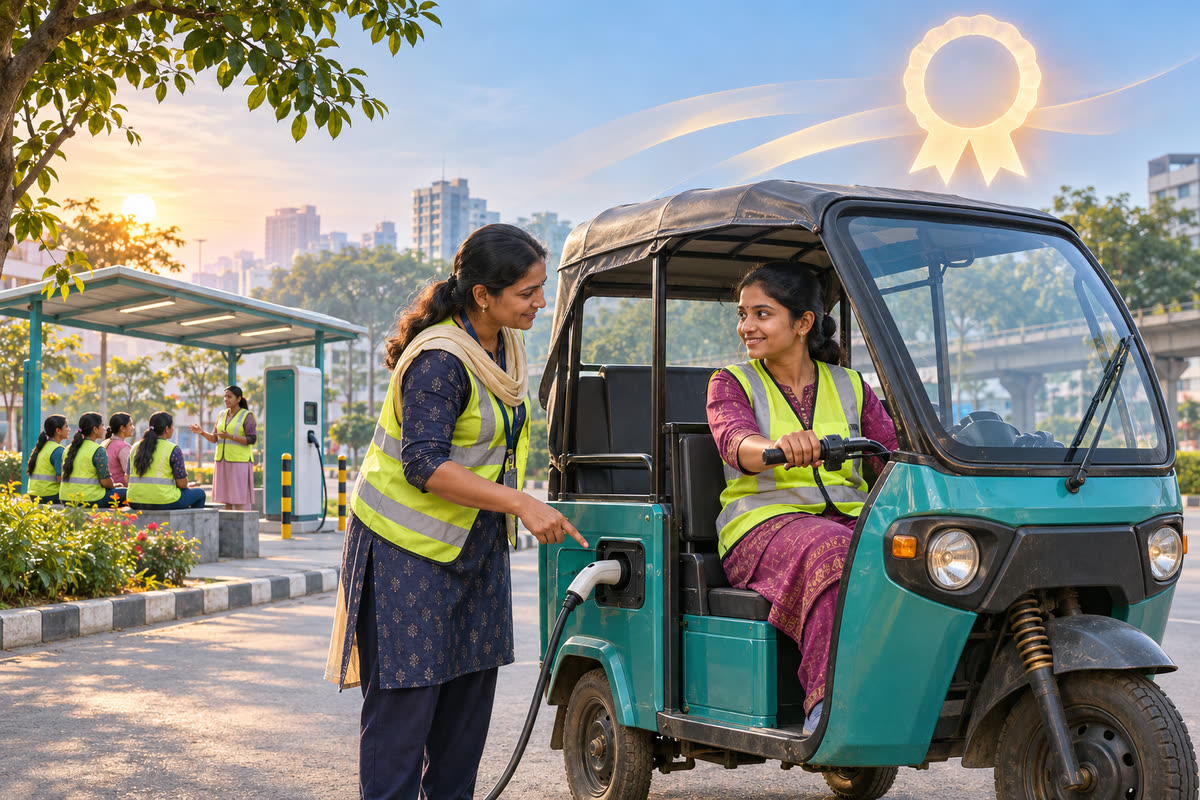
Business Standard and Fortune India reported that Mahindra plans to use the award money to train women drivers. For the commercial three-wheeler market, training can affect whether a vehicle is treated as a working asset or remains difficult for new operators to use. The reports did not set out a national target, a list of cities, a start date or an application process, so the scale and timing of the training programme remain to be announced.
Finance and charging in underserved areas
The reported plan also includes access to affordable financing and an expansion of EV charging infrastructure in areas that are not well served today. For an owner-driver, an electric auto’s practical economics depend on more than the vehicle price: financing terms, daily utilisation, charging access, downtime, battery coverage and local electricity tariffs all shape the result. More charging locations can reduce detours and waiting, but the award reports do not promise a particular saving or charging tariff.
Drivers and small fleets can use FuelPrice’s state-wise EV charging directory to check the current charging network.
They can then compare an electric route with a petrol or CNG alternative using the fuel cost calculator. These tools do not predict a Mahindra grant benefit; they help separate a general operating-cost comparison from an offer that may be announced later.
What it means for Indian auto operators
The immediate reader takeaway is that the award creates a funding plan, not an instant change at a dealership or on a loan statement. Private buyers should not assume that the £1 million prize reduces the price of an electric auto. Commercial drivers should also wait for the company or its partners to publish eligibility, lender terms, training locations and charging sites before treating the reported plan as available support.
When a financing programme is announced, the useful comparison will be the total repayment and operating cost, not only a headline monthly instalment. Operators can also check whether a charging point is open to their vehicle, whether it is suitable for the planned duty cycle, and what happens if a vehicle is off the road for service. For mixed fleets, the relevant comparison may be a full working day or month rather than the cost of a single short trip. FuelPrice’s live fuel-price hub can provide the petrol, diesel and CNG reference rates for that comparison.
How this connects with Mahindra’s latest EV push
The award follows a separate 16 Nov 2026 announcement by Mahindra Last Mile Mobility and Uber. Their official release and a Hindustan Times report said the EV Auto Advantage programme is intended to support the adoption of 5,000 Mahindra electric three-wheelers over the next 12 months by improving access to financing and other adoption enablers. FuelPrice has already covered that partnership in its report on the Mahindra-Uber electric-auto plan.
Together, the two announcements point to a broader commercial-EV strategy: increase vehicle deployment, make financing easier to access, and build the operating support around drivers. They do not yet establish that every city will receive charging infrastructure or that every driver can access the same finance terms. Coverage will depend on local partners, vehicle demand, electricity availability and the details of each programme.
What to watch next
The next useful updates will be concrete rather than ceremonial: the cities and partners selected for women-driver training; the number of charging points and their operating dates; the lenders or financing products involved; and whether support is open only to platform-linked drivers or also to independent owner-drivers and cargo operators. Mahindra’s disclosures should also clarify how the award money is separated from its existing sales, financing and charging initiatives.
For readers considering an electric three-wheeler, those details will show whether the award changes access in their route area. Until then, the confirmed development is the international recognition and the reported plan to scale clean last-mile mobility. The financial and operating benefit, if any, will depend on the programmes that follow.
Reader takeaway
Mahindra’s Earthshot win is relevant because it puts money and global attention behind the parts of electric-auto adoption that drivers often find hardest: training, finance and charging. It does not change today’s vehicle prices or create an automatic subsidy. The practical next step is to watch for published locations and eligibility, then compare the full cost of the available vehicle and route options.
Sources
- Business Standard — “Mahindra Last Mile Mobility wins Earthshot Prize 2026 for clean mobility” — 17 Nov 2026
- Fortune India — “Mahindra wins £1 million Earthshot Prize for clean air; grant to fund women-driver training, EV charging” — 17 Nov 2026
- Mahindra — “Mahindra Last Mile Mobility named Finalist for The Earthshot Prize 2026” — 21 Sep 2026
- The Earthshot Prize — “The Earthshot Prize Announces 2026 Finalists” — 18 Sep 2026
- Mahindra — “Mahindra Last Mile Mobility and Uber Partner to Accelerate 3W EV Adoption Across India” — 16 Nov 2026
- Hindustan Times — “5,000 e-autos to hit roads within a year as Uber, Mahindra announce tie-up” — 17 Nov 2026