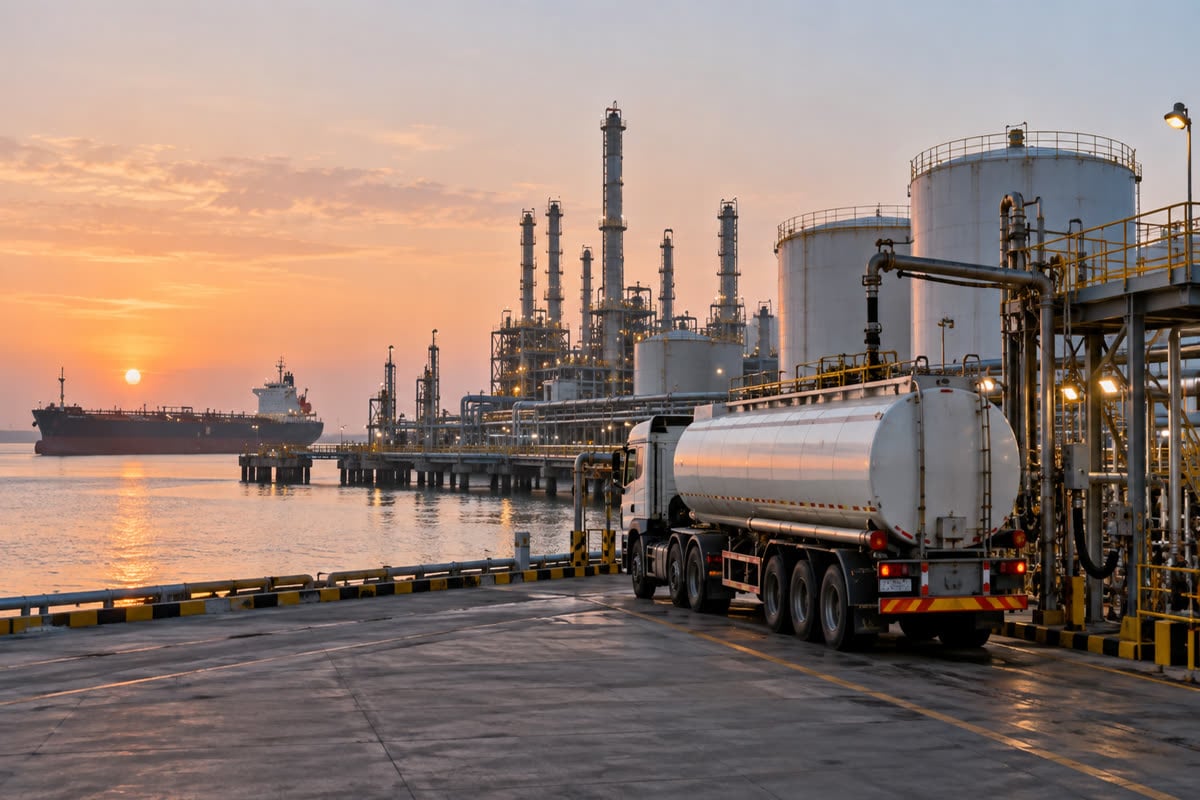
India will continue diesel exports under existing commitments even if the United States moves towards restricting overseas fuel sales, Petroleum Minister Hardeep Singh Puri said on 24 Sep 2026. For Indian drivers and fleet operators, the statement is a signal about global supply risk, not an announcement of a new Indian pump-price change.
Key takeaways
- India has not announced a diesel-export ban; Puri said contractual commitments will be honoured.
- Possible US restrictions are still a proposal under discussion, not a rule in force.
- Global route disruptions can still affect diesel benchmarks, freight costs and future pump-price decisions.
- PPAC listed Delhi diesel at ₹95.20 per litre as of 25 Sep 2026; city prices vary and should be checked by date.
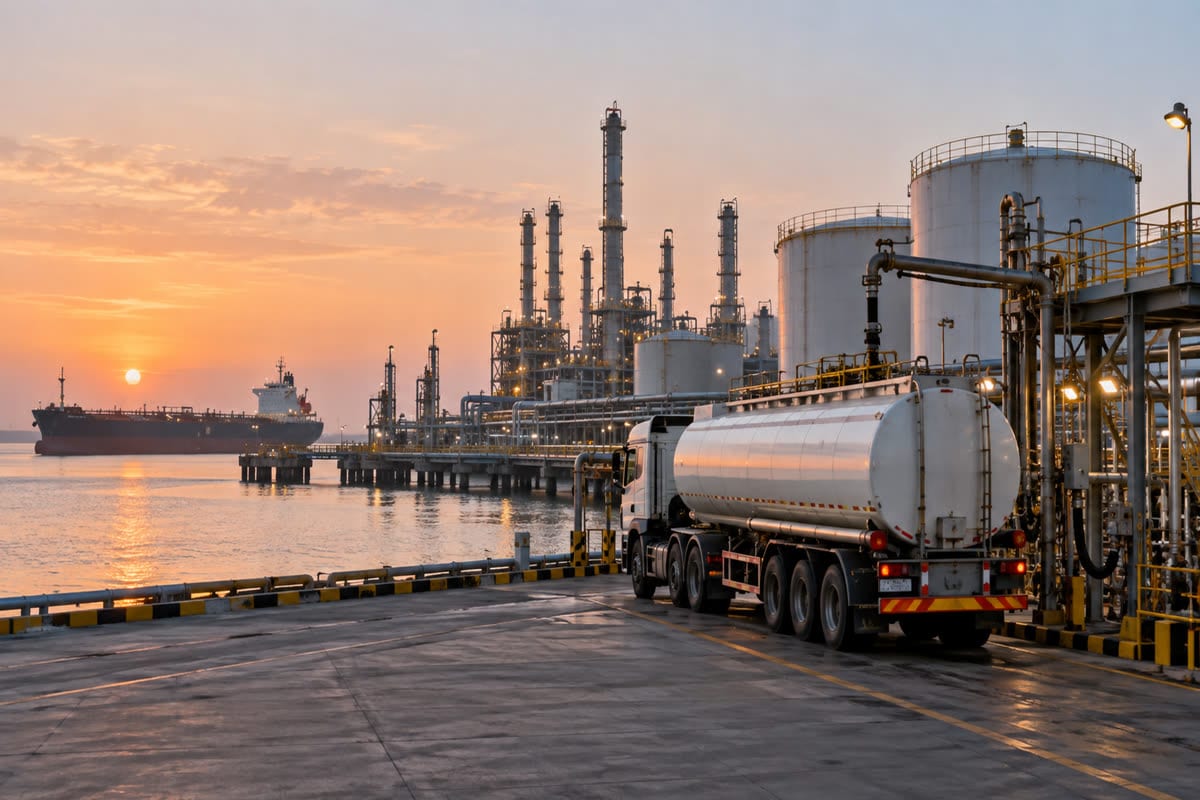 Diesel export logistics at a refinery terminal. Credit: FuelPrice, AI-generated editorial image.
What India has said about diesel exports
Puri made the remarks at the Public Affairs Forum of India’s 13th Annual Forum in New Delhi on 24 Sep. The Economic Times reported that he said India would not walk back its overseas commitments, while Bloomberg reporting published by Moneycontrol said he used the phrase “We honor our commitments” when discussing diesel-export contracts.
The immediate question is whether India will copy a possible US move to keep more diesel at home. Puri’s answer, as reported by both outlets, was no: India plans to keep supplying contracted buyers. Business Standard separately reported that India intends to continue exporting petroleum products under contractual commitments, even as the minister warned that a worsening West Asia crisis could create new challenges.
That distinction matters. The announcement is about keeping existing trade commitments; it is not a guarantee that every future cargo will move on schedule if shipping routes, insurance costs or refinery operations are disrupted. It also does not change the retail price displayed at Indian fuel stations by itself.
Why a possible US restriction matters to Indian fuel users
The United States has not confirmed a diesel-export ban. The American Petroleum Institute said on 22 Sep that the administration was considering restrictions and warned that limiting exports could disrupt refinery operations and tighten fuel availability in the US and abroad. A policy that changes the direction of large refined-fuel flows can affect international diesel pricing even when India is not the country imposing the restriction.
For India, the main exposure is through the wider market. Diesel is used by trucks, buses, construction equipment, agricultural machinery and backup generators, so a sustained rise in international refined-fuel prices can eventually feed into operating costs and transport rates. That is a risk to monitor, not a confirmed pass-through from this week’s statement.
What it means for Indian drivers and fleets
1. There is no automatic pump-price hike
Puri’s export comments do not announce a change in India’s retail diesel price. The practical check for a driver is still the dated rate at the relevant city or outlet. FuelPrice’s live fuel-price page and diesel prices across Indian cities are the useful starting points because local taxes and market rates differ.
2. A fleet’s cost can move before a private car owner notices
PPAC’s Delhi reference price was ₹95.20 per litre on 25 Sep 2026. At that rate, a 100-litre fill works out to ₹9,520; the example is only a dated baseline, not a forecast or a nationwide price. A transport operator should use the actual city rate, vehicle mileage and load pattern when estimating a run. FuelPrice’s fuel cost calculator can turn those inputs into a route estimate.
If diesel becomes more expensive internationally, the first visible effect may be higher freight, bus or equipment costs rather than an immediate change for every private motorist. Conversely, a stable global market would reduce the pressure without requiring any new domestic measure.
3. Export commitments do not remove route risk
India’s refining system gives it a large role in regional fuel trade, but refined products still depend on ships, ports and open sea routes. The minister’s warning about a possible worsening crisis means the key variable is not just how much crude exists; it is whether cargoes can move through important chokepoints at predictable cost. Drivers should therefore avoid reading “exports continue” as either a shortage warning or a promise that prices cannot rise.
What to watch next
- Whether the US moves from discussing restrictions to issuing a formal order, and what products or destinations it covers.
- Any further disruption around West Asian shipping routes, the Red Sea or other fuel corridors.
- Dated retail-price notices from Indian oil marketing companies and official PPAC updates.
- Any Indian change to export duties, quotas or domestic-supply directions. A ministerial comment is not the same as a notified rule.
FuelPrice’s earlier 24 September price update covered the domestic context of unchanged petrol and diesel rates. The new development here is the export and supply-route question: India says it will honour commitments, while global diesel flows remain exposed to policy and shipping shocks.
Reader takeaway
For now, Indian diesel users have a market-risk story to follow, not a confirmed domestic price hike or shortage announcement. Keep any cost estimate tied to the city, date and vehicle involved, and treat future price movement as dependent on international refined-fuel prices, shipping conditions and any formal government notification.
Sources
- The Economic Times — India to continue diesel exports despite US ban threat, says Hardeep Singh Puri amid global fuel crunch — 25 Sep 2026
- Moneycontrol, citing Bloomberg — India to keep up diesel exports as US ban prospect roils market — 24 Sep 2026
- Business Standard — West Asia troubles may exacerbate: Oil minister Hardeep Singh Puri — 24 Sep 2026
- American Petroleum Institute — API Statement on Potential U.S. Diesel Export Ban — 22 Sep 2026
- Petroleum Planning & Analysis Cell — Petroleum prices and under-recoveries / Delhi diesel RSP update — 25 Sep 2026
- Public Affairs Forum of India — 13th Annual Forum 2026 — 24–25 Sep 2026