The Straits Times reported on 8 Nov 2026 that more than one in two new three-wheelers sold in India in September was electric. The shift matters most to commercial drivers because an electric auto changes the daily energy bill, charging routine and upfront-cost calculation, while permits, battery cover and reliable access to power still determine whether it can work on a real route.
The latest retail data supports that picture. The Federation of Automobile Dealers Associations (FADA) put electric three-wheelers at 64.90% of the segment’s September 2026 sales, while ETAuto reported 86,024 electric three-wheelers for the month. India’s electric-auto transition is no longer limited to pilot fleets, but the numbers do not mean every operator or route is ready to switch.
Key takeaways
- Electric three-wheelers accounted for 64.90% of India’s three-wheeler retail mix in FADA’s September 2026 data.
- Drivers quoted in the latest reporting point to lower day-to-day energy costs as the main reason for moving from petrol or other fossil-fuel vehicles.
- Charging access, parking, service support and battery warranty remain practical constraints, especially for vehicles that operate for most of the day.
- PM E-DRIVE eligibility is not uniform: the government’s scheme page says the L5 incentive window closed on 26 Dec 2025, even though the wider scheme has been extended to 31 Mar 2028 for other segments.
What the latest data says
FADA’s 6 Oct 2026 release recorded 64.90% electric penetration in three-wheelers for September, up from 56.65% in September 2025. ETAuto’s report on the same dataset put electric three-wheeler retail at 86,024 units. Those figures cover retail registrations rather than factory dispatches, so they are a better indicator of what is reaching drivers and fleets.
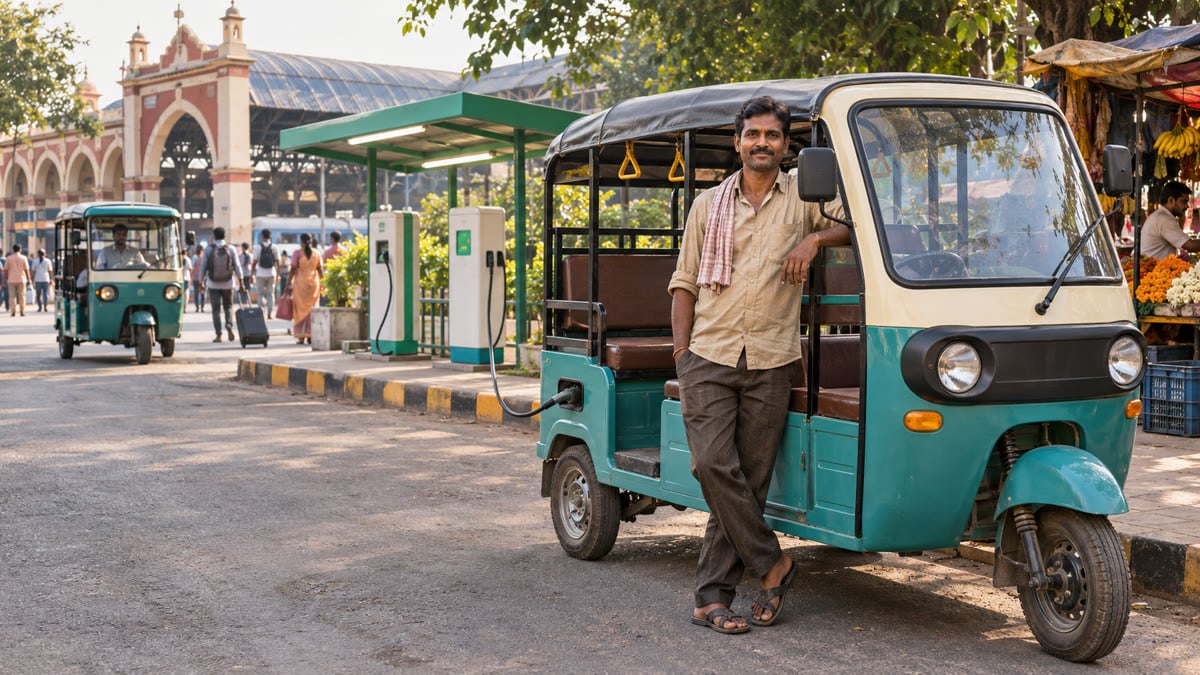
The fresh news angle is the operational story behind that share. The 8 Nov report describes electric autos becoming common around railway stations and markets in northern cities, while noting that adoption remains uneven. The International Energy Agency’s Global EV Outlook 2026 also identifies India as the world’s largest electric three-wheeler market. Together, the reporting points to a commercial-vehicle transition led by high-use, short-route vehicles rather than private cars alone.
Why commercial operators are moving
An auto-rickshaw can run through repeated short trips for much of the day. That makes energy cost a recurring business expense, not an occasional saving. Drivers quoted by The Straits Times said the lower cost of charging left more cash after daily work and helped them manage vehicle repayments. The same report cited analysis that petrol three-wheelers can cost substantially more to operate over their lifetime than electric alternatives.
That does not make an electric auto automatically cheaper for every owner. The purchase price, financing terms, downtime during charging, battery replacement risk and local electricity tariff all affect the result. A route with a fixed overnight parking point can look very different from one where the vehicle must depend on a public charger between passenger trips.
For a baseline comparison, drivers can use the fuel cost calculator to estimate what the existing petrol or CNG route costs, then compare it with the vehicle’s documented energy consumption and the local electricity tariff. The useful comparison is monthly operating cost and available working hours, not the headline range printed in a brochure.
PM E-DRIVE has an eligibility catch
The Ministry of Heavy Industries says PM E-DRIVE supports electric three-wheelers registered for commercial use and limits incentives to vehicles fitted with advanced batteries. Its official scheme page also says the overall scheme has been extended to 31 Mar 2028 for all segments except e-3W L5, whose window closed on 26 Dec 2025. The Ministry’s scheme brief is the relevant primary source for the dates and categories.
The distinction matters because e-rickshaws, e-carts and L5 electric autos are not one interchangeable policy bucket. The IEA says allocations for e-rickshaws and e-carts remain available, while L5 funds had already been exhausted by December 2025. A buyer or fleet operator should therefore verify the exact vehicle category, battery qualification, registration date and e-voucher position instead of treating a general EV subsidy headline as a guaranteed benefit.
Charging is still the practical constraint
The same report that documents the market’s growth also describes charging and parking problems in cities where public space is limited. A vehicle that works continuously cannot be assessed only on its maximum range: the operator needs to know where it can be charged, how long the stop takes, whether the site has a dependable power connection and what happens when the charger is occupied or unavailable.
FuelPrice’s state-wise EV charging directory can help map public options before a route is planned. It should be treated as one part of the check, alongside the operator’s own depot or home-charging arrangement, local electrical-load limits and the vehicle maker’s service network.
For longer journeys, the road-trip planner can help compare route time and stopping points. The earlier report on India’s EV charging viability test also explains why the number of listed chargers is less important than uptime, location and the type of vehicle each site can serve.
What operators should compare
A practical comparison should start with the route rather than the vehicle advertisement. Check the typical daily kilometres, passenger or cargo load, grade and traffic, then ask whether the battery can cover the working shift with a realistic reserve. A lower energy bill is useful only if charging does not remove too many paid trips.
- Energy and uptime: record the vehicle’s tested consumption, charging time and the electricity tariff at the intended charging point.
- Battery protection: confirm the warranty period, coverage conditions, replacement process and whether the battery is owned, leased or bundled into the vehicle price.
- Commercial paperwork: check registration class, permit, fitness, insurance and any city-level operating restriction before taking delivery.
- Service and parts: ask where the nearest approved workshop is and how long common electrical or body parts typically take to arrive.
- Finance and resale: compare the complete repayment amount and expected downtime, not just the advertised monthly instalment or purchase incentive.
What to watch next
The next test is whether electric three-wheelers can keep their majority share as demand moves beyond subsidy-supported purchases and into replacement cycles. Market growth will also depend on charging networks in smaller cities, stronger battery and motor localisation, and clearer support for operators who cannot charge at home.
For now, the data shows that electric autos have become a mainstream commercial option in India’s three-wheeler market. It does not remove the need for a route-level calculation. The useful decision is the one that matches daily kilometres, charging access, paperwork, battery support and total operating cost to the way the vehicle will actually earn.
Sources
- The Straits Times — Electric auto rickshaws reshape India’s roads — 8 Nov 2026
- Federation of Automobile Dealers Associations — FADA Releases Sep’26 Vehicle Retail Data — 6 Oct 2026
- ETAuto — Electric three-wheeler retail sales jump 40% to 86,024 units in September: FADA — 7 Oct 2026
- Ministry of Heavy Industries — PM E-DRIVE Sales Dashboard — data as of 5 Nov 2026
- International Energy Agency — Trends in other EV modes, Global EV Outlook 2026 — 2026