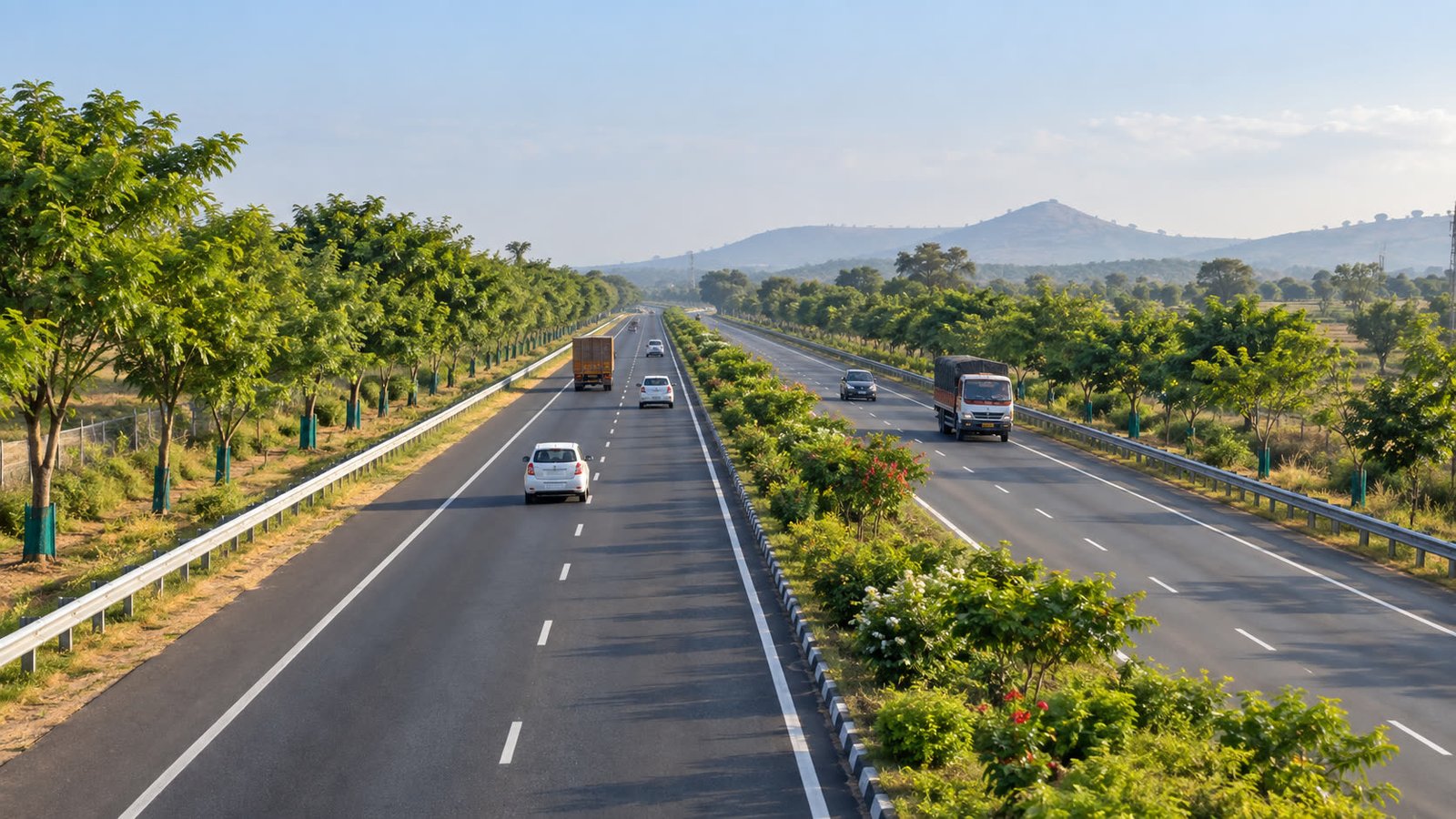
India's 28 Sep 2026 Green Highways update says more than 3.61 crore saplings were planted along approximately 1.32 lakh km of National Highways over the past five years. It also describes satellite-based green-cover monitoring, new plantation-survival benchmarks and bio-bitumen trials, but it does not change fuel prices or toll fees today.
Key takeaways
- As of July 2026, the government says more than 3.61 crore saplings had been planted along about 1.32 lakh km of National Highways over the previous five years.
- NHAI's September 2026 guidance links plantation compliance to at least 80% coverage of the available plantation Right of Way and 90% sapling survival.
- The NHAI-ISRO Green Cover Index assessed about 30,000 km across 24 states in its first cycle, giving officials kilometre-level data on roadside vegetation.
- CSIR's rice-straw bio-bitumen work is a road-material trial; the government says a blend can replace 20–30% of conventional bitumen, but wider standards and deployment are still ahead.
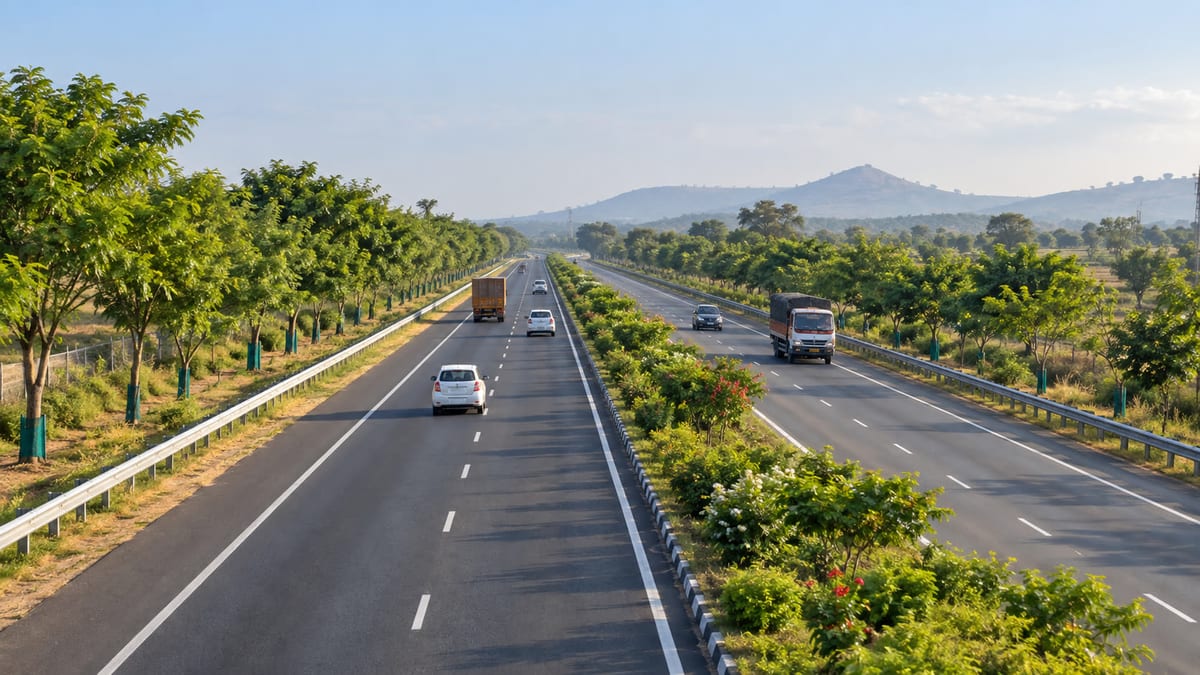 Illustrative editorial image of a greener divided highway; it is not a photograph of a specific road (FuelPrice/AI-generated).
What the 28 September update says
The Ministry of Road Transport and Highways' Green Highways backgrounder, posted on 28 Sep 2026, frames roadside planting as part of a wider highway-management programme rather than a one-time tree-planting drive. It says the Green Highways Policy, 2015 is being supported by plantation, transplantation, recycled construction material, satellite monitoring and community participation.
The same update says India's National Highway network expanded from 91,287 km in 2014 to 1,46,572 km by March 2026, an increase of nearly 61%. That growth matters to road users because the network is carrying more passenger and freight traffic, so roadside maintenance, drainage, visibility and slope protection become part of the travel experience as well as an environmental issue.
The 3.61 crore figure is a planting count, not a claim that every kilometre has continuous tree cover. The government's wording also says the planting covered approximately 1.32 lakh km over the five years up to July 2026. Survival, distribution and the condition of the surrounding road remain separate questions.
The important shift is measurement, not planting alone
NHAI and ISRO's National Remote Sensing Centre have built the National Highways Green Cover Index to make that distinction measurable. The first NH-GCI report, released in March 2026, covered approximately 30,000 km of National Highways across 24 states for the July–December 2024 assessment period. It calculates a green-cover percentage for each one-kilometre segment, separately for the left and right sides of the highway, using satellite imagery and field validation.
That creates a more useful management loop: stretches with weak cover can be identified, compared over time and targeted for replanting or maintenance. It also gives drivers and fleet operators a reason to treat future government claims about “green” corridors with more care. A planting total by itself says little about whether trees survived, whether they obstruct signs or sight lines, or whether the road surface and shoulders are being maintained.
The September 2026 guidance adds a practical compliance test. The PIB update says plantation work can count toward provisional completion only when at least 80% of the available Right of Way earmarked for plantation is covered. It also specifies a minimum 90% survival rate at official inspection, with the same survival benchmark applying during operations and maintenance and replacement of plants that do not survive.
Bio-bitumen is a trial, not a fuel-price story
The other notable part of the update is the move toward alternative road materials. CSIR-CRRI and CSIR-Indian Institute of Petroleum have developed a process that uses rice straw: the residue is processed through pyrolysis to produce bio-oil, which is then blended with conventional bitumen. A January 2026 government release said laboratory validation showed that 20–30% of conventional bitumen could be replaced without compromising the tested performance of the mix.
A trial section has also been laid on the Jorabat–Shillong Expressway in Meghalaya, and the government says wider integration into highway construction standards is being planned. That wording is important. This is not a new petrol blend, a change in the fuel sold at pumps or an immediate reduction in what a driver pays at a toll plaza. It is a construction and supply-chain development that may reduce dependence on petroleum-derived bitumen if field performance, cost and standards continue to hold up.
What it means for drivers, riders and transporters
For a private driver, the immediate effect is indirect. More reliable plantation monitoring could support shade, dust control, embankment protection and better-managed highway verges, but it does not guarantee a smoother surface or a shorter trip on every corridor. The 80% and 90% benchmarks are implementation checks, not a promise that every existing highway will meet them today.
For a transporter, the longer-term question is whether durable, locally produced road materials help control construction and maintenance costs. Any benefit would arrive through project quality and network reliability, not through an instant change in diesel prices or freight rates. Operators should continue to check actual route conditions, diversions, tolls and fuel availability before dispatch.
For a long-distance trip, the practical starting point remains trip planning. Use the road-trip planner to compare the route and stops, then estimate the vehicle's fuel spend with the fuel cost calculator. If the journey uses National Highways, check the expected toll outlay separately with the toll-charge calculator.
What to watch next
The useful follow-up is evidence of survival and maintenance, not another planting announcement. Future NH-GCI cycles should show whether green-cover scores improve on the assessed stretches. NHAI's completion and operations records will also indicate whether the 80% coverage and 90% survival conditions are being enforced consistently.
On bio-bitumen, watch for additional field trials, technical specifications and a formal decision on how much of the conventional binder can be replaced in different climates and traffic conditions. Until those steps are documented, the correct reading is that India is testing a potentially lower-fossil-content road material, not that the national highway network has already switched to it.
Reader takeaway
The 28 Sep 2026 Green Highways update is a road-infrastructure and maintenance story, not a same-day fuel-price or toll-rate change. Its value for road users will be judged by whether planting survives, roadside risks are managed and road materials perform in real traffic. For now, drivers should treat the update as a sign of how highways may be maintained in future while relying on current route, fuel and toll information for today's journey.
Sources
- Press Information Bureau, “Green Highways: India's Journey Towards Sustainable Road Infrastructure,” 28 Sep 2026
- Press Information Bureau, “NHAI Releases First Annual Report on National Highways – Green Cover Index (NH-GCI) for 2025–26,” 9 Mar 2026
- NHAI and ISRO-NRSC, “National Highways Green Cover Index (NH-GCI) Final Report,” 9 Dec 2025
- Press Information Bureau, “Bio-Bitumen via Pyrolysis: From Farm Residue to Roads,” 7 Jan 2026
- CSIR-Central Road Research Institute, “CSIR-CRRI Bio-Bitumen Technology,” accessed 30 Sep 2026