India’s two-wheeler retail reached 17,90,188 units in September 2026, up 33.08% year on year and 4.41% from August, according to FADA data reported by Autocar Professional and The Economic Times. Electric two-wheelers accounted for 11.58% of the month’s two-wheeler retail, making the result relevant to buyers deciding between another petrol commuter and an EV before the festive peak.
The figures describe vehicle retail, not fuel economy or ownership cost. For a buyer, the useful question is what the stronger demand says about model availability, petrol running costs, charging access and the choices likely to be visible at dealerships over the next few months.
Key takeaways
- September two-wheeler retail rose to 17.90 lakh units, the segment’s strongest September on record.
- Year-on-year growth was 33.08%, while the month-on-month increase from August was 4.41%.
- Electric two-wheelers made up 11.58% of September two-wheeler retail.
- FADA expects festive bookings to convert into more registrations in October, but it has also flagged supply and weather risks.
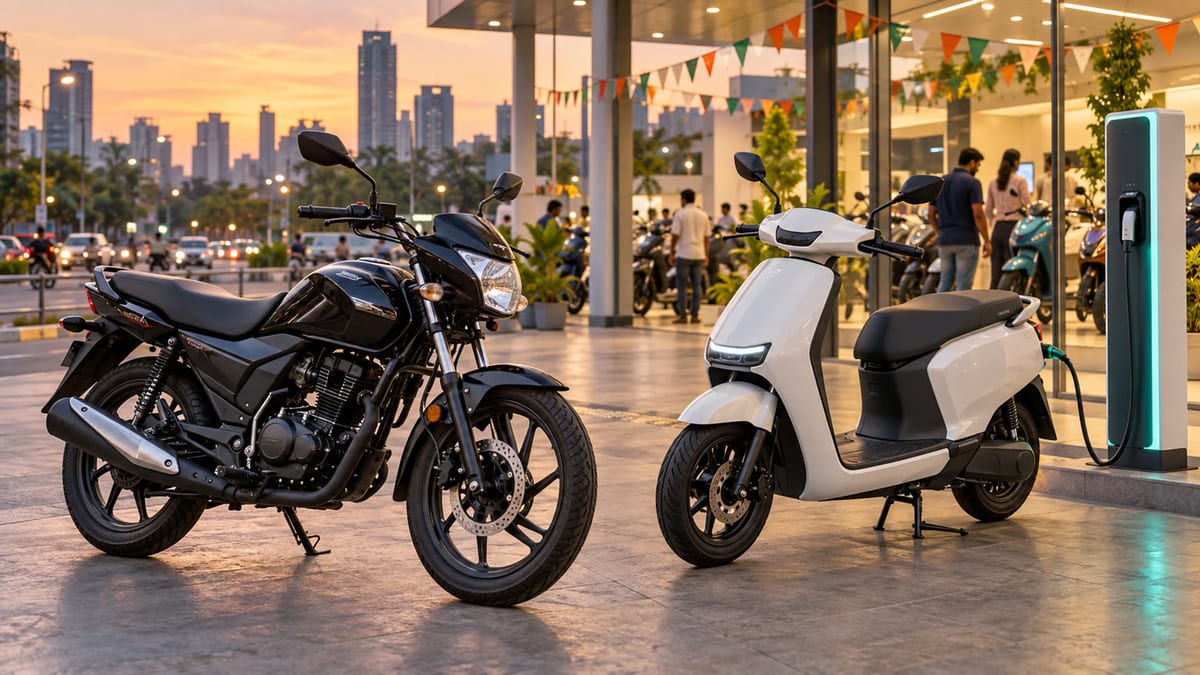 Illustrative editorial image: generic petrol and electric two-wheelers at an Indian dealership. Image generated for FuelPrice; it is not a photograph of a specific model.
What changed in September
FADA’s September retail data shows a broad two-wheeler recovery heading into the festive buying period. Autocar Professional and The Economic Times both reported that 17,90,188 two-wheelers were retailed during the month, a 33.08% increase over September 2025 and a 4.41% improvement over August.
The year-on-year comparison needs context. Buyers had deferred some purchases in September 2025 ahead of the GST 2.0 rollout later that month, leaving a relatively weak base for this year’s comparison. The month-on-month increase is therefore important: it indicates that demand also improved from August, rather than the entire headline being explained by last year’s timing.
Demand was not limited to large cities
FADA data cited in both reports showed rural and urban two-wheeler retail growing at broadly similar rates over the year-earlier month. That matters for commuter-bike and scooter availability because dealer demand is being supported by more than one customer group. Rural cash flows, semi-urban purchases, premium motorcycle interest and festive buying all featured in FADA’s explanation of the month.
It is still too early to treat one month as a permanent change in the market. Registrations can move when buyers shift purchases between months, and manufacturers can also influence retail numbers through stock availability. The September result is best read as a strong starting point for the festive season, not as a guarantee that every brand or model will see the same pace.
EVs are taking a larger place in the two-wheeler decision
Electric two-wheelers accounted for 11.58% of September retail, according to the FADA figures reported by Autocar Professional and The Economic Times. That gives electric scooters a meaningful presence in the mainstream market, even though the data does not say that every buyer is switching from petrol to electric.
For shoppers, the practical change is a wider comparison. A petrol model may offer familiar refuelling and a broader established service network, while an electric model may fit a daily route better if home charging, workplace charging and local public chargers are convenient. The right comparison depends on distance travelled, parking, electricity access, service support and the vehicle’s purchase terms.
What buyers should compare
- Daily distance: separate the advertised range or mileage from the distance the vehicle must cover on a normal week.
- Energy access: check whether home or workplace charging is practical, then use the EV charging directory to review public options in the places you regularly visit.
- Running cost: use the fuel cost calculator for a petrol bike or scooter and compare that result with the applicable electricity tariff and charging pattern for an EV.
- Ownership items: compare insurance, service intervals, battery warranty terms, charger installation and the on-road price rather than looking only at the showroom figure.
What the sales data means for fuel use
The September headline cannot be converted directly into a national fuel-saving figure. Retail data records vehicles sold or registered; it does not show how many kilometres each vehicle will travel, whether it replaces an older vehicle, or how often it will be used. A new petrol scooter used for a short commute has a different fuel impact from a motorcycle used for long daily travel.
That is why local inputs matter. Petrol prices can vary by city and change over time, so owners checking the running cost of a new petrol two-wheeler can start with FuelPrice’s live fuel prices and then use their own mileage and distance. EV users need the comparable electricity rate, charging losses and public-charging fees where applicable.
For riders planning longer trips, charging stops and route length also matter. The road-trip planner can help frame the route question, but the final estimate still depends on the vehicle, traffic, weather and charging or refuelling conditions on the day.
What to watch through the festive season
FADA expects the booking-to-retail conversion to strengthen in October, supported by auspicious festive dates, rural cash flows, easier financing and continued EV interest. The association has also flagged the supply of fast-moving models, possible October price increases and uneven rainfall as factors that could change the pace of registrations.
For buyers, those watchpoints make the next few weeks more useful for checking facts than for assuming that every advertised offer will be available everywhere. Ask for the variant’s current ex-showroom and on-road price, delivery timeline, insurance cost, service schedule and, for an EV, the charger and installation terms. A booking number or retail-growth headline does not by itself establish the running cost or suitability of a particular vehicle.
Reader takeaway
September’s data sends two clear signals: two-wheeler demand is strong going into the festive season, and electric models are taking a larger share of the category. The decision for an individual buyer remains more specific. Compare the local fuel or charging cost, annual distance, access to energy, service support and total ownership terms before choosing between a petrol two-wheeler and an EV.