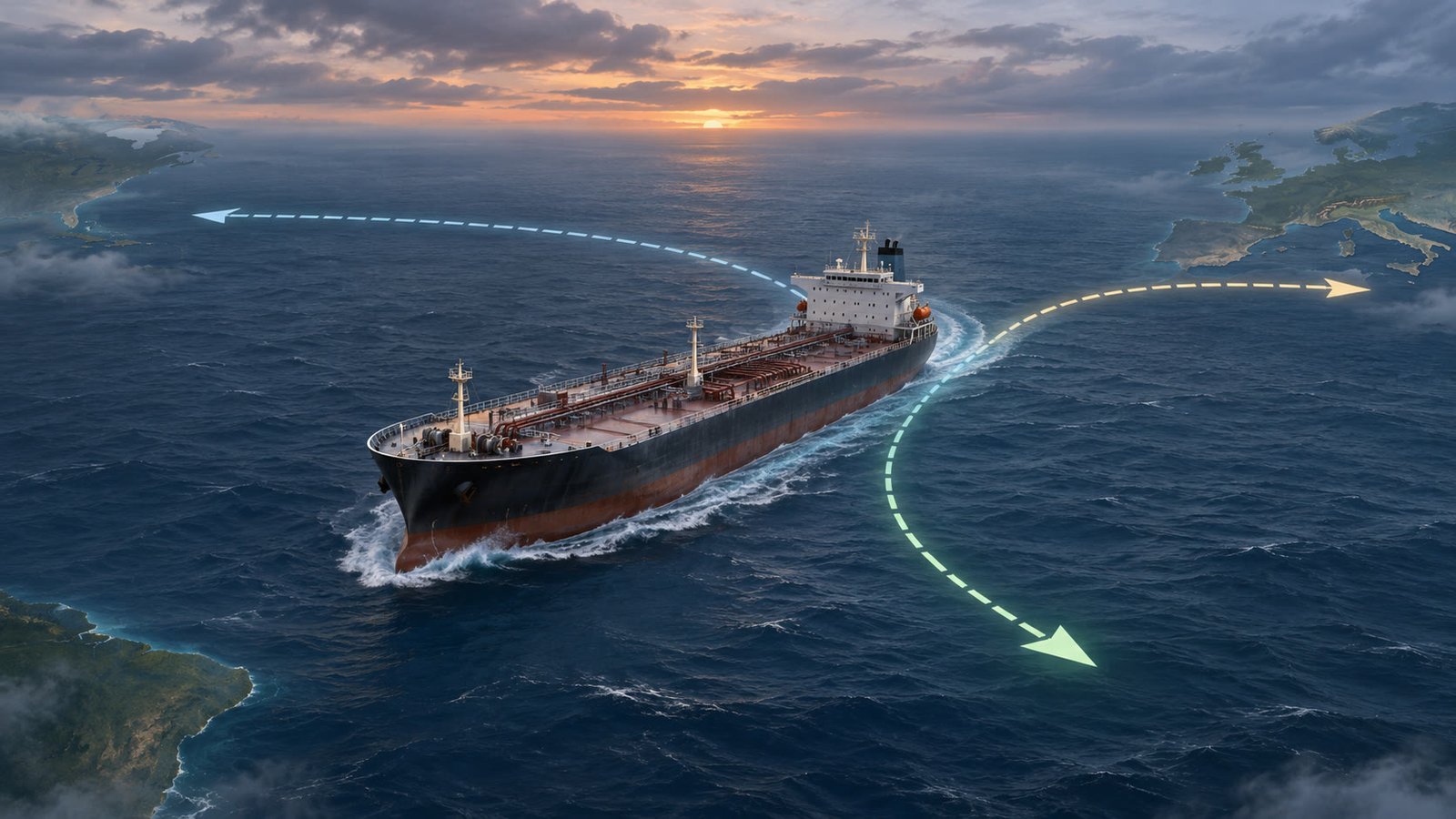
The first US–Russia diesel shipments are now uncertain: two tankers that had been reported as bound for US Atlantic ports changed course, while a third remains listed as “for orders.” For drivers, freight operators and fuel markets, the immediate takeaway is that a temporary sanctions authorization has not yet translated into a confirmed US delivery or broad price relief.
Key takeaways
- AP and Le Monde independently reported that the tankers Talisman and Leruo changed destination after leaving Russia’s Baltic port of Primorsk.
- The Leruo was listed as heading to Brazil and the Talisman toward the Mediterranean; a third tanker, the Agioi Fanendes, remained without a confirmed unloading port.
- OFAC General License 135 authorizes covered transactions involving Russian-origin diesel, including importation into the United States, through 7 April 2027.
- The reported November tranche of 500,000 metric tons is not the same as a guaranteed US delivery or a guaranteed fall in diesel prices.
What changed in the shipment plans
The immediate development is a logistics and compliance setback, not a confirmed cancellation. AP reported on 5 November that two sanctioned tankers which left Primorsk in late October had originally declared destinations on the US East Coast. Marine-tracking data showed both had changed course: the Talisman toward the Mediterranean and the Sierra Leone-flagged Leruo toward Brazil. Le Monde independently reported the same route changes, noting that the Leruo updated its transponder on 2 November and that the Talisman was off Algeria.
A third tanker carrying Russian diesel, the Greek-flagged Agioi Fanendes, was still moving toward the United States but had changed its destination to “for orders.” That status means the cargo does not yet have a confirmed unloading point. It is therefore too early to say that Russian diesel has reached a US port under the new arrangement.
The public accounts also conflict. AP reported that Kremlin spokesperson Dmitry Peskov said commercial details were not public and that the diesel would find buyers. Kirill Dmitriev, a Russian presidential envoy, called the reports about the diverted ships false. AP’s account, however, said the two route changes were reported through Kpler, MarineTraffic and the Financial Times, while Le Monde cited the same maritime-tracking evidence. The safe editorial conclusion is that the intended US delivery is uncertain, not that every cargo has been cancelled.
The authorization exists, but delivery is not automatic
The US Treasury’s Office of Foreign Assets Control issued General License 135 on 9 October. The primary document authorizes transactions related to the sale, delivery, offloading and importation of Russian-origin diesel, including importation into the United States, through 12:01 a.m. Eastern daylight time on 7 April 2027. The OFAC license text is the clearest source for what the sanctions waiver covers.
That authorization does not guarantee that a port, bank, insurer, terminal or fuel buyer will accept a specific cargo. AP reported that New Jersey Gov. Mikie Sherrill warned port and terminal operators in the state against handling the fuel and that senators urged the administration to reverse course. Le Monde reported that US lawmakers disputed whether an executive sanctions waiver can override the congressional ban on Russian hydrocarbon imports. The administration has defended the authorization as lawful, and AP noted that no court had ruled on the dispute in its report.
For global fuel users, this distinction matters. A licence can remove one US sanctions obstacle while commercial participants still assess legal exposure, reputational risk, insurance, banking and the possibility that the authorization changes before a voyage is complete. A tanker changing course is evidence of that uncertainty; it is not proof that the diesel has vanished from the world market.
How much fuel is at stake
The reported November tranche was 500,000 metric tons. AP’s account of the original announcement and Le Monde’s follow-up both cited that figure, while Le Monde also described the wider arrangement as a multi-million-tonne plan for US and global buyers. The number is large enough to matter to the companies arranging cargoes, but it should not be treated as a direct promise of lower pump prices.
Diesel is traded through a global network. If a cargo originally expected in the United States is diverted to Brazil or the Mediterranean, the barrels may still be sold elsewhere, while US buyers may need to source replacement supply from another origin. The market effect depends on the quality of the fuel, refinery availability, shipping time, insurance, sanctions screening, inventories and the price at which the cargo can be financed and delivered.
That is why a headline about a new supply arrangement does not translate one-for-one into a lower price at a filling station. Retail diesel also reflects local taxes, distribution costs, currency movements and retailer margins. Readers can use FuelPrice’s live fuel-price pages to check a dated local rate rather than assuming that a diplomatic announcement has already changed the price at the pump.
Why the development matters to drivers and fleets
Diesel is a working fuel for trucking, farming, construction, buses, shipping and backup power. When a cargo is rerouted, the first impact is usually on supply-chain planning: a buyer may need a replacement cargo, a longer route or extra compliance checks. Those costs can feed into wholesale fuel markets and freight contracts even when a private driver does not see an immediate retail change.
For fleet operators, the useful question is whether the delivered cost of diesel is easing across several market sessions, not whether one shipment has been announced. For households, the practical question is how much fuel a planned journey uses at the current local rate. A driver can put the vehicle’s mileage, route distance and fuel price into the fuel-cost calculator to estimate trip spending. That estimate is more useful for budgeting than treating the US–Russia arrangement as a guaranteed saving.
What to watch next
- Whether the Agioi Fanendes confirms a US unloading port or changes destination again.
- Whether any US port, buyer or terminal publicly confirms acceptance of a Russian diesel cargo under General License 135.
- Whether the reported 500,000-metric-ton November tranche reaches the market on schedule and where it is discharged.
- Whether Congress, a court or OFAC changes the legal position before more cargoes are loaded or delivered.
- Whether wholesale diesel, shipping and insurance costs move together; a crude or supply headline alone is not enough to establish a retail-price trend.
Reader takeaway: The new US–Russia diesel arrangement has produced a real but disputed shipping development: two tankers changed course and a third has no confirmed unloading port. The temporary OFAC authorization remains in force through 7 April 2027, but the market will only get a measurable supply signal when cargoes are accepted, discharged and sold. For broader context, follow FuelPrice’s worldwide fuel and energy coverage.
Sources
- AP News, “Tankers carrying Russian diesel change course, raising doubts about shipments to US”, 5 November 2026
- Le Monde, “US-Russia diesel deal touted by Trump falters”, 7 November 2026
- US Treasury OFAC, “Issuance of Russia-related General License 135”, 9 October 2026
- US Treasury OFAC, “Russia-related General License 135”, 9 October 2026
- AP News, “Trump strikes deal with Putin for Russian diesel”, 9 October 2026
This article is for general information only and is not financial, insurance or legal advice.