IRDAI has proposed a new product-level commission framework that would set distributor commission at zero for mandatory third-party motor insurance, while allowing 2.5% for agents and associates, subject to final rules. The two-part consultation released on 23 Sep 2026 is open for comments until 25 Oct 2026, so current policy prices and compulsory-cover rules continue to apply. For vehicle owners, the immediate significance is how insurance is presented, priced and bundled at the point of sale—not an automatic premium cut.
Key takeaways
- The proposal is not in force; IRDAI’s comment window closes on 25 Oct 2026.
- For mandatory motor third-party cover, the draft sets zero commission for distribution entities and 2.5% for agents and associates.
- IRDAI’s FY2024-25 motor-insurance analysis reported average commissions of 24%, with a range of 13% to 50%.
- Buyers could get clearer commission disclosures, more insurer choice and stronger safeguards against forced insurance bundling.
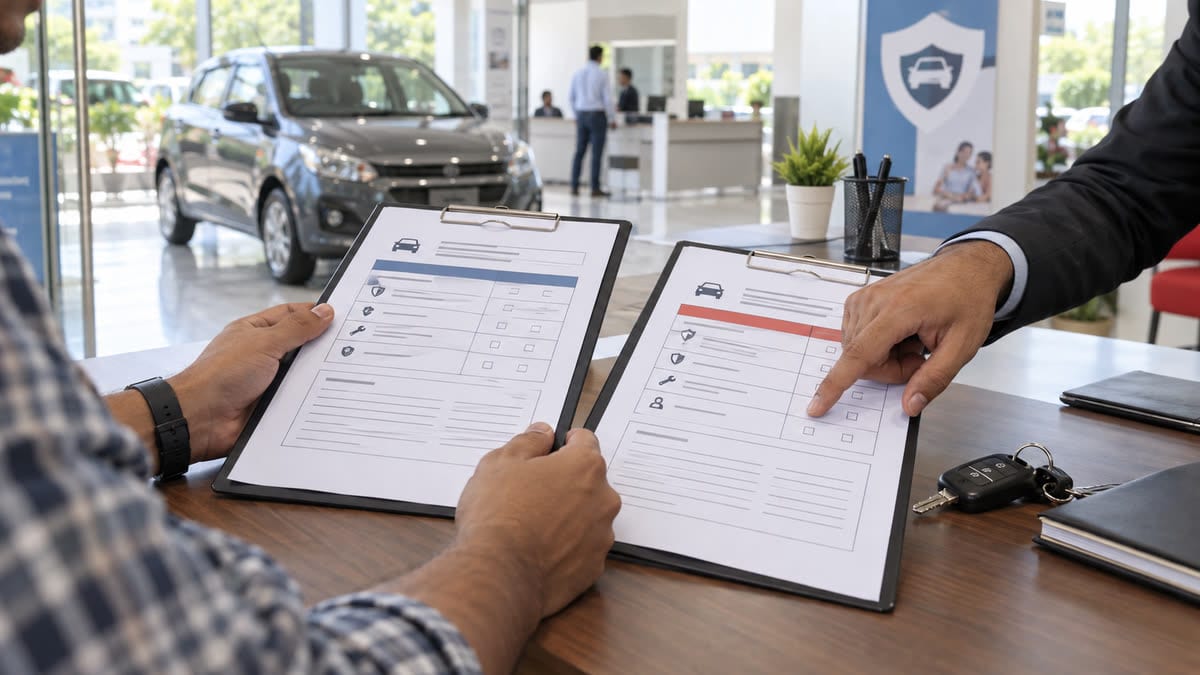 Editorial illustration of a motor-insurance comparison at a vehicle dealership. Credit: FuelPrice/AI-generated.
What IRDAI is proposing
IRDAI’s two-part public consultation, Recalibrating Economics of Insurance Distribution, looks at how insurers and intermediaries are paid, how distribution costs are measured and how customers encounter insurance products. It remains a consultation paper, not a notification or an effective-date order.
Third-party cover would have a lower commission ceiling
Third-party liability insurance remains mandatory for vehicles using public roads. In the proposal released on 23 Sep 2026, IRDAI sets commission at 0% for distribution entities on motor third-party cover and 2.5% for agents and associates. The design treats a compulsory, relatively simple product differently from covers that need more explanation or servicing.
For own-damage motor insurance, Business Standard’s 24 Sep 2026 review of the paper reported a proposed 5% cap against a 16% current payout in the comparison cited by the report. These are proposed commission limits, not a new motor-premium tariff. They should not be read as an immediate 5% reduction in a customer’s quote.
Why motor insurance is in focus
IRDAI’s analysis says motor insurance had an average commission rate of 24%, with rates ranging from 13% to 50%. India Today’s 26 Sep 2026 report on the consultation said OEM-linked brokers and Motor Insurance Service Providers represented about 30% of the new and old vehicle market; during FY2024-25, that segment generated nearly ₹29,000 crore in premiums and received nearly ₹7,050 crore in commissions. The regulator’s point is that distribution payments can become large even where a product is mandatory or relatively easy to sell.
That does not mean every dealer, broker or insurer earns the same amount, and it does not establish that a particular driver has been overcharged. It explains why the paper proposes product- and channel-specific limits, simpler disclosures and tighter checks on incentives.
What could change for vehicle buyers
1. Commission information could become easier to find
The draft proposes that insurers and large distribution entities publish their commission policies and structures in simple language. Certain commercial policies could also carry commission disclosures. For a buyer, this is meant to make the distribution cost visible alongside the cover, exclusions and service terms rather than leaving the selling relationship unclear.
2. Loan-linked insurance could be harder to force
The consultation proposes safeguards against compulsory bundling of insurance with loans and other financial products. Business Standard reported on 24 Sep 2026 that the proposed framework would allow only defined packages with a customer benefit, require the insurance payment to be separate and preserve the borrower’s insurer choice. That remains a proposal; it does not cancel or rewrite an existing vehicle loan.
3. Dealer service should not depend on where the policy was bought
IRDAI has proposed that a motor dealer should not deny cashless repair service merely because the customer purchased the policy elsewhere. It has also proposed restrictions on OEM-linked service-level or performance incentives that reward dealers for selling insurance. The intended separation is between the repair service a customer is entitled to receive and the channel through which the policy was purchased.
4. Digital comparison could get a stronger role
The paper proposes Motor Insurance Information platforms, including Bima Sugam-type infrastructure, as pull-based routes for customers to compare and buy policies. The consultation’s objective is greater choice and lower friction, but no final launch date or operating rule for the proposal has been notified.
What the proposal means for premiums and renewals
A lower commission ceiling does not automatically reduce a motor premium by the same percentage. Insurers also price for claims, repairs, servicing, technology, taxes and capital, and the proposal does not order insurers to pass every distribution saving to customers. India Today’s 25 Sep 2026 explainer also noted that the reform is aimed at structural costs and should not be treated as a guaranteed one-for-one premium reduction.
When a new-car or renewal quote is being compared, the useful distinction is between the mandatory third-party section and optional own-damage or add-on sections. A customer-facing comparison should show the insurer, policy period, insured value where relevant, deductibles, exclusions, claim-service conditions and any insurance being placed inside a loan or dealer package. A vehicle owner can separately estimate fuel expenditure with FuelPrice’s fuel cost calculator; insurance and fuel are different parts of the monthly running-cost picture.
What happens next
IRDAI has invited comments from insurers, intermediaries, policyholders and other stakeholders until 25 Oct 2026. The commission grids, disclosure format, bundling safeguards and any implementation date may change after that process. Until a final regulation or notification is issued, the consultation does not change a current policy, renewal quote or dealer’s legal obligations.
This is a specific follow-up to FuelPrice’s earlier coverage of the broader possible motor-insurance reform timeline, which explains what vehicle buyers should track while the proposal develops: IRDAI motor-insurance reform and buyer checks. Further confirmed updates will be added to the FuelPrice latest-news archive.
This article is for general information only and is not financial, insurance or legal advice.
Sources
- Insurance Regulatory and Development Authority of India, “Recalibrating Economics of Insurance Distribution — Part 1” (23 Sep 2026)
- Insurance Regulatory and Development Authority of India, “Recalibrating Economics of Insurance Distribution — Part 2” (23 Sep 2026)
- IRDAI, “Motor Insurance — Policyholder guidance” (accessed 27 Sep 2026)
- India Today, “Why are motor insurance commissions so high? IRDAI wants changes” (26 Sep 2026)
- Business Standard, “Irdai’s draft distribution norms could put insurance volumes at risk” (24 Sep 2026)
- Moneycontrol, “IRDAI’s proposed reforms will push adoption, make insurance buying more consumer-friendly, says chairman Ajay Seth” (27 Sep 2026)