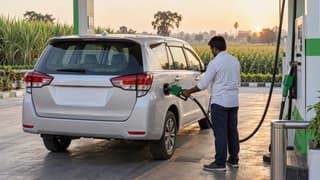
Union Road Transport and Highways Minister Nitin Gadkari said on 25 Sep 2026 that flex-fuel engines capable of running on 100% ethanol are being developed, during a Bhopal event where Madhya Pradesh's public bus service was launched. For private drivers, this is a policy signal—not a new E100 pump mandate: E20 remains the reference blend in current government material, and actual compatibility and fuel cost still depend on the vehicle.
Key takeaways
- Gadkari's 25 Sep 2026 statement is a reported development about flex-fuel engine development, not a confirmed nationwide switch to E100.
- E20 means petrol blended with 20% ethanol. A 30 Jul 2026 government release says the rollout was based on testing and field experience, but that does not guarantee identical mileage for every vehicle.
- The Petroleum Ministry has separately said some older vehicles may need rubber-part or gasket replacement earlier than they would with non-blended fuel; the point is to check the vehicle, not assume failure.
- Drivers can judge the real impact by tracking fuel used over a consistent route and multiplying it by the dated local price, rather than relying on a general claim about mileage.
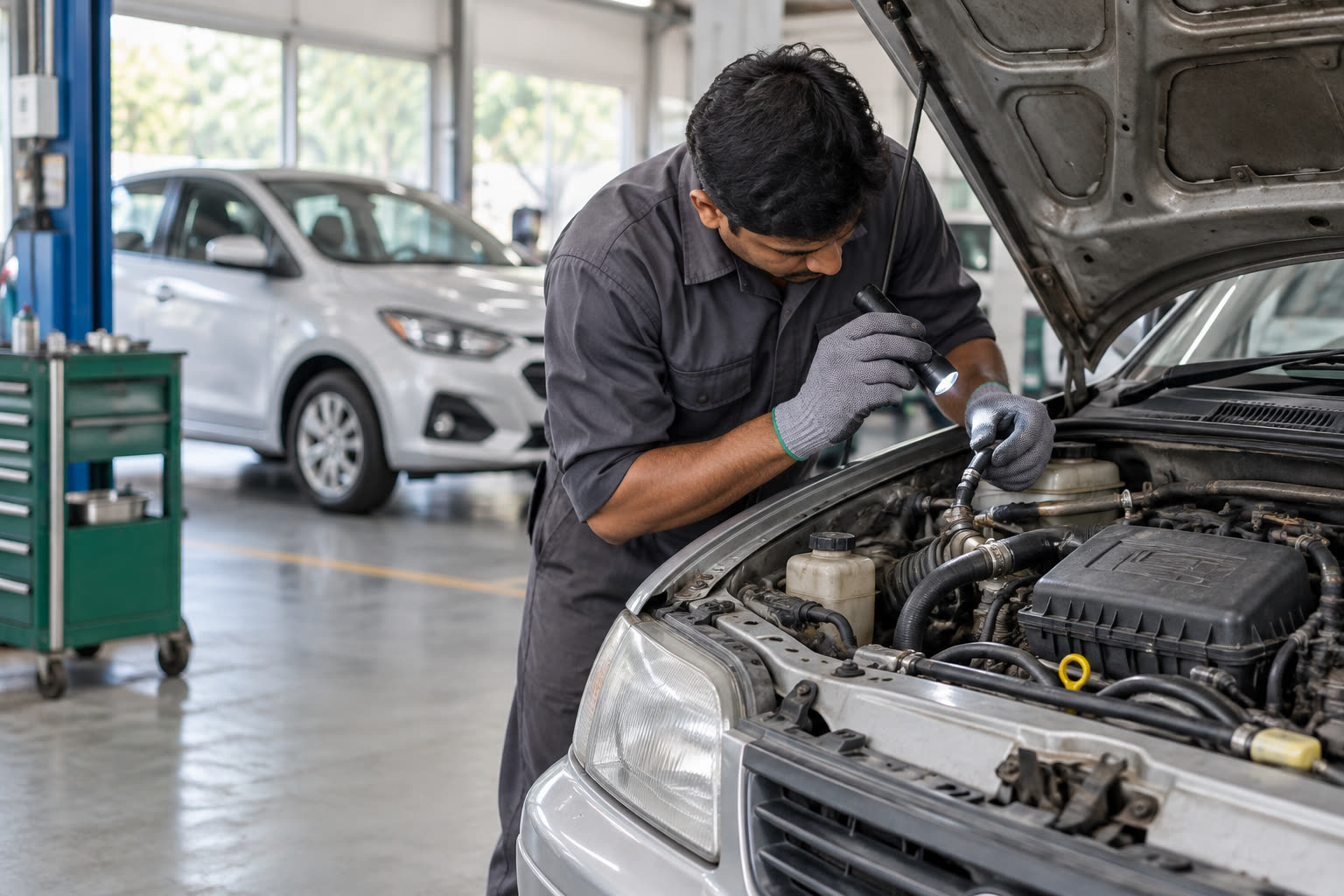
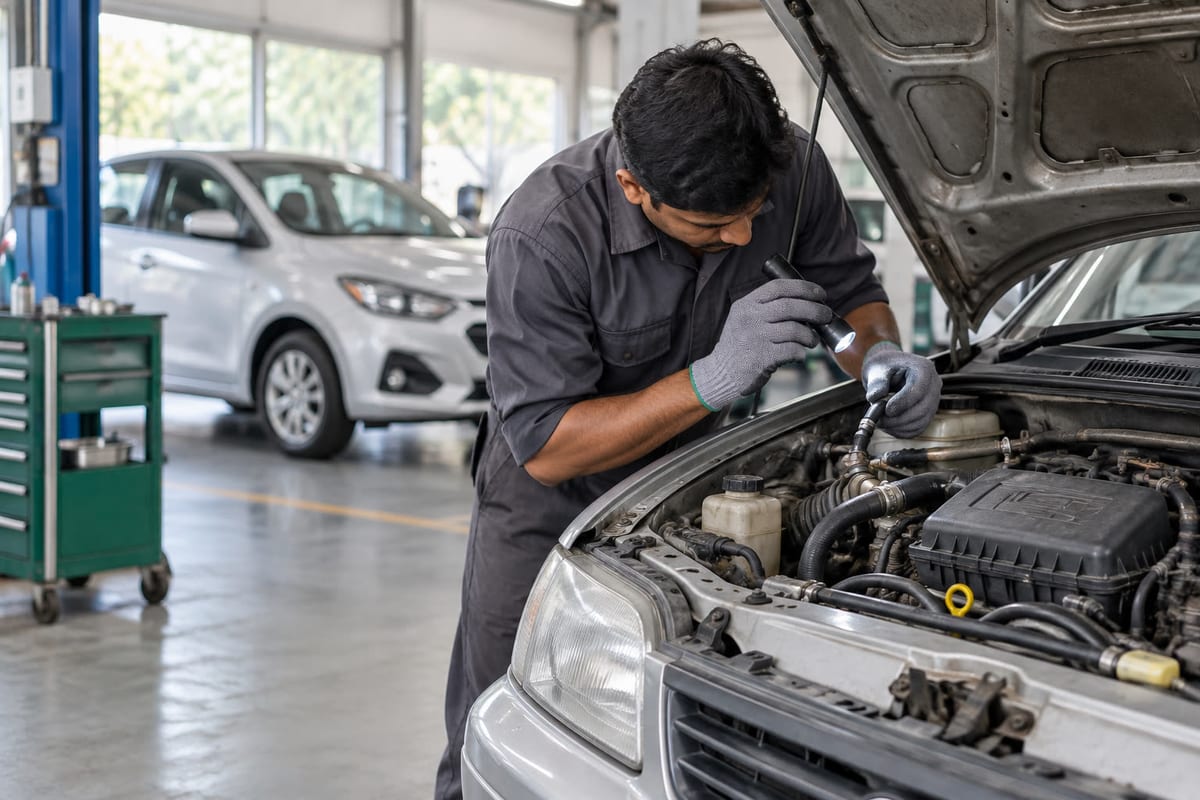 Illustration: FuelPrice; AI-generated visual. It shows a generic service-bay inspection, not an official vehicle or workshop photograph.
What changed at the Bhopal event
The Economic Times reported that Gadkari said flex-fuel engines capable of running on 100% ethanol were being developed while he spoke about ethanol, electric and hydrogen mobility. News On AIR separately confirmed that Gadkari and Madhya Pradesh Chief Minister Mohan Yadav launched the state's new public bus service in Bhopal on 25 Sep 2026.
The distinction matters for car and bike owners. The minister's statement points to the direction of vehicle development, but it does not change the fuel specification of a car already on the road, announce an E100 retail price or require every petrol station to stock a high-ethanol blend. Those details would need a formal vehicle certification, manufacturer communication and a fuel-distribution plan.
What is confirmed about E20
E20 is petrol containing 20% ethanol. In a 30 Jul 2026 release, the Ministry of Petroleum and Natural Gas said the higher-blend programme followed laboratory studies, field trials and consultation with vehicle manufacturers, testing agencies and oil marketing companies. The ministry said those checks had not established widespread engine failure or abnormal wear attributable to E20 under prescribed conditions.
That is an official assessment, not a promise that every vehicle will deliver the same fuel economy. A vehicle's age, calibration, maintenance, traffic, tyre pressure, load and driving pattern can all change the result. The Rajya Sabha response on E20 also says mileage is affected by factors beyond fuel type, while the ministry's 12 Aug 2025 response noted that some older vehicles may require certain rubber parts and gaskets to be replaced earlier than they would with non-blended fuel.
For a driver, the practical reading is balanced: E20 is not a reason to assume immediate engine damage, but a broad government statement should not be converted into a universal mileage-saving claim. If a vehicle develops a drivability, starting or fuel-system issue, the owner's manual and an authorised service inspection are more useful than a generic online claim.
E20, E100 and flex-fuel vehicles are not the same
The government's 4 Jun 2026 flex-fuel release says certified flex-fuel vehicles can operate across a range from E20 to E100. That description applies to vehicles designed, tested and certified for the relevant blend range. It does not mean an ordinary petrol car can use E100 simply because the country is using E20 at retail outlets.
This is different from FuelPrice's earlier report on the reported Toyota 100% ethanol Innova timeline. That was a vehicle-specific launch story; this update is about the wider policy signal and the checks that ordinary drivers need while the vehicle and fuel network develop.
What drivers should check now
- Approved fuel: Read the owner's manual and fuel label for the blend the vehicle is certified to use. Do not treat a flex-fuel announcement as permission to use E100 in a non-flex-fuel vehicle.
- Age and service history: At the next scheduled service, ask for the condition of relevant hoses, seals and gaskets if the vehicle is older or showing a fuel-system symptom. This is a check, not a prediction that every older vehicle will fail.
- Measured mileage: Compare fuel used over the same route, load and traffic pattern across more than one refill. A single tank can be distorted by traffic, idling, tyre pressure or a different driving style.
- Local price and availability: Record the price actually paid at the station and check whether the blend required by a certified flex-fuel vehicle is available. The live fuel prices page can provide a dated starting point for the comparison.
- Cost per kilometre: Once the vehicle's measured fuel economy is known, use the fuel-cost calculator to compare a trip or monthly running cost. This keeps the comparison tied to the car, route and local rate.
What the change could mean for a monthly fuel budget
Here is an arithmetic illustration, not a forecast of E20's typical effect. Assume a petrol car travels 1,000 km in a month, returns 15 km per litre and the local rate is ₹100 per litre. It would use about 66.7 litres, costing roughly ₹6,667. If the same car's measured efficiency changed by 5%, the same distance would require about 70.2 litres, or ₹7,018, a difference of roughly ₹351.
All inputs in that example are assumptions, not a reported market price or a claim about the average E20 impact. The useful takeaway is the method: measure the vehicle's own fuel use, use the price for the date and city, and compare the cost per kilometre. Drivers can also compare petrol, diesel, CNG and electric running costs in FuelPrice's fuel-choice guide.
What to watch before the next fuel-policy step
The Petroleum Ministry's 12 Aug 2025 response said the roadmap was committed to E20 up to 31 Oct 2026 and that any move beyond E20 would require an inter-ministerial report, technical evaluation and stakeholder consultation. That means the next meaningful developments for drivers are likely to be formal decisions, certified vehicle models, clear blend labels, service guidance and reliable retail access—not just another speech or an unpriced prototype.
The June flex-fuel roadmap also discussed phased E85-ready outlets and supporting infrastructure. Until those arrangements are visible in a driver's area, the cost and convenience of a future flex-fuel vehicle cannot be judged from the fuel blend alone. Price, certified range, maintenance, warranty terms and the distance to a compatible outlet will all matter.
Sources
- The Economic Times — Ethanol can help raise farmers' income and reduce fuel imports: Nitin Gadkari — 25 Sep 2026
- News On AIR — Union Minister Nitin Gadkari and Madhya Pradesh CM launch Mukhyamantri Sugam Parivahan Seva — 25 Sep 2026
- Ministry of Petroleum and Natural Gas, PIB — E20 rollout based on scientific validation and extensive stakeholder consultation — 30 Jul 2026
- Ministry of Petroleum and Natural Gas, PIB — Response to concerns on 20% blending of ethanol in petrol and beyond — 12 Aug 2025
- Ministry of Petroleum and Natural Gas, PIB — From reducing oil imports to farmer prosperity: first flex-fuel passenger vehicle — 4 Jun 2026
- Rajya Sabha, Ministry of Road Transport and Highways — Transition to E20 fuel and discontinuation of E10 petrol — 17 Dec 2025