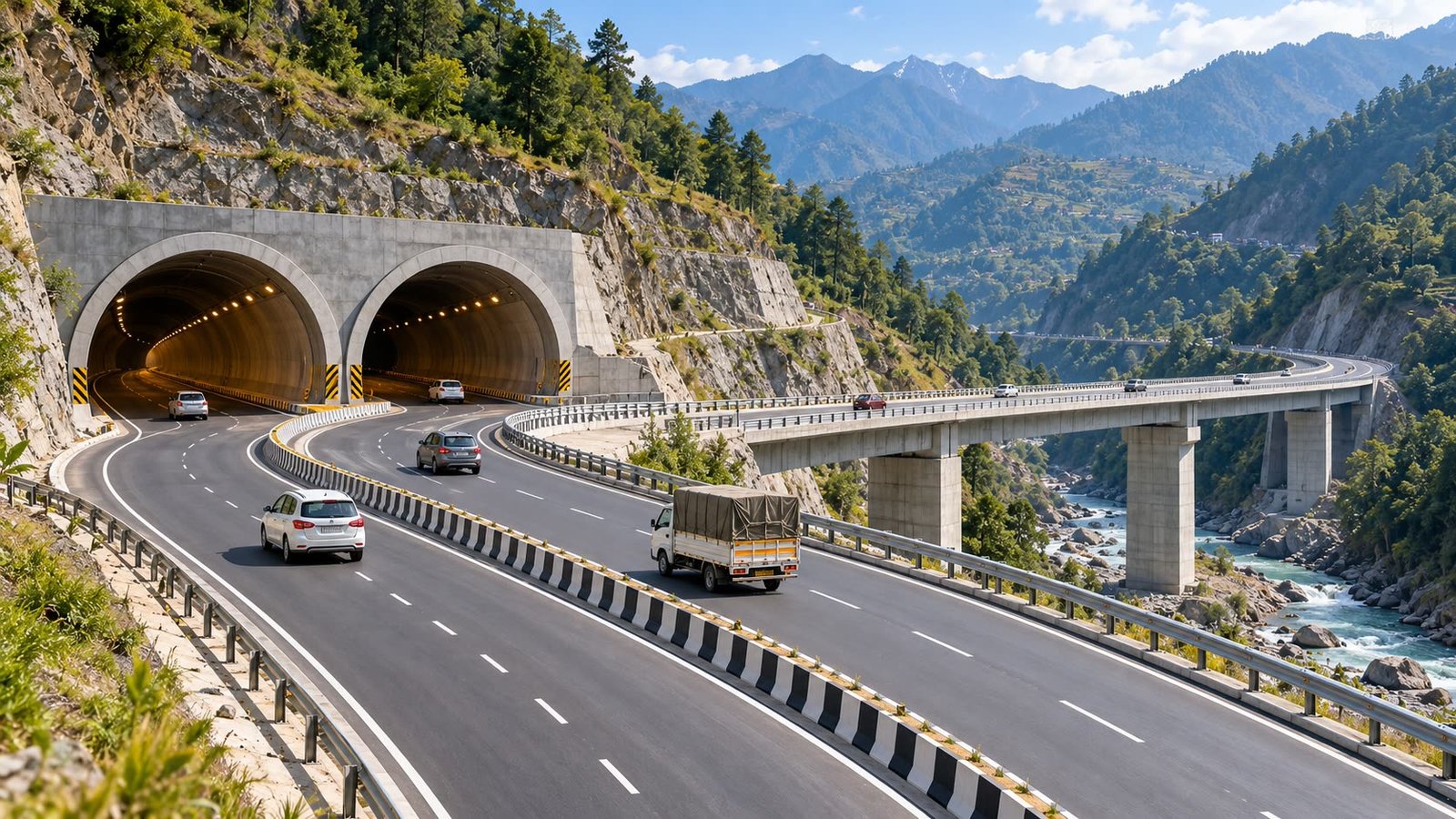
NHAI has opened the 4.5-km Kangra bypass on the Shimla–Mataur corridor to traffic on a trial basis from 1 November 2026. The new alignment is intended to take local, tourist and commercial traffic around congested sections of Kangra, so drivers heading towards Kangra, Dharamshala and McLeodganj may have a shorter and more predictable route to check before travelling.
The opening is a confirmed change in road access, but it is not a new toll-rate notification. The reports available for this opening do not announce a toll waiver, a revised fee or a final commissioning date. Drivers should treat the road as a trial facility, follow signs and staff instructions, and allow for unfinished safety work or changing traffic controls.
Key takeaways
- The 4.5-km bypass began carrying vehicles on a trial basis from 1 November 2026.
- It forms part of the Bhangbar–Kangra section of NH-503 on the Shimla–Mataur corridor.
- A local report says the relevant route distance falls from about 8 km to 4.5 km, a reduction of roughly 3.5 km.
- The works include a 593-metre twin-tube tunnel, multiple bridges, a viaduct and a railway overbridge-cum-viaduct.
- The opening changes route access; it does not by itself confirm any change to toll charges.
What opened on 1 November
The Times of India reported that NHAI opened the Kangra bypass after the completion of a 155-metre bridge over Riuand Khad. The bypass is part of the Bhangbar–Kangra project and is described in current reporting as a section of NH-503, a route used by traffic moving through the Kangra area towards the tourism centres of Dharamshala and McLeodganj.
Amar Ujala’s same-day report also describes the opening as trial traffic from 1 November and places the bypass within the Shimla–Mataur corridor. It says the route replaces an approximately 8-km movement with a 4.5-km bypass alignment in the relevant stretch. That is an important distinction for readers: the saving applies to the covered section, not automatically to every journey that starts in Kangra or ends in Dharamshala.
What the shorter route means for drivers
A shorter alignment can reduce the distance a vehicle covers, but the real benefit will depend on the entry point, traffic levels, weather and whether vehicles are held during the trial. The new road is expected to reduce the need for through traffic to use congested parts of Kangra town, which can matter more than the distance saving during tourist and weekend peaks.
For a private driver, the practical comparison is between the old route and the bypass: distance, likely waiting time, fuel used and any toll or other road charge on the complete trip. The fuel cost calculator can help compare the fuel part of that journey once the route distance and vehicle mileage are known. It should not be read as a promise of a fixed rupee saving, because actual fuel use changes with gradients, traffic, load and driving conditions.
Tourists and families planning onward travel should also check the approach roads rather than assuming that the bypass removes all delays on the corridor. The road-trip planner can be used to review the full route, stops and alternative timing before departure.
Tunnel, bridge and corridor details
The opened section is more than a surface-road diversion. Reporting by The Times of India and Amar Ujala lists a 593-metre twin-tube tunnel, three major bridges with a combined length of about 477 metres, a 160-metre viaduct, a 455-metre railway overbridge-cum-viaduct and the 155-metre bridge over Riuand Khad. These structures explain why the road can bypass difficult terrain and the built-up route through Kangra.
The government’s project-status annexure attached to Lok Sabha Unstarred Question No. 4715, answered on 21 August 2025, recorded the broader Bhangbar-to-Kangra Bypass package as 18.130 km with a sanctioned cost of ₹1,322.95 crore and a scheduled completion date of 31 December 2025. That document is useful background, but it is an earlier status snapshot. The current fact that matters to drivers comes from the November 2026 reports: the 4.5-km bypass has been opened to trial traffic after the bridge work was completed.
Trial-opening checks before using the road
Drivers using the new alignment should treat the first journeys as a live transition period. Amar Ujala reported that NHAI asked motorists to obey the prescribed speed limit, follow road signs and traffic rules, and comply with instructions from personnel deployed on the route. Jagran reported that approach-area safety work was continuing and that lighting on the bridge was expected to be added shortly.
- Confirm the approach and exit on the day of travel, especially if using a navigation app that has not yet updated the alignment.
- Follow temporary signs, lane markings and any on-site traffic marshal instructions instead of assuming that the final road layout is in force.
- Keep extra time for checks or slow movement during the trial, particularly in poor visibility or rain.
- Do not assume that the opening changes an existing toll charge. If the complete trip includes toll plazas elsewhere, use the toll-charge calculator and verify the applicable route details.
What changes now and what to watch next
For now, the confirmed change is that vehicles can use the Kangra bypass on a trial basis. The likely benefit is a cleaner movement path around the town and a shorter covered stretch for traffic between the Bhangbar side and Kangra. That can improve reliability for local commuters, tourism traffic and goods vehicles, but the size of the time saving will only become clear after traffic patterns settle.
The next useful updates will be whether NHAI moves from trial access to regular operations, whether any approach or safety work changes lane use, and whether a separate notification changes tolling or vehicle restrictions. None of those should be inferred from the opening alone. Drivers planning a trip should check the latest signs and local instructions on the day rather than relying only on an older map route.
Reader takeaway
The Kangra bypass is now a usable trial route, not merely a construction milestone. Its confirmed 4.5-km alignment and tunnel-and-bridge design may reduce distance and congestion on the covered stretch, while the final travel-time benefit remains route- and traffic-dependent. Treat the opening as a new option to compare, keep the trial status in mind, and do not assume a toll change without a separate official notice.
Sources
- The Times of India — “NHAI opens 4.5km Kangra bypass to traffic on trial basis” — 2 Nov 2026
- Amar Ujala — “कांगड़ा बाईपास ट्रायल आधार पर खुला, कछियारा से भंगवार तक सभी वाहनों को मिली राहत” — 1 Nov 2026
- Dainik Jagran — “शिमला-मटौर फोरलेन: ट्विन टनल और रियुंद पुल से यातायात शुरू, 12 से 14 मिनट में पहुंचेंगे रानीताल” — 1 Nov 2026
- Ministry of Road Transport and Highways, Lok Sabha — “Four-Laning of Kangra-Shimla Road”, Unstarred Question No. 4715 — 21 Aug 2025