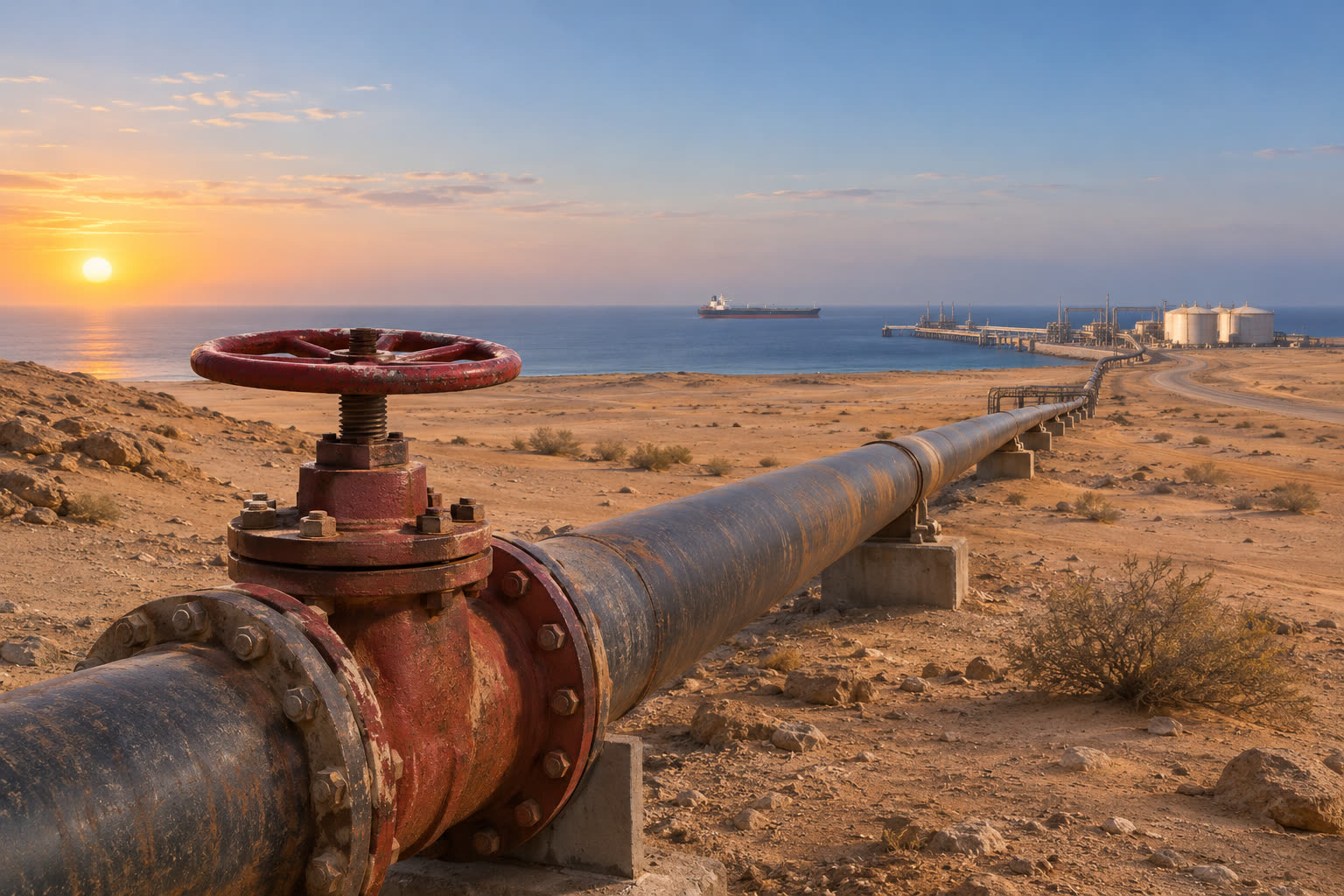
Global oil prices slipped on 23 Nov 2026 even as Libya warned that closures affecting its Sharara and Hamada pipelines could put about 365,000 barrels per day of crude output at risk. Reuters and Bloomberg later reported that Sharara flows had resumed, but neither report gave a new throughput figure.
For drivers, fleets and fuel buyers, the episode shows why a supply disruption can coexist with a falling crude benchmark. Markets were weighing the Libyan risk against stronger Middle East flows, continuing tanker and refinery threats, and expectations that global supply could become more comfortable.
Key takeaways
- Libya's National Oil Corporation (NOC) said on 23 Nov 2026 that a closed valve on the Sharara pipeline could cut about 350,000 barrels per day of field production.
- The NOC said a separate Hamada pipeline disruption was costing about 15,000 barrels per day, taking the potential combined reduction to about 365,000 barrels per day.
- Associated Press described the combined disruption as roughly a quarter of Libya's output; Anadolu Agency reported the NOC-based estimate at about 26% of October's average production.
- Reuters reported Brent at $90.55 per barrel and WTI at $81.82 per barrel at 14:36 GMT on 23 Nov, both lower on the day.
- Bloomberg and Reuters reported that Sharara flows later resumed toward Zawiya, but a restart report is not the same as confirmation of normal export volumes.
What Libya reported
In a statement dated 23 Nov, the NOC said a group acting outside the law had closed one valve on the crude pipeline carrying production from the Sharara oil field, which is operated by Akakus Oil Operations. The corporation said the action was expected to result in a loss of approximately 350,000 barrels per day from the field.
The statement also referred to the continued closure of the Hamada pipeline and estimated that it was already removing about 15,000 barrels per day. Adding the two figures, the NOC put Libya's daily oil-production losses at approximately 365,000 barrels. The wording matters: the 350,000-barrel figure was an expected production impact from the valve closure, not a confirmed full-day loss measured at the wellhead.
The disruption is material because Sharara crude moves through the western Libyan network toward the Zawiya area. Anadolu Agency reported that the terminal supports both the local refinery and tankers loading crude for export. That creates two channels of exposure: less feedstock for domestic processing and less crude available for international cargoes if the interruption lasts.
The scale is also large relative to Libya's recent production. Anadolu Agency said the combined 365,000-barrel-per-day estimate equated to about 26% of the country's average October output, based on NOC figures. The Associated Press separately described the disruption as roughly a quarter of national output. Those descriptions are consistent as rounded measures, but they should not be read as a permanent loss of Libya's production capacity.
Why crude prices fell despite the risk
Oil markets were reacting to the balance of several signals, not to Libya's statement in isolation. Reuters reported that Brent crude futures fell $2.02 per barrel, or 2.18%, to $90.55 per barrel by 14:36 GMT. U.S. West Texas Intermediate (WTI) futures fell $1.59 per barrel, or 1.91%, to $81.82 per barrel at the same snapshot.
A separate Bloomberg News market report carried by Transport Topics put January Brent at $90.46 per barrel, down 2.2%, and WTI for January delivery at $82.07 per barrel in its 23 Nov update. The small difference between those figures reflects the time of the quote and the contract snapshot rather than a disagreement about the direction of the move. Neither is a full-day settlement price.
| Market measure | Reported level | Move | Source and time |
|---|---|---|---|
| Brent crude futures | $90.55 per barrel | Down $2.02, or 2.18% | Reuters, 14:36 GMT, 23 Nov 2026 |
| WTI crude futures | $81.82 per barrel | Down $1.59, or 1.91% | Reuters, 14:36 GMT, 23 Nov 2026 |
| January Brent settlement contract | $90.46 per barrel | Down 2.2% | Bloomberg via Transport Topics, 23 Nov 2026 update |
| January WTI delivery contract | $82.07 per barrel | Lower in the session | Bloomberg via Transport Topics, 23 Nov 2026 update |
Reuters attributed the decline to increased supplies from the Middle East and the reported restart of Libya's Sharara pipeline, while also noting that attacks on shipping and refineries were still supporting a risk premium. Transport Topics, citing Bloomberg, described robust crude exports and the prospect of a global surplus as counterweights to Persian Gulf tensions.
That is the central market lesson. A short-lived outage can be bullish for crude, but the benchmark can still fall if traders believe other producing regions are restoring flows or if demand expectations weaken. Prices reflect the marginal barrel expected to be available to the market, not only the barrels temporarily at risk in one country.
What the reported restart does and does not mean
Bloomberg News reported that NOC Chairman Masoud Suleiman said on 23 Nov that the Sharara pipeline was open again and flows to Zawiya had resumed. Reuters separately reported that crude was beginning to move into storage at the Akakus facility in Zawiya. Both accounts are important because they point to a change after the initial closure warning.
They do not establish that the full 350,000 barrels per day was immediately restored, that the Hamada line was open, or that export loadings had returned to normal. Bloomberg said no further details on throughput were provided. Until the NOC or operating companies publish a sustained-flow update, the prudent reading is partial or early resumption rather than a completed return to normal operations.
What it means for drivers and fleets
Brent and WTI are wholesale benchmarks, not universal pump-price tags. A crude move reaches motorists through refinery margins, product availability, freight and insurance costs, storage, taxes, currency movements and local pricing policy. Petrol and diesel can therefore respond at different speeds, and a lower international quote does not automatically mean a same-day reduction at a filling station.
Drivers can check current local rates on FuelPrice's live fuel prices page rather than treating an intraday Brent quote as a retail notice.
For a specific journey, the fuel cost calculator is more useful than a headline benchmark because it combines distance, efficiency and the fuel price that actually applies to the route.
For transport operators, the more relevant question is whether the market move persists and whether refined diesel supply follows crude. A fleet budget can be affected by wholesale diesel, route length, freight rates and currency exposure even when crude is stable. A brief pipeline disruption in Libya should therefore be tracked alongside tanker flows, refinery operations and product-market indicators rather than used alone to reset a monthly cost assumption.
Vehicle buyers and EV owners face a similar distinction. Oil volatility can change the running-cost comparison between powertrains, but it does not determine electricity tariffs, charging access, vehicle prices or usage patterns. Those inputs remain local and should be evaluated separately.
What to watch next
The first question is whether Sharara flows continue after the reported restart and whether the NOC confirms a measurable return toward normal production. The second is the Hamada pipeline: its separate disruption remains part of the NOC's 365,000-barrel-per-day estimate and was not removed by the Sharara update.
Markets will also watch Middle East export volumes, tanker traffic, refinery outages and the next round of official production guidance. If more supply becomes available while demand expectations soften, crude can stay under pressure even with a geopolitical risk premium. If shipping or infrastructure attacks reduce physical flows again, low spare inventories could make the response sharper.
The practical takeaway is that Libya's pipeline episode is a live supply risk, not yet a confirmed long-term loss. The reported Sharara restart helped crude prices fall on 23 Nov, but the absence of a fresh throughput number leaves the physical market unsettled. For ongoing global coverage, readers can follow FuelPrice's worldwide fuel news section.
Readers can use the road-trip planner when translating local fuel prices into a journey budget.
This article is for general information only and is not financial, insurance or legal advice.
Sources
- Libya National Oil Corporation — “National Oil Corporation Statement on the Closure of a Valve on the Sharara Oil Pipeline by an Outlaw Group...” — 23 Nov 2026
- Anadolu Agency — “Pipeline closure to cut output at Libya's largest oil field by 350,000 barrels a day” — 23 Nov 2026
- Associated Press — “Ukrainian naval drones strike new Russian warship in Libya, and other Mideast news” — 23 Nov 2026
- Reuters, republished by Yahoo Finance — “Oil falls on increased Middle East flows, Libyan pipeline restart” — 23 Nov 2026
- Bloomberg News, republished by BusinessMirror — “Libyan oil pipeline reopens after ‘outlaws’ shut valve” — 23 Nov 2026
- Transport Topics, citing Bloomberg News — “Oil prices dip as ample supply balances Persian Gulf tensions” — 23 Nov 2026