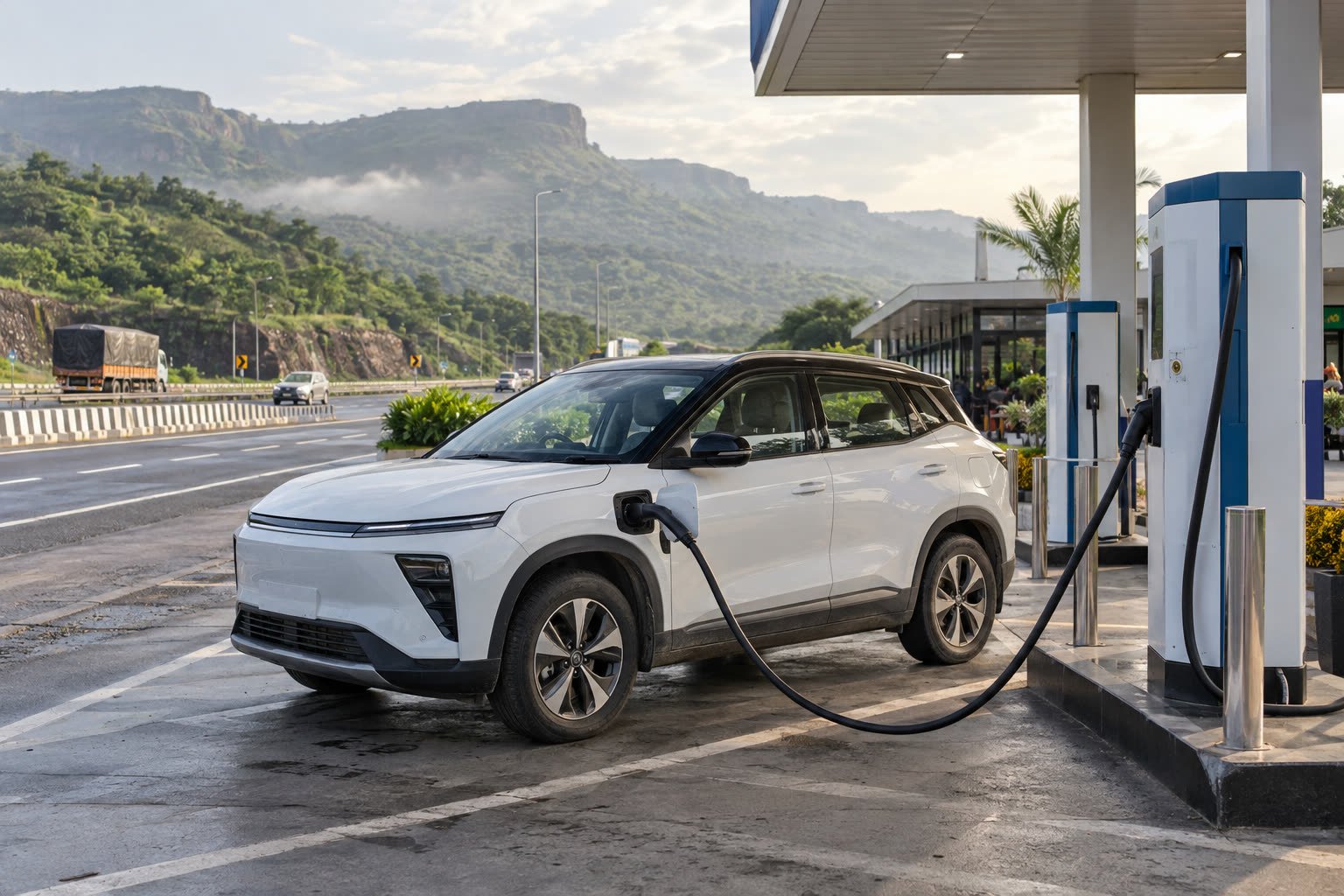
Mahindra has announced that its Charge_iN public EV charging network has reached 50 live locations and 200 charging points across India as of 24 Sep 2026. The milestone includes the first operational site under its HPCL collaboration at the HP Auto Care Centre in Sajgaon on the Mumbai–Pune Expressway, giving highway EV users another fast-charging stop to consider.
Key takeaways
- Charge_iN now has 50 live locations and 200 charging points across India, according to Mahindra’s 24 Sep 2026 announcement.
- The first joint site under Mahindra’s HPCL partnership is live at Sajgaon on the Mumbai–Pune Expressway.
- The network uses 180 kW dual-gun DC chargers; Mahindra says compatible Electric Origin SUVs can charge from 20% to 80% in about 20 minutes under standard conditions.
- Mahindra’s planned next step is 250 stations with approximately 1,000 charging points by December 2027.
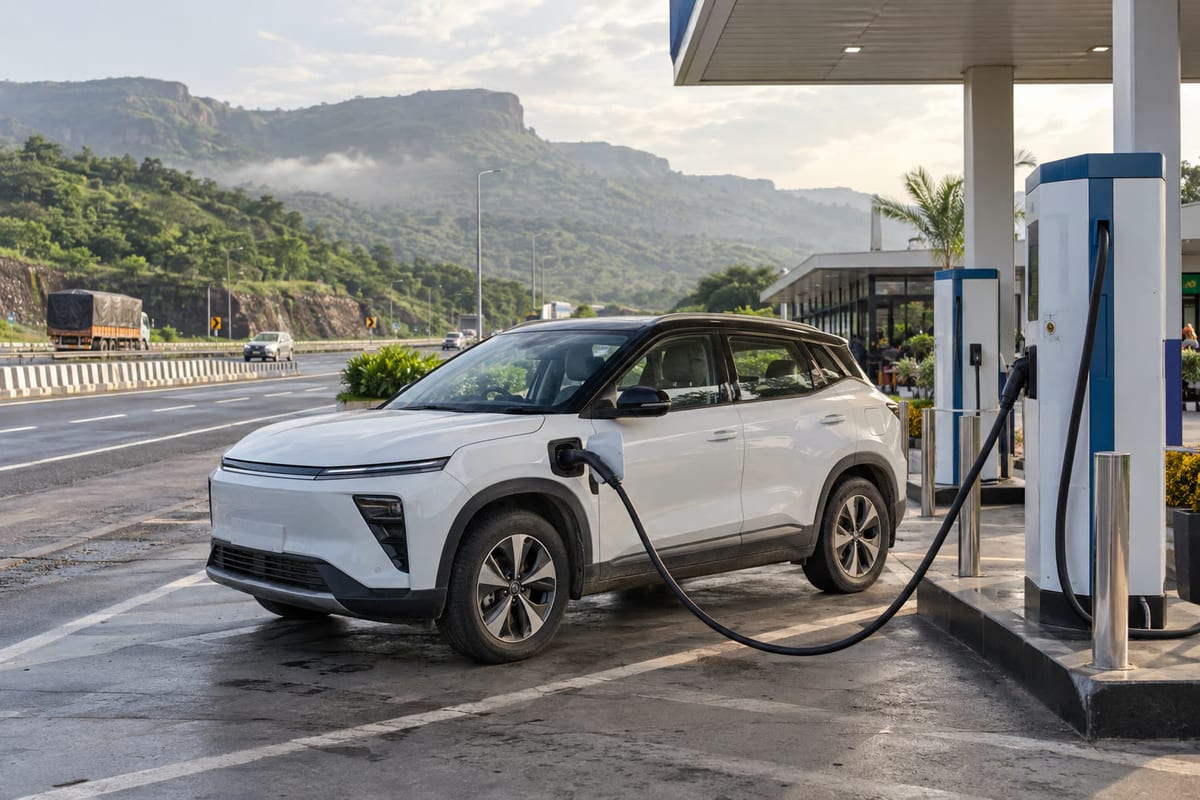 Credit: FuelPrice, AI-generated editorial illustration; not an official Mahindra or HPCL photograph.
What Mahindra announced
Mahindra’s latest update is a network expansion, not a new vehicle launch. The company said on 24 Sep that Charge_iN is now live at 50 locations; Autocar Professional independently reported the same milestone and the 200-point footprint. The current rollout is spread across India, with a focus on highway corridors and locations that can support a stop during a longer journey.
That distinction matters for readers. Fifty sites nationwide does not mean a charger is available on every major route or at every fuel station. The 200-point total is a useful sign of scale, but drivers still need to check the exact station, connector availability, operating status and access before setting out.
Why the HPCL site matters to highway users
The Sajgaon facility is the first Charge_iN site to go live under the March 2026 agreement between Mahindra and HPCL. That agreement uses HPCL’s retail-outlet network as a platform for deploying EV charging stations across India; the latest site places the partnership on a busy inter-city corridor rather than only in an urban charging cluster.
The site is therefore relevant to private EV owners and to the growing highway-trip use case. Co-locating charging with a fuel-station property can make a stop easier to find and can put charging near existing road amenities, but it does not remove the need to confirm that the charger is open and compatible when the trip begins.
What the 180 kW figure means
Charge_iN stations use 180 kW dual-gun DC chargers, Mahindra says. Autocar reports that the setup is designed to take the company’s Electric Origin SUVs — the XEV 9e, BE 6 Sporteq and XEV 9S — from 20% to 80% in approximately 20 minutes under standard operating conditions.
A 20-minute figure should not be read as a guaranteed stop time for every vehicle. Actual charging time can change with battery state of charge, battery and ambient temperature, charger output and other operating conditions. Drivers of other brands may be able to use the network because Mahindra says it is open to all brands, but they should verify the app listing, connector standard, charging terms and live status rather than assume every site will work for every car.
What changes now for Indian EV drivers
For EV owners planning a Mumbai–Pune journey or another long highway route, the practical change is more choice at potential stopping points, not a blanket promise of uninterrupted coverage. Use FuelPrice’s state-wise EV charging directory to check station locations and the road-trip planner to map charging stops. Check the operator’s live status shortly before departure, especially for a trip that depends on one specific site.
FuelPrice readers comparing an EV with an internal-combustion road trip can use the fuel-cost calculator to estimate petrol or diesel outlay. That tool does not calculate a charging tariff or battery degradation, so it should be treated as one part of a trip-cost check rather than a verdict on which powertrain is cheaper.
What to watch next
Mahindra’s next milestone is a target, not an achieved network count. The company said it plans to expand Charge_iN to 250 stations with approximately 1,000 charging points by December 2027. Autocar reported that several joint highway locations are in engineering and civil construction. The key watchpoint is delivery across corridors: a higher national total will matter most if it closes gaps between cities, offers reliable uptime and provides compatible connectors for multiple car brands.
HP eCharge integration is also planned for the Charge_iN network, according to Mahindra’s latest release. That could reduce app switching for drivers using HPCL-linked sites, but the operational experience will depend on when each location and platform is activated.
The reader takeaway
The confirmed development is the move to 50 live locations and 200 live points, together with the first HPCL-linked Sajgaon site. The 250-station and approximately 1,000-point expansion is a company plan through December 2027. For a driver, the immediate checklist is simple: check a live site along the route, verify connector compatibility, leave enough range for an alternate stop and treat the 20-minute claim as a test-condition estimate.
That turns a network headline into a usable road-trip plan. The new stop can improve route confidence, but live status and backup planning remain part of EV travel.
Sources
- Mahindra, “Charge_iN by Mahindra expands to 50 charging stations” — 24 Sep 2026.
- Autocar Professional, “Mahindra Scales Charge_iN Public EV Network to 50 Stations, Targets 250 Sites by December 2027” — 24 Sep 2026.
- Mahindra Auto, “Charge_iN by Mahindra Signs Strategic Agreement with HPCL to develop Electric Vehicle Charging Infrastructure at HPCL Retail Outlets” — 20 Mar 2026.