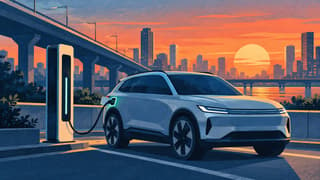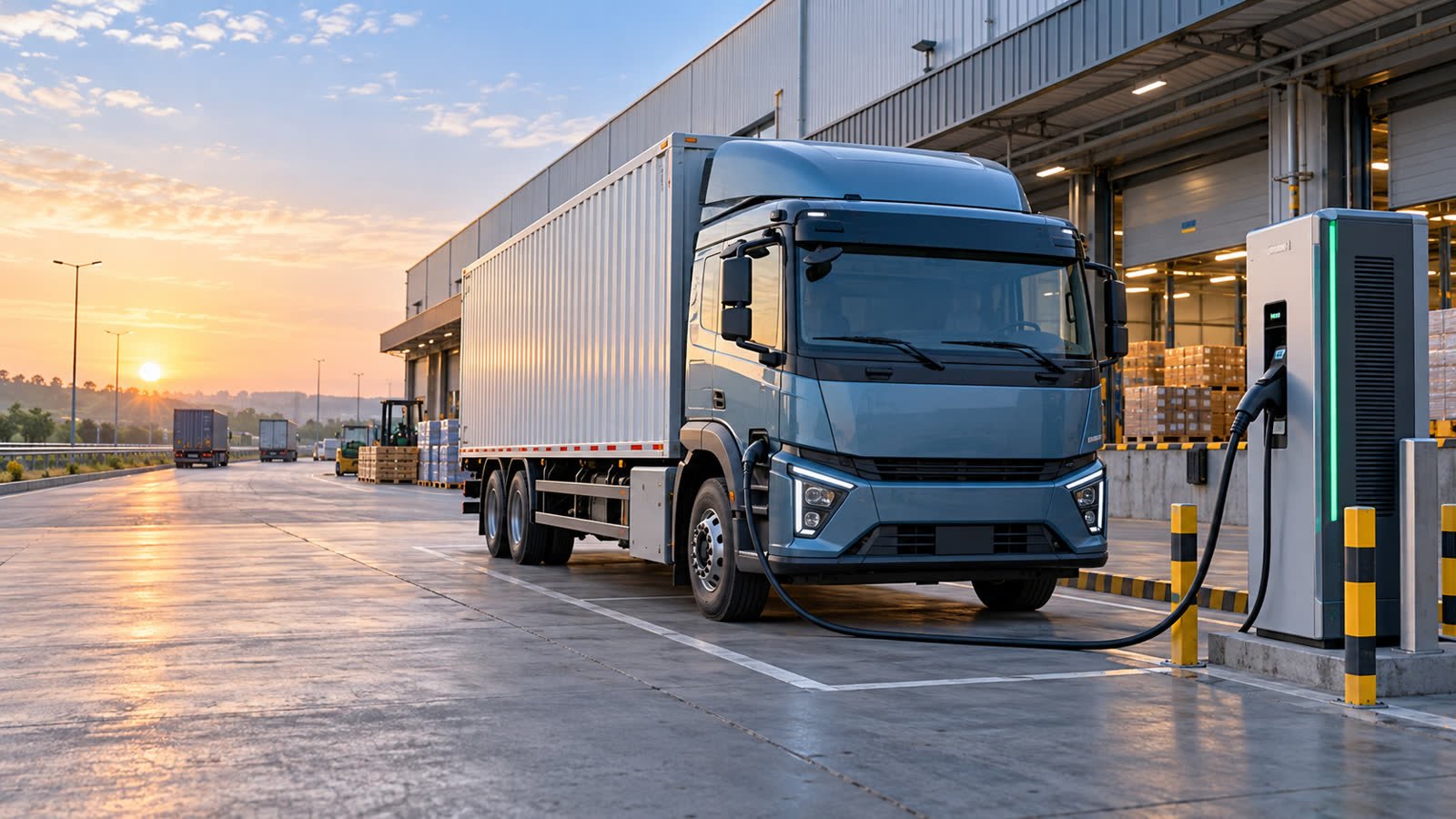
Mega Nirman & Industries and Safexpress signed an electric-vehicle charging services framework on 9 Oct 2026. It allows MegaCharge, Mega Nirman’s charging division, to install, own, operate and maintain charging stations at logistics sites selected by the two companies. For fleet operators, the key point is that this is a site-by-site framework, not a confirmed nationwide rollout with a published station count.
The agreement matters because depot and hub charging is one of the practical constraints for electric freight vehicles. It can give a logistics operator a defined process for adding charging capacity at suitable facilities, but the effect on routes, charging availability and operating costs will depend on the site annexures that are signed later.
Key takeaways
- The master agreement was executed on 9 Oct 2026, according to the BSE-sourced disclosure reported by EquityBulls on 10 Oct 2026.
- Each location needs a feasibility assessment and a separate site annexure before it becomes part of the rollout.
- A commissioned site has a 10-year term, extendable by 3 years by mutual consent.
- The agreement does not commit either side to a minimum number of sites or an aggregate contract value.
- The earlier agreement for an Agra, Uttar Pradesh site dated 29 Apr 2026 is intended to come under the master framework after the relevant site annexure is executed.
What the agreement actually covers
Under the arrangement, MegaCharge is responsible for installing, owning, operating and maintaining the charging stations. Safexpress and Mega Nirman must agree the locations separately. The disclosure says each location will be assessed for feasibility and added through a site annexure, which is the document that will set out the terms for that specific facility.
The disclosure also says each charging station is to be commissioned within 60 days in accordance with the agreement. That should not be read as a universal public-network launch date: the clock applies to a station after the relevant site and commercial arrangements are in place. The site annexure is therefore more important to actual deployment than the headline master agreement.
An earlier EV charging services agreement dated 29 Apr 2026 covered a site at Agra. The newer framework is intended to govern that location once its site annexure is executed, while also providing a structure for additional facilities. Business Standard’s 12 Oct 2026 company-provided release described the arrangement as a long-term charging framework for designated logistics hubs and transit facilities.
Why this matters to logistics fleets
Electric freight vehicles need charging plans that fit loading, unloading, driver breaks and route schedules. A charger at a logistics hub can be operationally different from a public charger: the fleet may need predictable access, vehicle-compatible power, a service-level commitment and a clear process for handling downtime. None of those site-level specifications is publicly fixed by the master agreement.
For a fleet manager, the announcement is best treated as a framework to monitor rather than as proof that a new charging corridor is already available. The useful details will arrive with each annexure: the site address, charger capacity, grid-connection status, commissioning date, access rules, tariff structure, minimum utilisation terms and maintenance responsibilities.
Private EV owners should not assume that the agreement changes public charging access or prices. Drivers planning an electric trip can still use FuelPrice’s state-wise EV charging directory to check available locations. For a multi-stop journey, the road-trip planner can help organise the route around charging stops, subject to confirming live availability with the operator.
What is confirmed, and what is not
The confirmed part is the agreement itself and its broad operating terms. EquityBulls’ 10 Oct 2026 report, which reproduces the company’s disclosure, says the framework does not guarantee a minimum number of sites or an aggregate contract value. It also says actual revenue will depend on the sites commissioned and the energy dispensed at them.
That qualification is important for readers tracking the commercial EV market. A framework can make future deployments easier to negotiate, but it is not the same as a purchase order for a fixed number of chargers. Until site annexures are signed and equipment is commissioned, the scale and geographic reach of the network remain open.
What fleet operators should check next
- Site confirmation: whether Agra and any additional locations have signed annexures and approved feasibility assessments.
- Vehicle fit: charger power, connector standards, charging windows and compatibility with the fleet’s electric trucks or other commercial vehicles.
- Operating terms: tariff, minimum consumption, service levels, access restrictions and responsibility for maintenance or outages.
- Deployment timing: the date on which a site receives grid approval, equipment installation and commissioning clearance.
For diesel operators comparing an electric transition with existing route costs, FuelPrice’s fuel cost calculator can provide a baseline for the fuel portion of a trip. It does not replace a fleet-specific energy model, which would also need electricity tariffs, charging losses, vehicle payload, maintenance and financing assumptions.
Reader takeaway
The MegaCharge–Safexpress agreement is a meaningful commercial-charging signal, but its immediate value is the structure for future sites rather than a guaranteed public network. Watch for the Agra site annexure and any subsequent location announcements. Those documents will show whether the framework becomes a functioning freight-charging network and what access, timing and operating terms fleet users can actually rely on.
Sources
- Moneycontrol, “Intimation Under Regulation 30: Execution of Master EV Charging Services Agreement With Safexpress Private Limited”, 10 Oct 2026
- EquityBulls, “Mega Nirman & Industries Ltd inks Master EV Charging Services Agreement with Safexpress”, 10 Oct 2026
- Business Standard, “Mega Nirman Industries LTD and Safexpress Announce Landmark EV Charging Partnership to Accelerate Green Logistics in India”, 12 Oct 2026