The National Highways Authority of India (NHAI) has introduced stricter monitoring for toilets and other public-facing facilities at toll plazas. For highway users, the immediate change is more formal inspection and complaint tracking; the announcement does not change the toll charged on a trip or the way a valid FASTag is deducted.
+The Ministry of Road Transport and Highways said on 12 Oct 2026 that NHAI field officials will inspect facilities at least once a week. Agencies that repeatedly leave deficiencies unresolved can be classified as non-performers and kept out of NHAI bids for 15 days or until the pending issues are fixed.
+ +Key takeaways
+-
+
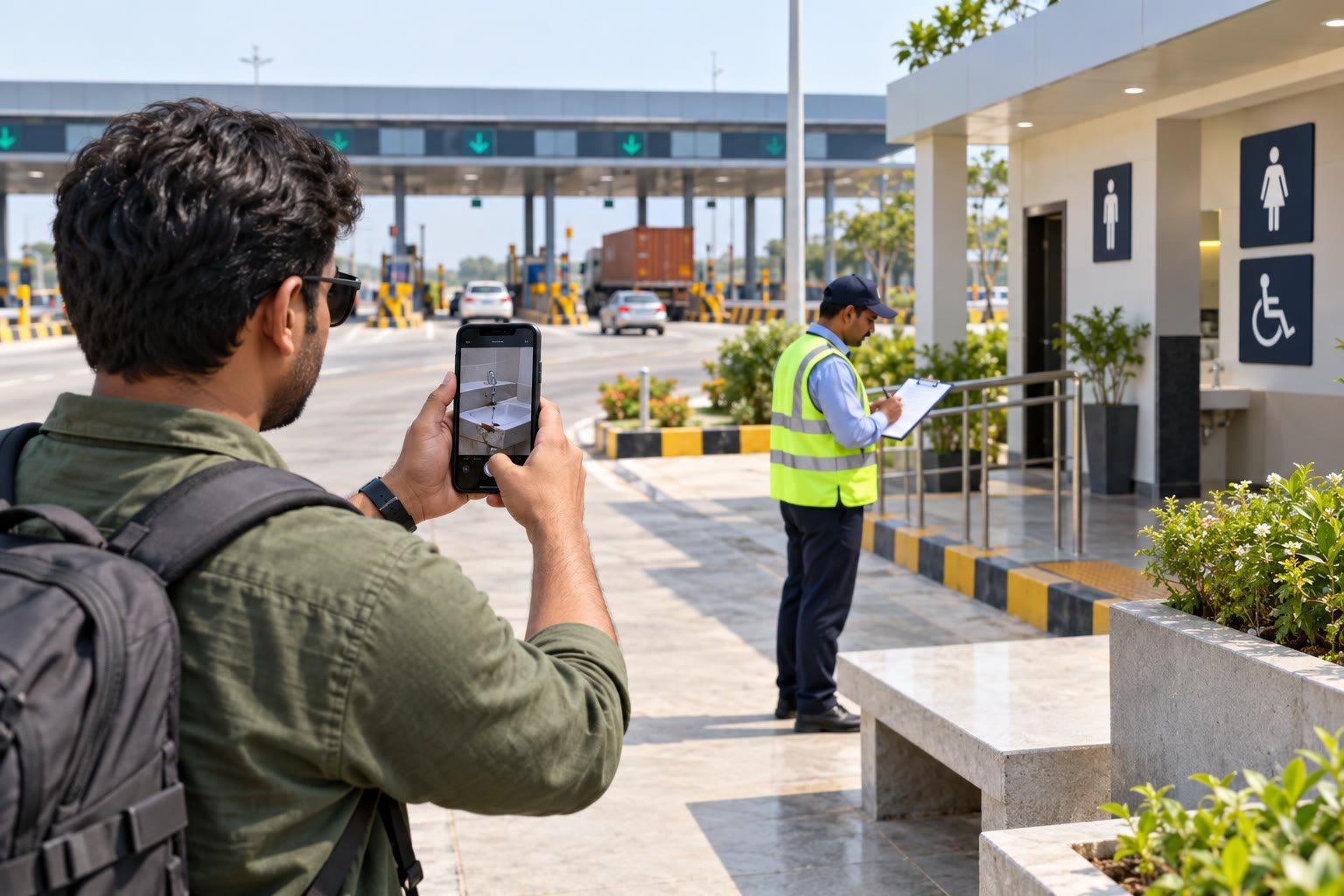
- Weekly inspections will cover toilet blocks, toll collection booths, surrounding areas and signboards. +
- Show-cause notices, dated photographs and corrective-action evidence will be uploaded to NHAI's Data Lake portal. +
- An agency can be declared a non-performer when unresolved-deficiency notices reach or exceed 10% of the toll plazas it operates. +
- A non-performing agency may be barred from NHAI bidding for 15 days or until all pending deficiencies are rectified. +
What changed on 12 Oct 2026
+NHAI's new mechanism applies to publicly funded toll plazas and to other plazas where NHAI appoints User Fee Collection Agencies. The service-quality scope is wider than the washroom itself: the PIB release also names toll booths, the surrounding area and signboards. That matters on long journeys because a facility can be available but still fail if it is not clean, accessible, lit or maintained.
+When an inspection finds a deficiency, the agency responsible will receive a show-cause notice and a direction to correct the problem within the stipulated time. Where the lapse violates a contract or prescribed service standard, NHAI can impose the applicable penalty under the existing contractual provisions and guidelines. This is an enforcement and maintenance change, not a notification revising user-fee rates.
+ +How NHAI will track unresolved problems
+The process is designed to leave a digital trail rather than rely only on a verbal instruction at the plaza. NHAI says its field units will record the notice and dated photographs on the Data Lake portal. The agency must then submit its response and upload photographs showing the corrective action. That gives officials a way to compare the reported deficiency with the claimed fix.
+The 10% threshold is measured against the total toll plazas operated by the agency. It is not a new charge on motorists and it does not mean that 10% of the toll at a plaza is affected. Once the unresolved notices reach or exceed that threshold, the agency can be classified as a non-performer. The bid restriction covers toll-plaza contracts, regular toll operations, civil works and other NHAI bids, according to the ministry's release and same-day secondary reporting.
+The restriction is described as 15 days or until all pending deficiencies are rectified, whichever keeps the agency ineligible for the relevant period. That wording leaves the practical outcome dependent on the agency's response and NHAI's verification; it is not a permanent blacklist announced for every service failure.
+ +What this means for highway users
+Travellers should see this as a service-quality accountability measure. A weekly inspection schedule may make it easier for NHAI to identify recurring problems, but it does not guarantee that every facility will be clean on every visit. The result will depend on the inspection record, the time allowed for repairs and whether the agency's corrective action is checked.
+NHAI's release also refers to its Clean Toilet Picture Challenge, launched in 2025. It says an eligible vehicle registration reporting an unclean toll-plaza toilet through the Rajmargyatra app can receive a ₹1,000 FASTag recharge reward. The release describes the report as a clear, geo-tagged and time-stamped photograph. Because this is a specific challenge with eligibility conditions, users should verify the current option and terms in the official app before relying on a reward.
+The new monitoring mechanism does not replace trip planning. Before a long drive, a user can estimate the route's toll charges and trip cost, keep the FASTag linked to the correct vehicle and note where a planned break is likely to fall. For fuel-and-toll budgeting, the road-trip planner can help compare the practical cost of a route instead of treating a toll plaza as only a payment point.
+ +How to report a facility problem responsibly
+-
+
- Confirm that the facility is at an NHAI-linked toll plaza; a petrol-pump, restaurant or private roadside toilet may fall outside this mechanism. +
- Record the location and take a clear photograph of the facility issue without including other travellers unnecessarily. +
- Use the official Rajmargyatra app and follow its current reporting fields. Do not upload a manipulated, duplicate or old image. +
- Keep the plaza name, time and submission details if a follow-up is needed. The FASTag balance and recharge guide can help check whether a credited recharge has appeared, but it cannot replace the app's complaint process. +
Why the change matters for operators and fleets
+For a private driver, the visible benefit is a better chance of finding a usable stop on a long route. For bus, taxi and goods-vehicle operators, facility quality affects where drivers can safely take breaks and how much unplanned time a route may consume. The policy does not set a new toll or fuel cost, but unresolved maintenance can create detours, delays and poor trip experience even when the highway itself is open.
+Operators should also distinguish between an agency's bid eligibility and a traveler's toll obligation. A contractor's non-performer status does not cancel the user fee at a plaza, and a complaint about a toilet does not by itself create a toll refund. Payment disputes still need to go through the relevant FASTag issuer, NHAI channel or official grievance route.
+ +What to watch next
+The useful test will be implementation: whether weekly inspection records lead to prompt repairs, whether corrective photographs are verified and whether repeat deficiencies trigger the stated action. Highway users should also watch for separate NHAI or MoRTH notifications if a future update changes toll rates, pass terms or the Rajmargyatra reporting process. None of those changes is part of the 12 Oct announcement.
+ +Reader takeaway
+For now, plan the trip and toll budget as usual, keep the FASTag ready, and treat the new mechanism as a way to make facility problems more traceable. If a toll-plaza amenity is unusable, a factual report through the official channel is more useful than an unverified social post—and the inspection record should make it easier to see whether the problem is corrected.
+ +Sources
+-
+
- Press Information Bureau — “NHAI Introduces Stricter Monitoring to Ensure Clean and Well-Maintained Toilets Blocks and other Facilities at Toll Plazas” — 12 Oct 2026 +
- Public and Policy — “NHAI tightens monitoring of toll plaza toilets, bars non-compliant agencies from bids” — 12 Oct 2026 +
- Press Information Bureau — “NHAI Launches Initiative to Develop World-Class Public Toilet Facilities at Toll Plazas” — 30 Jul 2026 +
- Press Information Bureau — “Report a Dirty NH Toilet and Get Rewarded” — 13 Oct 2025 +