Montra Electric says it has rolled out its 1,000th Rhino heavy-duty electric truck at its Manesar facility in Haryana. The milestone matters to Indian fleet operators because it shows that electric heavy trucking is moving beyond pilot deployments, while still leaving route, charging and cost questions for each operator to verify.
Key takeaways
- Montra said the 1,000th Rhino was rolled out on 20 Nov 2026, with the company describing it as the first Indian-brand milestone of its kind.
- The company said Rhino trucks deployed so far have covered more than 36 million km, avoided over 6.5 million kg of CO2 emissions and saved operators more than ₹70 crore in running costs.
- PM E-DRIVE support for e-trucks is limited by battery capacity, ex-factory price and gross vehicle weight (GVW); it is not an automatic discount for every truck.
- For a fleet, depot charging, route length, payload, electricity tariff, utilisation, financing and uptime matter more than the production milestone alone.
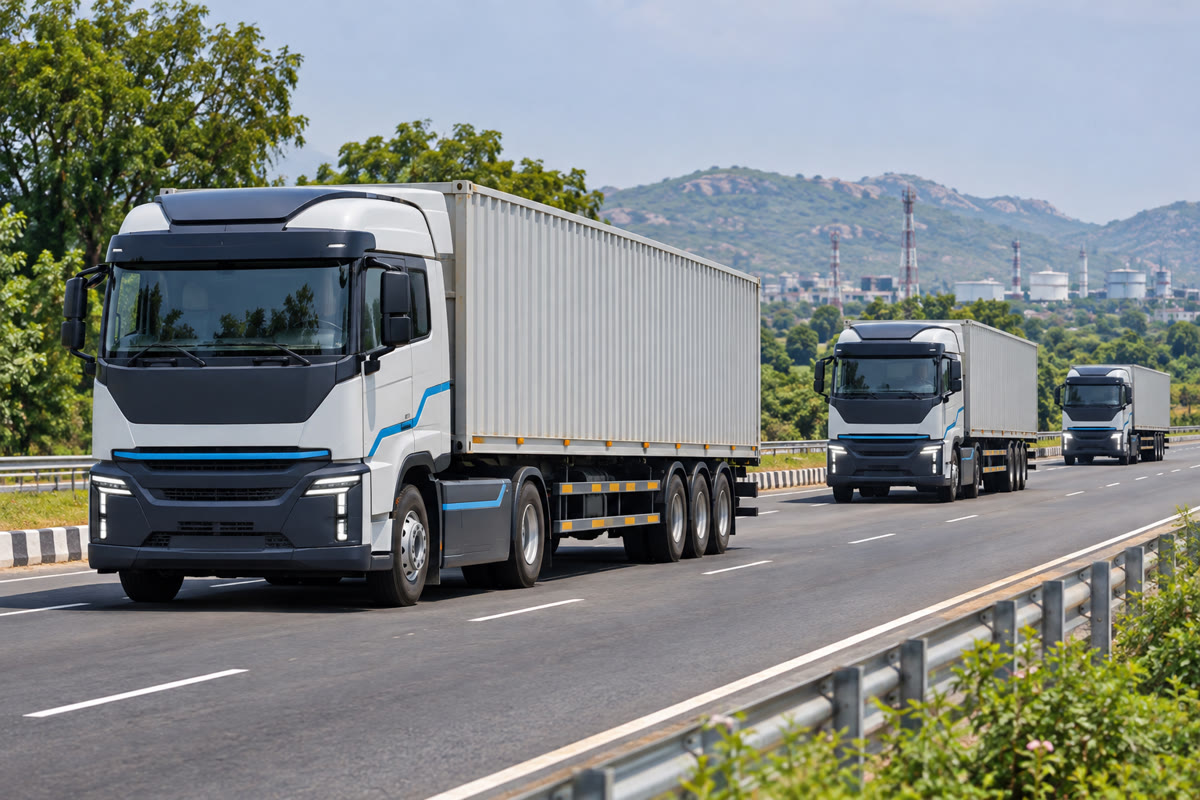
Illustration: a generic heavy-duty electric freight truck at a charging depot; it is not a photograph of the Montra Rhino model.
What Montra announced
Reports by ETAuto and Autocar Professional said Montra Electric marked the 1,000th Rhino rollout at its Manesar plant on 20 Nov 2026. Montra’s own official update described the milestone as 1,000 RHINOs on the road and said it reflected customer and partner confidence. The company also claimed to be the first Indian brand to reach 1,000 heavy-duty electric trucks.
That “first” description remains a company claim, rather than an independently audited industry ranking. The independently reported part is the rollout milestone and the operational figures attributed to Montra. The company said the deployed Rhino trucks had collectively covered more than 36 million km, avoided over 6.5 million kg of CO2 emissions and generated more than ₹70 crore in running-cost savings for operators.
The reports do not set out the time period, route mix, electricity prices, diesel benchmark, maintenance assumptions or accounting method used for those aggregate savings and emissions figures. They should therefore be read as Montra’s fleet-level claims, not as a guaranteed saving or a result that applies to every freight route.
Why the milestone matters to freight fleets
Heavy trucks are harder to electrify than urban delivery vehicles because they carry larger payloads, spend longer hours on the road and often operate on tight turnaround schedules. A meaningful production and deployment base can help an operator evaluate service support, parts availability, driver familiarity and charging operations with more evidence than a single demonstration vehicle would provide.
For a fleet that repeatedly returns to the same depot, charging can be planned around loading and rest windows. A predictable route can also make it easier to match the truck’s usable range to daily work. Long-haul operations, however, may need high-capacity charging at both ends, spare-vehicle cover and a plan for delays caused by queues, grid constraints or a charger outage.
Montra’s aggregate running-cost claim gives a useful scale reference but not a quote. Dividing the stated ₹70 crore by 1,000 trucks produces a simple average of about ₹7 lakh per truck; that arithmetic does not show how long each truck operated, how much it carried or what energy and maintenance costs were used. A fleet manager can use the fuel cost calculator to establish a diesel baseline for a route, then replace the fuel assumption with the fleet’s verified electricity and charging costs.
PM E-DRIVE support has conditions
The Ministry of Heavy Industries’ PM E-DRIVE e-truck guidelines set the demand incentive as the lowest of ₹5,000 multiplied by battery capacity in kWh, 10% of the ex-factory price excluding the trailer, or the cap for the vehicle’s GVW category. The guideline table lists a maximum of ₹9.3 lakh for e-trucks above 35 tonnes and up to 55 tonnes, and ₹9.6 lakh for the category above 18.5 tonnes and up to 35 tonnes.
Montra’s current Rhino product information lists a 55-tonne gross combination weight for the Rhino 5538 EV. That puts a model-level comparison in the 55-tonne bracket only if the exact certified configuration and all scheme conditions are met. Buyers and fleet operators still need to confirm the eligible variant, battery, ex-factory price, registration and claim status through the official process; the maximum cap is not the same as the incentive payable in every transaction.
The PM E-DRIVE framework also has a finite allocation and eligibility conditions. Its support can reduce the initial purchase burden, but it does not remove the need to compare the vehicle’s total cost of ownership with a diesel alternative over the intended route and duty cycle.
What fleet operators should check
- Duty cycle: Map the daily kilometres, average payload, gradients, waiting time and return-to-depot pattern. An electric truck’s economics depend on how much of its operating day is productive movement rather than charging or queuing.
- Charging readiness: Confirm sanctioned electrical load, charger rating, installation lead time, space and backup arrangements. The EV charging directory can help with public-station discovery, but heavy-truck compatibility, access and uptime must be checked directly.
- Operating assumptions: Compare electricity tariffs, demand charges, maintenance, tyres, insurance, financing, battery warranty and downtime with the current diesel fleet. A lower energy bill alone does not establish a lower total cost.
- Incentive paperwork: Check the exact GVW category, battery and ex-factory price, manufacturing and registration requirements, available scheme allocation and the e-voucher or claim process before including an incentive in a purchase model.
What to watch next
The next useful evidence will be repeat orders, route-level uptime, charger utilisation and independently measured operating costs. Those measures will show whether heavy-duty electric trucks can scale across different freight applications rather than only on predictable, depot-based work.
For operators planning a corridor, tolls are another part of the trip budget. The toll-charge calculator can keep toll costs separate from the energy comparison, which makes the route model easier to audit when fuel, electricity or toll rates change.
Montra’s 1,000-truck milestone is a significant deployment signal, but the practical decision remains route-specific. Fleets should treat the company’s savings and emissions figures as reported claims, then test the exact vehicle, charger and duty cycle against their own records.
Sources
- ETAuto — “Montra Electric rolls out 1,000th Rhino truck, claims first Indian OEM to reach milestone” — 20 Nov 2026.
- Autocar Professional — “Montra Electric Rolls Out 1,000th Rhino Electric Truck” — 20 Nov 2026.
- Montra Electric Truck — official “1,000 RHINOs” milestone update — 20 Nov 2026.
- Ministry of Heavy Industries — “PM E-DRIVE 2025 - Operational Guidelines (e-Truck)” — 11 Jul 2025; scheme checked 22 Nov 2026.
- Montra Electric — “Electric Truck India | Heavy Commercial EV by Montra Electric” — product information checked 22 Nov 2026.