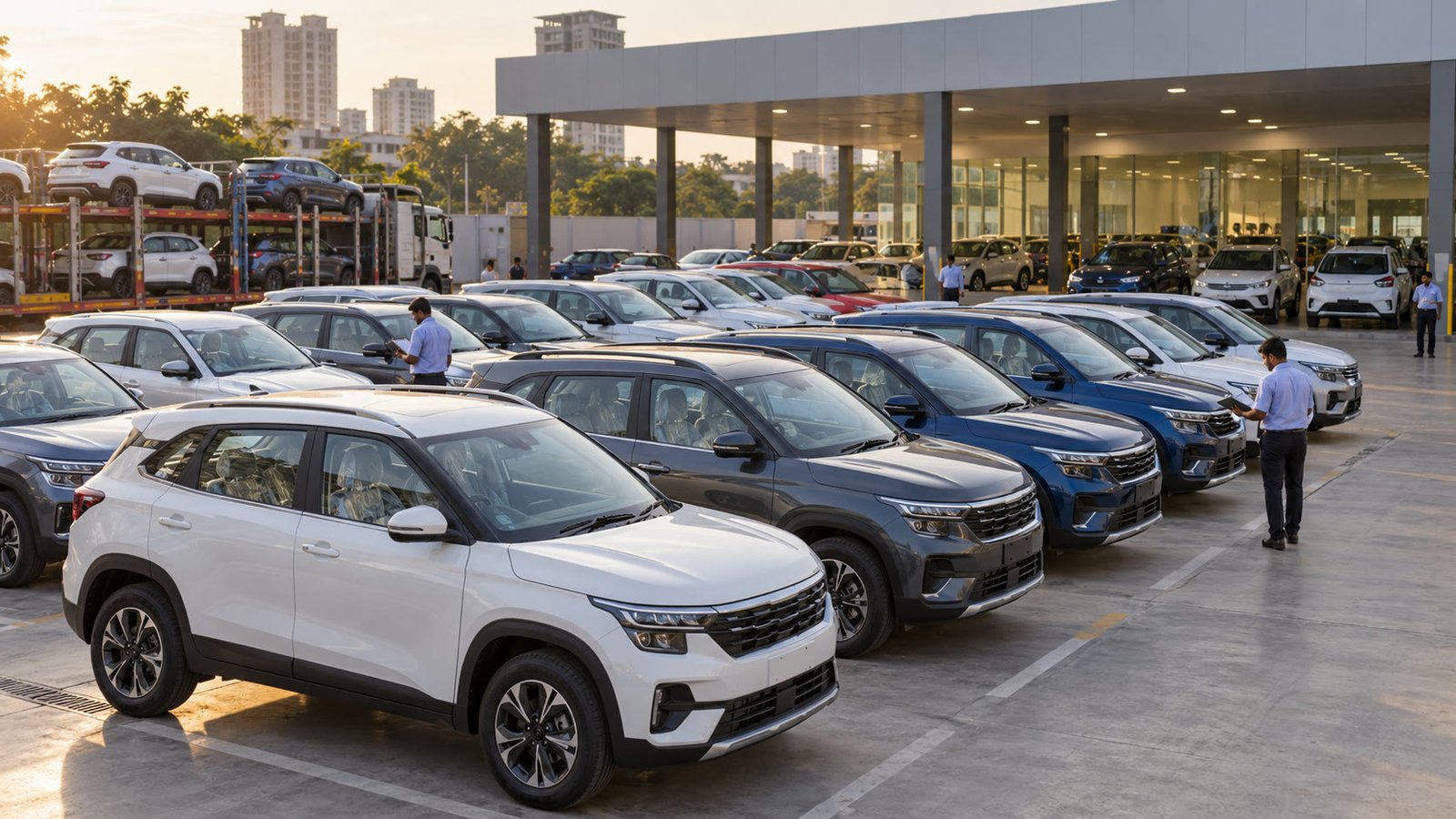
India’s domestic passenger-vehicle dispatches to dealers are estimated at 5.25–5.30 lakh units for October 2026, taking monthly wholesales above the five-lakh mark for the first time. The record matters to buyers because it points to strong festive-season supply, but it does not mean that 5.25–5.30 lakh cars were already registered or handed over to customers.
Key takeaways
- The October 2026 wholesale figure is an industry estimate, not a final audited tally.
- Moneycontrol and Autocar Professional reported the estimate at 5.25–5.30 lakh units, against about 4.60 lakh in October 2025.
- Maruti Suzuki, Tata Motors, Mahindra and Hyundai all reported strong domestic October volumes.
- Dealer dispatches can run ahead of registrations when manufacturers build stock for Dhanteras and Diwali deliveries.
- Buyers should read the record as a supply signal and still check the exact car’s manufacturing month, variant, price and delivery date.
What the record actually measures
Wholesales or dispatches are vehicles sent by manufacturers to dealerships. They are an important measure of production and channel supply, but they are not the same as retail registrations. A car can be counted in a manufacturer’s monthly dispatches while it is still in dealer stock, awaiting a customer, inspection, financing or registration.
Same-day reports from Moneycontrol, Fortune India and Autocar Professional put October’s domestic passenger-vehicle wholesales at an estimated 5.25–5.30 lakh units. That compares with roughly 4.60 lakh units in October 2025, implying reported year-on-year growth of about 13–15%. The estimate was attributed to Maruti Suzuki senior executive Partho Banerjee, so it should be treated as a reported industry range until the final industry data is released.
The distinction is visible in the retail data as well. A VAHAN snapshot reported by Autocar Professional and Autocar India showed 4,98,208 passenger-vehicle registrations across 14 manufacturers in October, with the figures subject to revision and the table not covering every manufacturer. That snapshot is close to, but different from, the wholesale estimate because the two measures capture different points in the vehicle journey.
What the leading carmakers reported
The industry estimate was supported by strong company-level disclosures. Moneycontrol and Autocar Professional reported the following domestic passenger-vehicle or utility-vehicle figures for October 2026; individual results were also reported by the companies’ filings and by major business outlets.
| Manufacturer | October 2026 domestic volume | Reported change |
|---|---|---|
| Maruti Suzuki | About 2.12 lakh passenger vehicles | About 20% year on year |
| Tata Motors Passenger Vehicles | 73,894 units | 21% year on year |
| Mahindra & Mahindra | 73,338 SUVs | 2% year on year |
| Hyundai Motor India | 62,799 units | 16.7% year on year |
These are not directly interchangeable categories: Mahindra’s figure is domestic utility-vehicle or SUV sales, while the other figures are described as passenger-vehicle sales or wholesales. The table is useful for showing the breadth of the month’s performance, not for declaring one uniform ranking method.
Why October dispatches were unusually strong
The timing of the 2026 festive calendar is central to the result. Dhanteras and Diwali fell in November, so manufacturers increased shipments in October to make cars available in showrooms before the busiest delivery period. That means the record combines genuine demand with inventory preparation: some cars were likely already booked, while others were positioned for walk-in customers and later registrations.
Company and media reports also pointed to the after-effects of GST rate rationalisation, lower borrowing costs, new model activity and rural demand. Those factors can support purchases, but the October dispatch number by itself cannot show how many buyers received discounts, took loans or completed deliveries. Actual offers and delivery timelines vary by model, city, dealer stock and buyer profile.
What it means for buyers now
Use the record as a supply signal
A well-stocked dealer network can improve the chance of finding a preferred colour or variant during the festive period, but a high national dispatch number does not guarantee availability in a particular city. Before paying or registering, a buyer can verify the manufacturing month, vehicle identification number, exact variant, included equipment and the written on-road price. Those checks matter more than the industry headline when the purchase is for a specific car.
Separate purchase price from running cost
A new-car decision also changes monthly fuel spending. Comparing expected kilometres, mileage and fuel type in the fuel cost calculator can show how the running cost differs from the showroom price. The calculation is only an estimate; traffic, driving style, payload and maintenance affect real consumption.
Because petrol, diesel and CNG rates vary by city and can change independently of vehicle sales, use the live fuel prices page for the location where the vehicle will mostly run. This helps keep a trip or monthly budget tied to a dated pump price rather than a national average.
Do not confuse dispatch with registration
The VAHAN snapshot’s lower figure is not evidence that the wholesale estimate is wrong. It reflects a different clock and a different data set. Registrations can move into November when festive deliveries are completed, while the snapshot can also change as records are uploaded or corrected. For an EV buyer, the state-wise EV charging directory is another practical check before treating a strong industry sales month as proof that every local charging need is already covered.
What to watch in November
The next useful checkpoint is final retail-registration data for November and the eventual industry wholesale total. If registrations catch up with the October dispatch build-up, it would suggest that dealer stock converted into deliveries. If the gap remains wide, manufacturers may be carrying more inventory into the next month. Either outcome needs to be read alongside the festive calendar, model launches, price revisions and financing conditions.
For readers, the takeaway is straightforward: October’s estimated 5.25–5.30 lakh dispatches show that automakers prepared an unusually large supply of passenger vehicles for the festive season. They do not, on their own, establish a car’s local availability, final price or delivery date. Those details still need to be checked at the point of purchase.
Sources
- Moneycontrol — “Maruti, Hyundai, Mahindra post record October sales as passenger vehicle dispatches cross 5-lakh mark” — 01 Nov 2026
- Autocar Professional — “Festive Demand Drives Domestic PV Dispatches Past Half a Million Mark” — 01 Nov 2026
- Autocar Professional — “October PV Registrations Near Half a Million Units: VAHAN Data” — 01 Nov 2026
- Autocar India — “October 2026 car sales: Tata retains second place” — 01 Nov 2026
- Fortune India — “India’s Passenger Vehicle Sales Hit Record 5 Lakh in October 2026” — 01 Nov 2026
- Maruti Suzuki — “Maruti Suzuki Sales in October 2026” — 01 Nov 2026
- The Economic Times — “Tata Motors Passenger Vehicles sales rise 23% to 75,426 units in October” — 01 Nov 2026
- The Economic Times — “Mahindra clocks record SUV sales of 73,338 units in October on festive demand” — 01 Nov 2026
- NDTV Profit — “Hyundai Motor Clocks Highest-Ever October Sales, Export Segment Shines The Most” — 01 Nov 2026