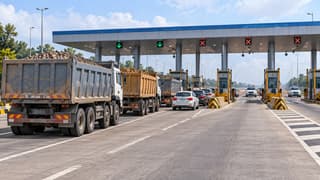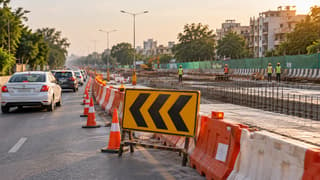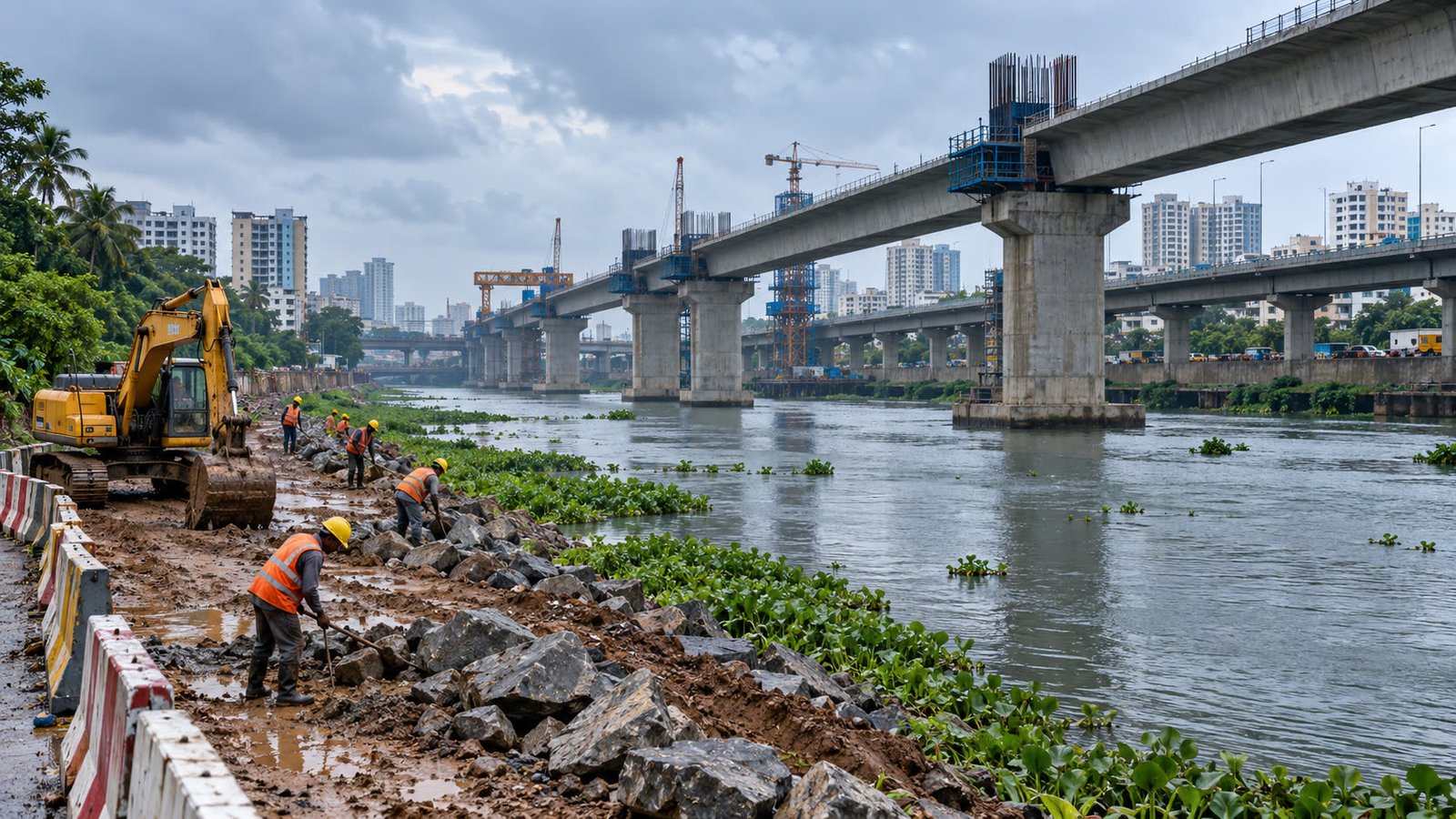
The Greater Chennai Corporation (GCC) has asked the National Highways Authority of India (NHAI) to remove remaining boulders, embankments and temporary access paths created along the Cooum River for the Chennai Port–Maduravoyal elevated corridor by 15 Oct 2026. The request is intended to keep the river channel clear before the northeast monsoon; for road users, it signals construction activity and possible local disruption, not a new toll or a citywide route closure.
Key takeaways
- GCC wants the remaining temporary construction obstructions along the Cooum removed by 15 Oct 2026.
- Reports from The Times of India and DT Next put removal progress at about 70% as of early October.
- The deadline covers river-side construction works, not completion of the elevated corridor itself.
- Drivers should watch for separate local traffic advisories before using approaches affected by construction or heavy rain.
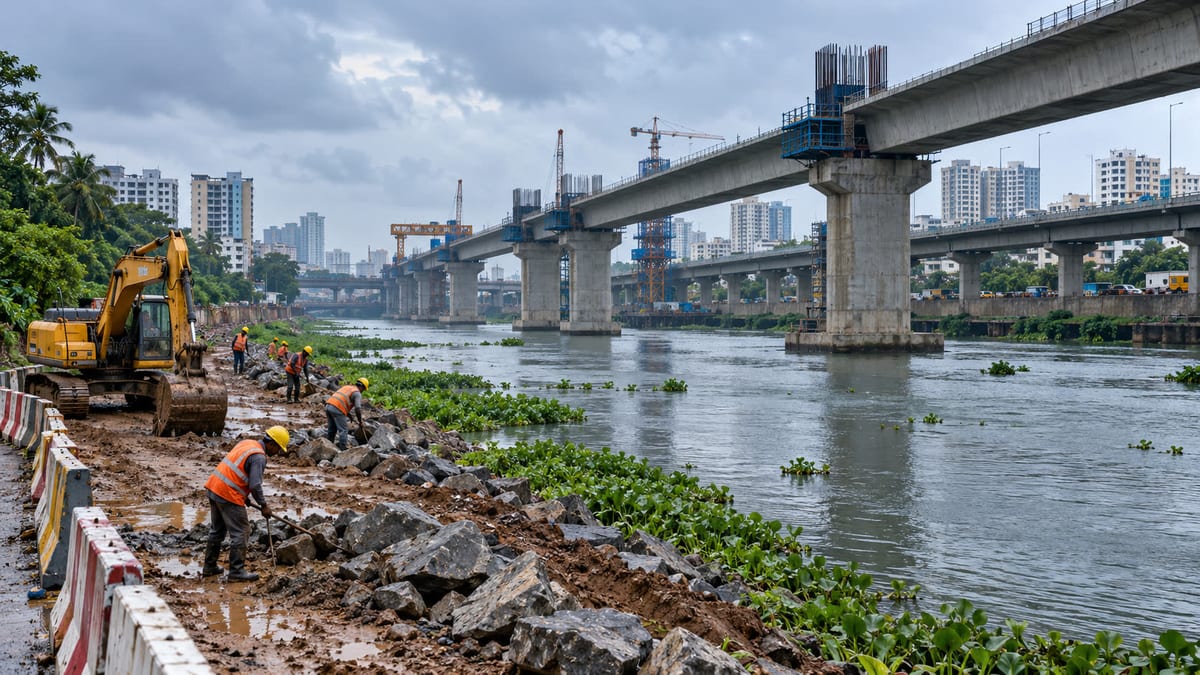 Illustrative editorial image of river-side elevated-road construction and clearance work; it is not a photograph of the Chennai Port–Maduravoyal project. Credit: FuelPrice illustration.
What GCC has asked NHAI to clear
The civic body has asked NHAI to remove boulders, embankments and temporary pathways built along parts of the Cooum for the elevated-corridor work. The Times of India reported that GCC also asked NHAI to temporarily halt work affecting the river while those structures are removed. Corporation Commissioner G S Sameeran said nearly 70% had already been cleared and that the balance was to be removed by the 15 October target.
DT Next separately reported that around 70% of the temporary access structures and boulders had been removed in coordination with NHAI, with complete removal targeted for mid-October. The two reports place the update in the city's preparations for the northeast monsoon. That attribution matters: the 15 October date is a civic clearance target, not a confirmed date for opening the elevated road or finishing the wider project.
NHAI's official bid document identifies the Chennai Port–Maduravoyal work as a double-tier elevated corridor in Chennai. The current update concerns temporary river-side construction arrangements around that project. The reports do not announce a new toll fee, FASTag rule or blanket closure for Chennai roads.
Why this matters for Chennai road users
A river-clearance update may look separate from daily driving, but it has a direct mobility angle. Temporary access tracks, stone embankments and other work-site material can affect how water moves during intense rain. Clearing them is meant to reduce the chance that construction-side obstructions worsen waterlogging or complicate access near the work zone. That is a preparedness measure, not a prediction that flooding will occur.
For commuters and commercial drivers, the important distinction is the timeline. The 15 October date applies to the removal of temporary works in and along the river; it is not an instruction to avoid the entire Chennai Port–Maduravoyal corridor. Conditions can change if rain, barricading or construction vehicles affect a particular approach. Before a longer journey, use the road-trip planner to review the route and likely stops.
If a diversion adds distance or idling time, estimate the trip's fuel requirement with the fuel-cost calculator rather than assuming that a local delay will have no cost. This is particularly useful for fleet operators making repeated deliveries through the corridor, where a small detour can be repeated across several runs.
What changes now—and what does not
- Construction work: NHAI is expected to continue removing the remaining temporary river-side structures in response to the GCC request.
- Monsoon preparation: GCC is coordinating with multiple agencies so the Cooum and nearby drainage systems are less constrained before seasonal rain.
- Toll payments: This update does not change FASTag operation or announce a new user fee. If a trip also includes a tolled highway, check the toll-charge calculator separately.
- Route access: Any lane closure, diversion or work-hour restriction would need a separate traffic notice. Drivers should not treat the clearance deadline itself as a blanket road closure.
What to watch before 15 October
The next useful confirmation will be whether GCC and NHAI report that the remaining river-side structures have been removed. A separate traffic advisory would also be important if equipment or barricades affect a road approach while clearance continues. During heavy rain, drivers should rely on current local instructions and avoid entering a visibly barricaded work area.
For people planning Chennai trips around the deadline, the practical approach is to keep the route flexible. Check traffic conditions close to departure, allow time for a possible work-zone delay and keep fuel or toll estimates separate from the construction update. This avoids turning a monsoon-preparedness notice into an assumption about a citywide closure or a toll increase.
Reader takeaway
The Cooum clearance is a targeted NHAI construction-management step requested by GCC before the northeast monsoon. It may affect local traffic around the elevated-corridor work, but there is no reported new toll rule in this update. The useful check for drivers is the latest route advisory on the day of travel, followed by a realistic estimate of any added fuel, time or toll cost.
Sources
- The Times of India, “GCC asks NHAI to clear Cooum obstructions by Oct 15”, 04 Oct 2026
- DT Next, “Chennai Corporation prepared to handle northeast monsoon, says Commissioner Sameeran”, 03 Oct 2026
- NHAI, “Request for Proposal: Construction of New Double Tier 4-lane Elevated Corridor from Chennai Port to Maduravoyal”, 15 Jul 2022