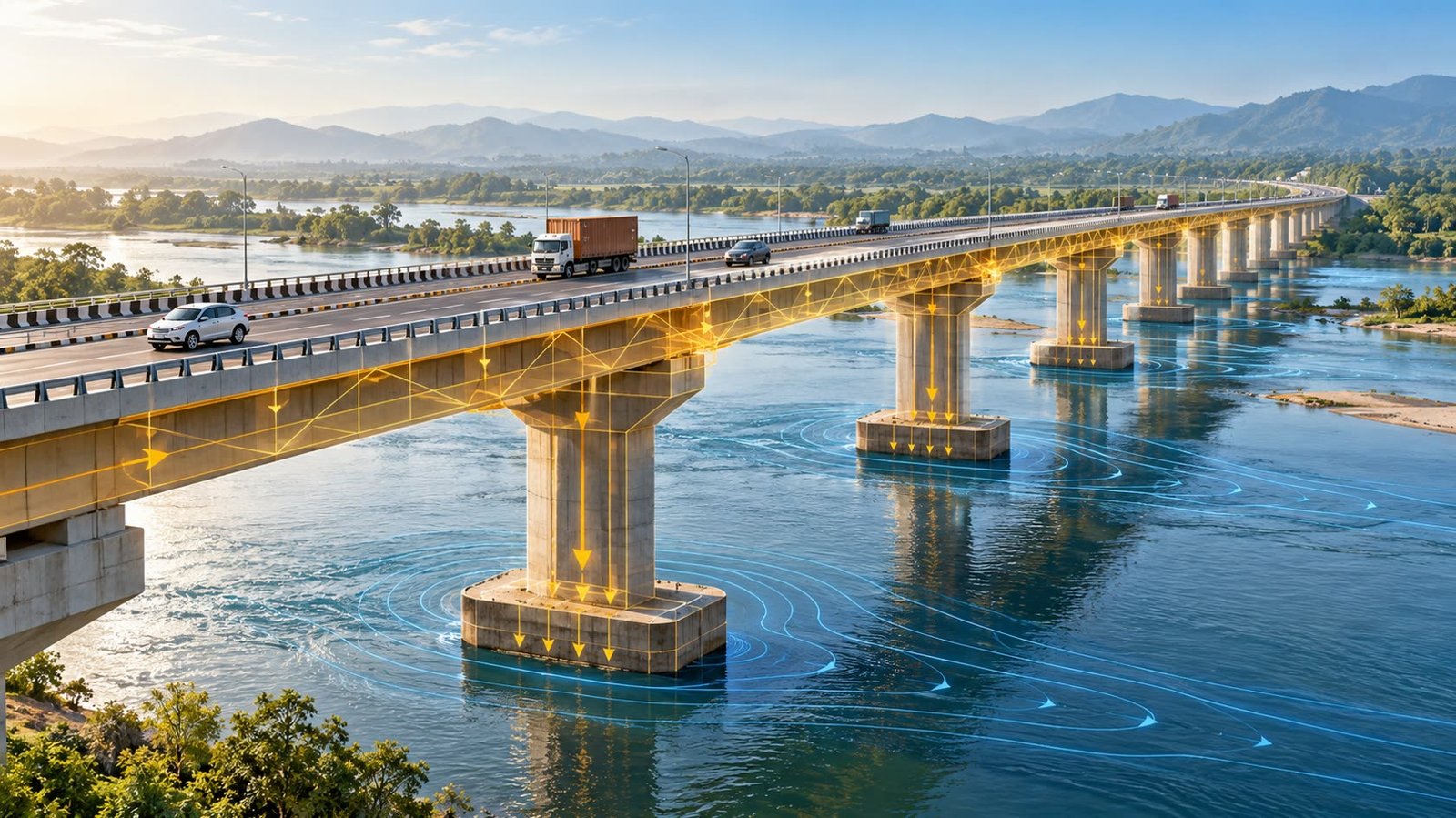
The National Highways Authority of India (NHAI) is set to make independent proof checking by empanelled IITs, government technical institutions and other specialist organisations part of the review process for critical structures on new NHAI projects from 1 Dec 2026, according to reports published on 12 Oct 2026. For drivers, this is an upstream road-safety change rather than an immediate toll or route-rule change: it adds an independent review of bridge designs, drawings and water studies before final approval.
The move matters because design decisions made before construction can affect how a bridge performs for decades. It also gives road users a clearer quality signal to watch as new national-highway corridors, river crossings and elevated structures are planned.
Key takeaways
- NHAI is reported to be institutionalising independent third-party proof checking for critical bridge and special-structure designs from 1 Dec 2026.
- The review will cover structural designs, drawings and hydrological or hydraulic studies, alongside compliance with Indian Roads Congress standards and contract requirements.
- The arrangement is reported to cover new NHAI projects across contract modes; projects already tendered but without submitted designs may also be included.
- This is not a new toll fee, FASTag charge or speed rule. Its direct benefit for drivers is expected only over time, through better-reviewed highway assets.
What NHAI is changing
The New Indian Express reported on 12 Oct 2026 that NHAI has prepared guidelines to empanel IITs, government technical institutions and other reputed organisations for proof checking. In this context, proof checking means an independent third-party verification of a critical structure's design, drawings and hydrological or hydraulic studies. The report said a memorandum of understanding will be executed with the selected technical institutions and that the new arrangement will apply irrespective of the contract mode.
This is a move towards a common institutional process. Existing contracts already provide for proof checking for some specified structures, but the scope, appointment method and level of institutional involvement can differ. NHAI's reported change is intended to make that review more uniform across projects.
The Ministry of Road Transport and Highways had announced the underlying initiative in its 30 June 2026 release. It said NHAI would empanel IITs and other reputed technical institutions to independently check major bridge designs and hydraulic studies on new national-highway projects.
What the independent review will cover
The official June release said the framework would examine structural design calculations, engineering drawings, construction methods, geotechnical investigations and hydraulic studies. The current reports add that the system is aimed at critical or special structures, rather than treating every routine highway element as a separate academic exercise.
That distinction is important for a road user. A bridge is not only a concrete deck. Its safety and serviceability depend on the interaction between the structure, its foundations, soil conditions, river behaviour, drainage and the construction method. Independent review of those inputs can identify design questions before work reaches a stage where changes are slower and more expensive.
The primary release also said major bridges are designed for a service life of 100 years or more. That is the reason NHAI has described long-term technical review as a quality-assurance measure, not simply as another construction approval checkpoint.
When the rule takes effect and who is covered
The New Indian Express and Jagran both reported that the arrangement is to come into force on 1 Dec 2026. Jagran's 12 Oct report said it will apply to new projects across EPC, BOT and hybrid-annuity modes. It also said projects for which tenders have already been issued but designs and drawings have not yet been submitted may be brought within the arrangement.
Jagran further reported that contractors will provide three options from the empanelled institutions, after which NHAI's regional office may select one or, where required, two proof-checking institutions. These operational details describe the reported workflow; the final list of empanelled institutions and the published guidelines will matter for how the process works in practice.
The reports do not say that existing bridges will suddenly be re-certified under this arrangement. The focus is on new project design and on projects still at a stage where the design documents have not been submitted. Readers should therefore distinguish between a future construction-quality process and an immediate inspection programme for bridges already in service.
What it means for drivers, riders and fleets
There is no immediate change to a driver's toll bill, FASTag balance or route permission. The measure is not a fee notification and does not alter today's toll schedule. If you are budgeting a journey, you can still use the toll-charge calculator for the route and the fuel-cost calculator for the vehicle's running cost.
The benefit is longer term. Better review of bridge design and water behaviour can reduce the risk of avoidable defects, premature restrictions, repeated repair work and disruption on important corridors. That does not mean the new process guarantees that every project will be delivered on time or that maintenance problems disappear. Construction quality, supervision, weather, traffic loading and later upkeep will still matter.
For freight operators, a reliable bridge is also a planning asset. A closure or weight restriction can add distance, fuel use, toll exposure and delivery time even when the alternative route is technically open. When a new corridor changes those variables, the road-trip planner can help compare the route and time implications; the independent review itself is not a promise of a specific travel-time saving.
What to watch before 1 Dec 2026
The next useful checkpoints are the final NHAI guidelines, the list of empanelled institutions and the way regional offices apply the selection process. It will also be worth watching whether NHAI publishes the categories of critical structures covered, the agreed timelines for proof checking and the responsibility for incorporating review comments before final approval.
Those details will tell road users more than the headline alone. A strong process should make the review independent, document-based and traceable, while keeping responsibility clear between the contractor or concessionaire, the authority or independent engineer and the specialist institution.
Reader takeaway
NHAI's reported 1 Dec 2026 start date is significant because it moves independent technical scrutiny closer to the front of highway-project delivery. It does not change what a driver pays at a toll plaza today, but it could improve the quality checks behind the bridges and other critical structures that drivers will use in the years ahead.
Sources
- The New Indian Express: NHAI to empanel IITs, technical institutions for proof checking of critical highway structures — 12 October 2026.
- Dainik Jagran: NHAI's highway-project proof-checking arrangement to apply from 1 December — 12 October 2026.
- Ministry of Road Transport and Highways, PIB: NHAI to Empanel IITs and Reputed Technical Institutions for Independent Proof Checking of Major Bridge Designs — 30 June 2026.