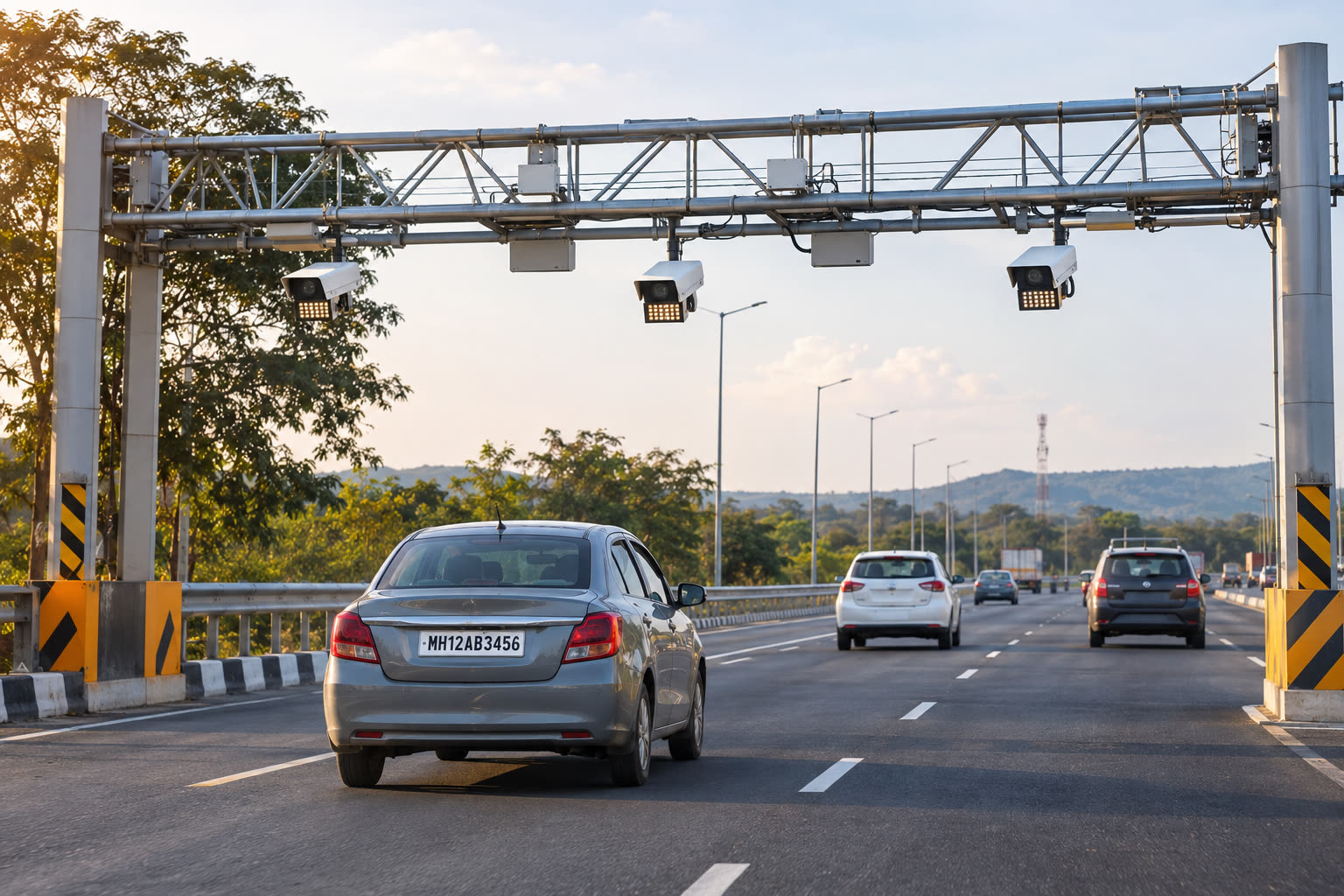
India is moving towards tougher enforcement at barrier-free FASTag toll plazas, but the higher charge being reported for vehicles with hidden or altered number plates is still only a proposal. NHAI has asked police and transport officials to intercept “unidentified” vehicles around MLFF plazas, so drivers need to keep both the registration plate and linked FASTag readable and correctly matched.
Key takeaways
- NHAI has sought local enforcement against vehicles whose plates or FASTags are hidden, altered, cloned or not readable at barrier-free toll plazas.
- The Times of India reported on 22 Nov 2026 that the road transport ministry is preparing a proposal for higher toll recovery in such cases. No final charge or effective date has been announced.
- Under the current MLFF process, the vehicle’s registration number and FASTag need to match for automated toll deduction.
- A clean, visible plate and an active FASTag with enough balance are the simplest checks before using a barrier-free toll corridor.
What NHAI is asking at barrier-free plazas
Multi-Lane Free Flow, or MLFF, removes the need for a vehicle to stop at a conventional boom barrier. Cameras and other electronic systems read the vehicle and its FASTag as it passes, allowing the toll to be collected without a manual booth. The government has described barrier-free electronic toll collection using Automatic Number Plate Recognition cameras as an additional facility on selected National Highway stretches.
The system depends on two things lining up: the FASTag account and the vehicle registration number captured by the cameras. The Indian Express reported on 21 Nov 2026 that NHAI had asked the Jaipur district administration, police and transport officials to run an enforcement drive near the Manoharpura Fee Plaza. The report said the action is aimed at vehicles with hidden, covered, taped, altered or cloned registration plates or FASTags, which authorities classify as “unidentified” vehicles.
A vehicle may pass through without stopping, but it still has to be traceable to the correct registration record and FASTag account.
FuelPrice’s earlier explainer on NHAI’s barrierless tolling and FASTag e-notices covers the basic payment flow. The latest development is the move towards physical enforcement when the automated system cannot reliably identify a vehicle.
The higher toll charge is proposed, not live
The Times of India reported on 22 Nov 2026 that the road transport ministry is preparing a proposal to change the National Highways Fee Rules. The reported plan would allow highway authorities such as NHAI to recover a higher toll charge when a vehicle is identified as using a manipulated or concealed registration number to evade payment. State transport departments would handle the separate registration-plate violation under the existing motor-vehicle framework.
The same report said photographs and details captured at toll plazas, supported by artificial intelligence, are expected to help identify vehicles with unreadable or altered plates. That is a reported plan, not a notification. Until the ministry issues a final rule, motorists should not treat any proposed higher multiplier as a charge that has already started.
The distinction is important for drivers. Current e-notice rules for a failed or unpaid toll transaction are separate from the proposed action against deliberate concealment or alteration. The proposal is aimed at conduct that prevents the system from identifying a vehicle; it is not an announcement that every failed FASTag read will automatically attract a new higher toll.
Why the move matters to ordinary drivers
For most private vehicle owners, the immediate risk is an avoidable mismatch rather than the proposed rule itself. A number plate covered by a frame, tape, mud or a bent panel can be difficult for a camera to read. A FASTag that belongs to another vehicle, is not properly placed or has insufficient balance can create a separate payment problem. In both situations, a trip may need follow-up after the vehicle has already crossed the plaza.
The Indian Express reported on 21 Nov 2026 that an e-notice is issued when an MLFF system cannot complete payment because the FASTag balance is insufficient. It described a 72-hour window for the user to pay. Business Standard’s 20 Jun 2026 explainer said the applicable charge can become twice the regular fee after that window, and that non-payment can also affect the FASTag or related vehicle services. These are the current e-notice mechanics; they should not be confused with the proposed higher recovery for tampered plates.
There is also a wider enforcement reason. NHAI told The Indian Express that hidden or cloned plates can create revenue leakage and wrongful notices for legitimate vehicle owners. A vehicle that cannot be identified can also be harder to trace when it is involved in a road-safety or law-enforcement issue. Better plate visibility therefore affects payment accuracy as well as toll collection.
For a family car, the impact may be one disputed transaction or an unexpected follow-up charge. For a taxi, bus or delivery fleet, repeated mismatches can consume more administrative time across many trips. Before a long journey, drivers can estimate the route’s toll exposure with the toll-charge calculator and plan the stop sequence with the road-trip planner.
What to check before a highway trip
- Keep the plate fully visible. Do not cover digits, bend the plate, add tape or use accessories that obstruct the registration number. Clean the plate if road grime makes the characters difficult to read.
- Check the FASTag match. Confirm that the active tag is linked to the vehicle you are driving and is mounted where the reader can detect it. Do not rely on an old tag left active after a vehicle transfer or replacement.
- Maintain enough balance. A barrier-free toll lane does not provide a cash stop if the tag fails. Check the balance and recent transactions before departure, especially when the vehicle is used by more than one driver.
- Review notices after the trip. If an e-notice appears, compare the vehicle number, travel time and plaza details with the journey record. Follow the official payment or grievance instructions in the notice and keep the receipt or acknowledgement.
- Budget the whole trip. Fuel and tolls are separate costs. Use the fuel-cost calculator alongside the toll estimate so a proposed rule change is not mistaken for a current toll rate.
What changes now—and what to watch
For now, the confirmed change is enforcement activity around barrier-free plazas, not a new nationwide toll rate. NHAI is asking local authorities to help intercept vehicles that cannot be identified, while the ministry’s reported rule change is still being prepared. Drivers should continue following the existing FASTag and registration-plate requirements.
The next meaningful update will be an official notification or rule amendment. It should state the exact trigger for a higher recovery, the authority that can collect it, the effective date, the process for correcting a mistaken identification and how the charge interacts with an e-notice or a traffic challan. Until those details are published, any headline quoting a future multiplier should be read as a proposal or reported plan.
Owners who keep their plates readable and their FASTags correctly linked are less exposed to both payment disputes and enforcement action. The practical takeaway is simple: the move to free-flow tolling removes the queue, not the need for an identifiable vehicle.
Questions drivers may have
Has the higher charge for hidden number plates started?
No. The reported higher-charge mechanism is being prepared as a proposal. The current reports do not announce a final notification or effective date.
What is the safest way to avoid an incorrect toll notice?
Keep the registration plate unobstructed, use the FASTag linked to that vehicle, maintain sufficient balance and check the transaction or e-notice after the trip. If the details do not match the journey, use the official dispute or grievance route shown in the notice.
Sources
- The Times of India — “Govt plans heavy penalty for number plate tampering to evade toll, fines of up to 8 times the fee” — 22 Nov 2026
- The Indian Express — “ ‘Unidentified’ vehicle menace: NHAI wants police to man barrier-less toll booths” — 21 Nov 2026
- Press Information Bureau — “Ministry of Road Transport & Highways Year End Review 2025” — 30 Dec 2025
- Business Standard — “NHAI launches Rajasthan’s first multi-lane free flow tolling system” — 20 Jun 2026
- The Indian Express — “Missed paying fee at a toll plaza? Here’s what you will be charged under new NHAI guidelines” — 30 Mar 2026