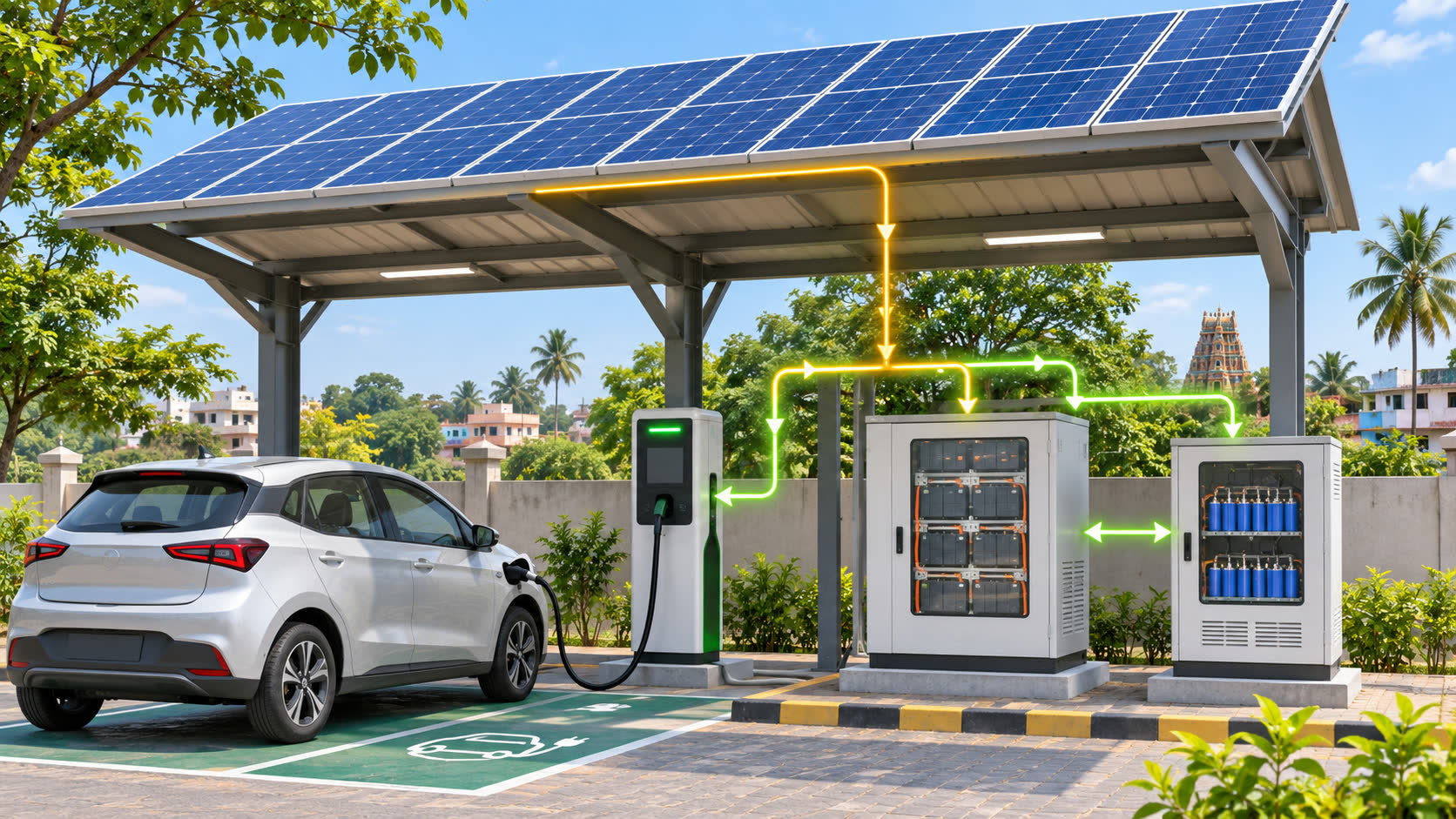
NIT Rourkela researchers have secured a patent for a solar-powered EV-charging microgrid that combines solar panels, grid electricity, batteries and supercapacitors. For Indian EV owners and fleet operators, the significance is not a new charger available today but a possible way to make future charging sites more stable when several vehicles plug in or solar output changes.
Key takeaways
- The patented design combines solar generation, the conventional grid, batteries and supercapacitors.
- An improved mixed droop control method is intended to share power between the two storage technologies as demand changes.
- The system can regulate voltage, adjust charging power and manage two-way grid-to-vehicle and vehicle-to-grid flows.
- A prototype has been tested under simulated changes in solar generation and electricity demand; real-time field trials are still planned.
- The development does not yet announce a public charger rollout, a charging-price change or a guaranteed saving for EV users.
What NIT Rourkela has patented
According to officials quoted in reports by PTI and OMMCOM on 16 Nov 2026, the National Institute of Technology Rourkela team has secured a patent for a smart power-management system for EV charging stations. The reports identify the research team as Professor Pravat Kumar Ray, Associate Professor Arnab Ghosh and research graduate Dr Anindya Bharatee. The patent application number is 202531101758, filed on 22 Oct 2025, according to the reports.
The official NIT Rourkela faculty profile for Ray lists his work in power systems, hybrid AC/DC microgrids and renewable integration, as well as an ongoing project for a solar-powered EV charging station on the campus. That background helps explain the direction of the work, but the new patent should be read as research-stage infrastructure rather than as evidence that the design is already installed at public sites.
How the battery and supercapacitor system works
Charging demand is not constant. A station can see a sharp rise when several vehicles start charging together, while a solar-powered site can see generation change with cloud cover, the season and the time of day. A battery can store energy for longer periods, but repeated high-rate charging and discharging can put additional stress on battery cells.
The NIT Rourkela design pairs a battery with a supercapacitor. In the arrangement described by the researchers, batteries handle slower and sustained demand. Supercapacitors can absorb and release energy much faster, so they are assigned the quick fluctuations. The aim is to reduce the current swings seen by the battery while keeping the charging microgrid stable.
The control layer is an improved mixed droop technique. In plain terms, it is a rule for automatically sharing power between sources as the operating conditions change. The reported system also manages electrical voltage, adjusts the amount of power sent to an EV based on its battery charge level and controls reverse electricity flow from a vehicle back to the grid.
Why this matters to Indian EV users and fleets
For a private EV owner, the immediate benefit is not a shorter charging time that can be claimed today. The potential benefit is more dependable charging infrastructure as public, workplace and fleet sites serve more vehicles. A station that handles demand spikes and variable solar output more smoothly may be easier to operate, but that conclusion still needs to be demonstrated in real-world trials.
That distinction matters for drivers planning longer trips. EV owners can use the EV station directory to check currently listed charging points and the road-trip planner to review a route before setting out. Those tools describe available infrastructure today; they are separate from the NIT Rourkela prototype and do not imply that this patented system is deployed at any listed station.
Fleet operators face a different issue: many vehicles may return to a depot and connect within a narrow time window. Smart load sharing could eventually help a depot balance charging demand against on-site solar or grid limits. Any commercial value, however, will depend on equipment costs, battery-management performance, grid-interconnection requirements and measured results at higher power.
Prototype stage: what is confirmed and what is not
The researchers have built a prototype and tested it by changing simulated solar generation and electricity demand, according to the 16 Nov 2026 reports. The next steps described by the team include scaling it to a higher-power EV charging system, adding advanced battery-management and energy-optimisation algorithms, exploring grid-forming control, integrating multiple EVs and conducting real-time field trials.
Those next steps are important because a simulation cannot answer every question raised by an operating public charger. Field testing will show how the controls behave under weather changes, repeated charging cycles, simultaneous vehicles and two-way electricity flows. It will also clarify whether the proposed battery-stress reduction translates into a measurable operating-life or maintenance benefit.
What to watch next
The useful milestones are a documented field trial, results from multiple-vehicle charging and evidence of operation at higher power. Until those results are published, there is no verified basis for promising EV owners faster charging, lower tariffs or longer battery life from this technology.
Reader takeaway: NIT Rourkela has reported a credible research development aimed at making solar-assisted EV charging more resilient. For drivers, it is a sign of work on the charging system behind the plug, not a change to the charger network or EV costs today.
Sources
- The Week / PTI — NIT Rourkela patents smart power management system for EV charging stations (16 Nov 2026)
- Dainik Jagran — NIT Rourkela smart EV charging microgrid patent report (16 Nov 2026)
- Ommcom News — NIT Rourkela researchers secure patent for solar-powered EV charging technology (16 Nov 2026)
- National Institute of Technology Rourkela — Pravat Kumar Ray, Electrical Engineering faculty profile (accessed 16 Nov 2026)