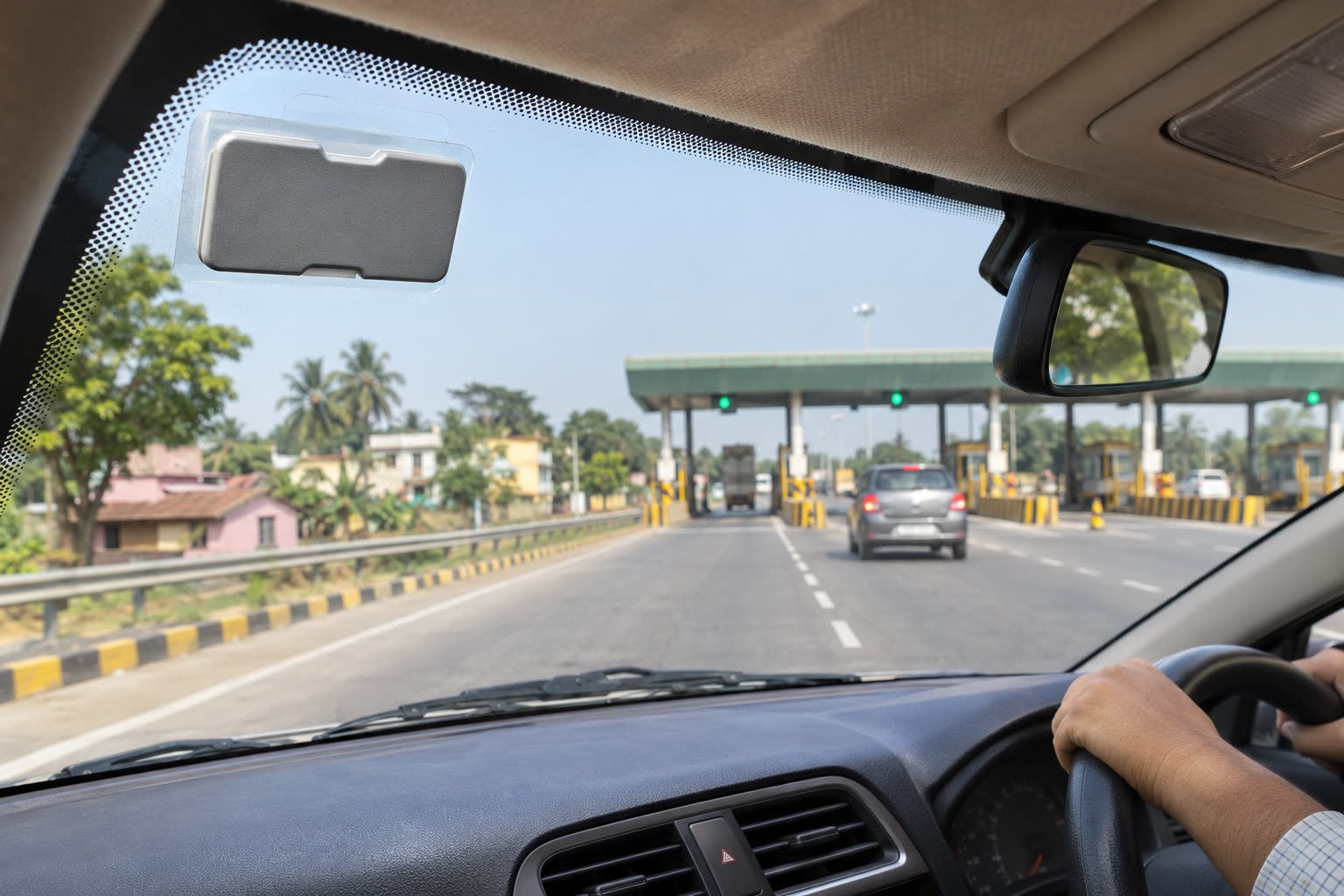
Eligible non-commercial vehicle owners who live within 20 km of a National Highway fee plaza can now choose a new Concessional Local Pass priced at ₹1,500 or ₹3,000 a year, depending on where the plaza is located. The rule took effect on 1 Nov 2026 and matters most to people who cross the same toll plaza regularly for work, education or other local needs.
Key takeaways
- The pass is for non-commercial vehicles with a valid, functional FASTag registered for non-commercial use.
- It costs ₹1,500 a year when the fee plaza is outside municipal or local town limits, and ₹3,000 a year when it is within those limits.
- Eligibility is based on the vehicle owner's residence being within 20 km of the selected plaza.
- The pass is valid only at that specific plaza and is not a nationwide FASTag pass.
- It is not available on closed-user-fee roads or where a service road or alternative road is available.
What changed from 1 Nov 2026
The Ministry of Road Transport and Highways notified the change through the National Highways Fee (Determination of Rates and Collection) (Fifth Amendment) Rules, 2026. The ministry's 27 Oct PIB release says the annual local option is available at eligible toll plazas from 1 Nov 2026. The Economic Times and NDTV separately reported the same effective date, fee structure and 20-km condition.
This is an additional local option alongside the existing monthly pass. It is different from a national FASTag annual pass: the new facility is tied to the fee plaza near the owner's residence, so it does not automatically cover other plazas on the same highway or a later trip on another route.
| Rule | What the notification means |
|---|---|
| Residence | Within 20 km of the selected National Highway fee plaza |
| Vehicle | Non-commercial vehicle with a valid, functional FASTag |
| Annual fee | ₹1,500 outside municipal or local town limits; ₹3,000 within those limits |
| Coverage | Only the specific fee plaza for which the pass is issued |
| Effective date | 1 Nov 2026 |
Who can use the local pass
The main test is not whether a driver uses the highway often; it is whether the vehicle is eligible and the registered residence falls within the prescribed 20-km distance. A valid and working FASTag is also required, and it must be registered for non-commercial use. Drivers should therefore check that the tag is linked to the correct vehicle before asking the plaza about the pass.
The price depends on the location of the fee plaza, not on a general claim that every nearby resident will pay the lower amount. A plaza outside municipal or local town limits carries the ₹1,500 annual rate. A plaza within those limits carries the ₹3,000 rate. The rule also says the Central Government may revise the rates each year, so the amount should be checked again if a pass is renewed after a future revision.
Where the pass will not work
The concession has important limits. It is not issued for a National Highway or expressway where the fee is collected through a closed user-fee collection system. It is also excluded where a service road or alternative road is available for the driver, owner or person in charge of the vehicle.
The pass is plaza-specific and cannot be treated as permission to travel toll-free across a corridor. A resident who crosses two different plazas may need to assess each plaza separately, subject to each location's eligibility and availability. That is why the regular toll-charge calculator remains useful for trips that go beyond the one local plaza covered by the pass.
How to judge whether it fits your commute
The useful comparison is between the annual local fee and the cost of the monthly local option or repeated toll payments at the same plaza. Start with the plaza's current board or official helpdesk information, then compare the number of crossings you expect with the fixed annual amount. An occasional user may not recover the fee, while a frequent local commuter may value the fixed cost more quickly; the rule itself does not promise a saving for every driver.
Do not confuse the annual local pass with a general FASTag balance or recharge facility. Before travelling, owners can review the FASTag balance, recharge and wrong-deduction guide and confirm that the tag is active. For a longer journey that includes several plazas, use the road-trip planner to compare the route, toll and fuel implications rather than assuming the local pass applies throughout.
What drivers should check now
- Confirm that the vehicle is registered as non-commercial and that its FASTag is valid and functional.
- Verify the registered residence distance from the exact fee plaza, not simply from the nearest town or highway.
- Check whether the plaza is inside or outside municipal or local town limits, because that determines the annual fee.
- Ask the eligible plaza or official NHAI channels about the current application process and documents before making a payment.
- Check whether a service road, alternative road or closed-user-fee system makes the plaza ineligible.
- Keep the pass linked to the same vehicle and plaza for which it was issued; it is not a corridor-wide travel pass.
What to watch next
The policy is now in force. The latest 5 Nov regional report from Himachal Pradesh also described the facility for residents near its toll plazas, underlining that the benefit is meant to be used locally rather than as a replacement for the nationwide FASTag pass. Drivers should rely on the selected plaza's current instructions and the ministry or NHAI channels for the final process.
For local residents who repeatedly cross one National Highway fee plaza, the change creates a new annual-cost option. For everyone else, normal toll calculations still apply. The clearest reader takeaway is to compare the pass only with the toll exposure at the one eligible plaza and to check the exclusions before treating it as a saving.
Sources
- PIB: Government of India Introduces Concessional Local Pass for National Highway Users Living Near Fee Plazas — 27 Oct 2026.
- The Economic Times: Road ministry introduces concessional local pass for FASTag user living near toll plazas — 27 Oct 2026.
- NDTV Auto: FASTag Annual Local Pass Gets Government Approval: Check Eligibility, Price, And More — 28 Oct 2026.
- The New Himachal: NHAI Introduces Special Toll Passes for Local Residents Living Within 20-km Radius of Toll Plazas — 5 Nov 2026.