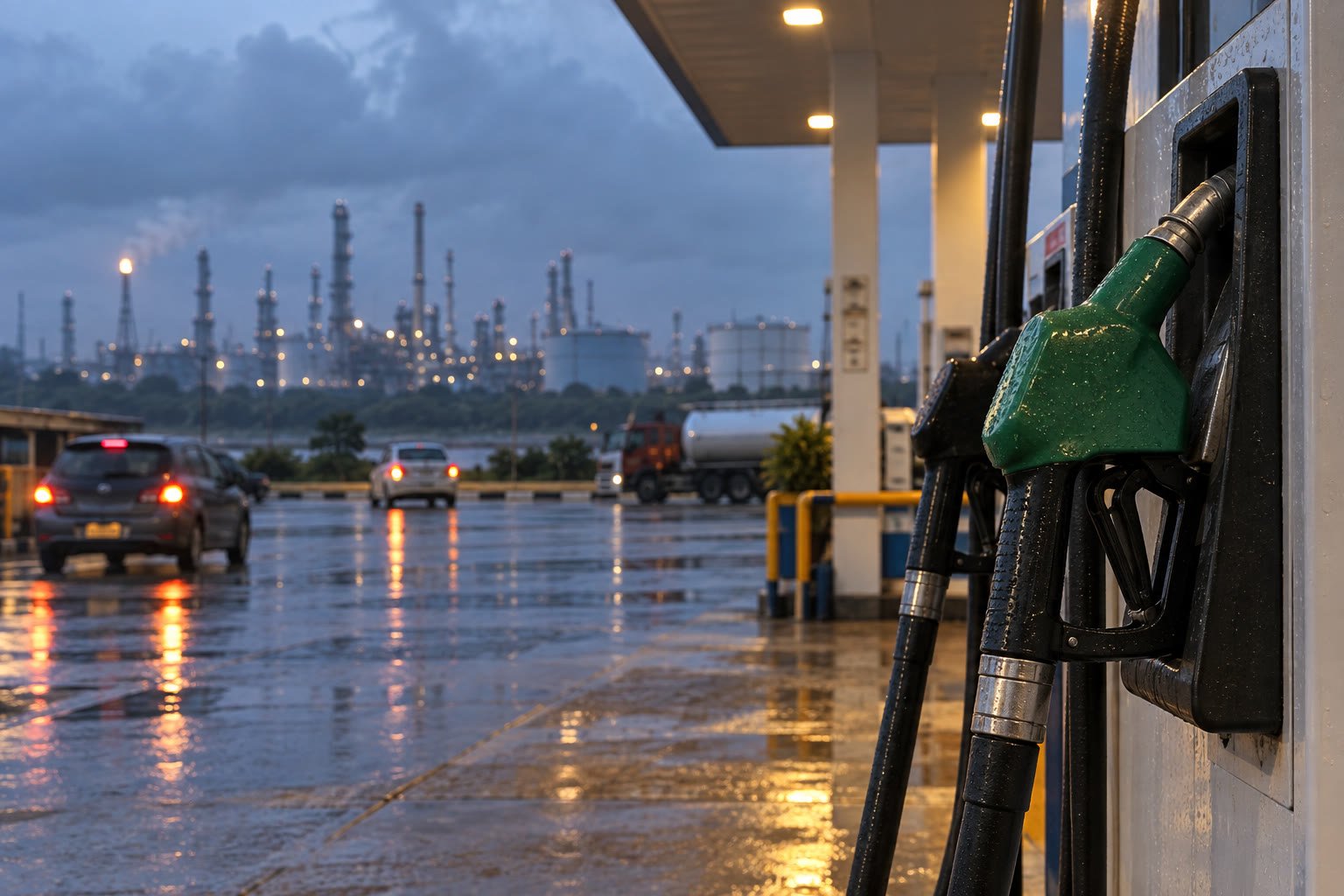
India’s state-run oil marketing companies are estimated to be losing about ₹530 crore a day because crude costs have risen while domestic petrol, diesel and LPG prices have not moved in step, ICRA said in a report dated 23 Sep 2026. For motorists, this does not mean an immediate pump-price hike: it means the cost pressure has shifted to OMC margins and could raise the risk of future retail revisions if crude stays elevated.
Key takeaways
- ICRA estimates negative marketing margins of about ₹8 per litre on petrol and ₹9 per litre on diesel for the state-run OMCs.
- The Indian crude basket reached $117.4 per barrel on 21 Sep 2026, against an average of about $66 per barrel in 2025–26.
- Domestic LPG under-recovery was estimated at about ₹300 per cylinder in September 2026, with a cumulative negative buffer of ₹61,940 crore as of 30 Jun 2026.
- The report is a cost-pressure assessment, not an official announcement that pump prices will rise.
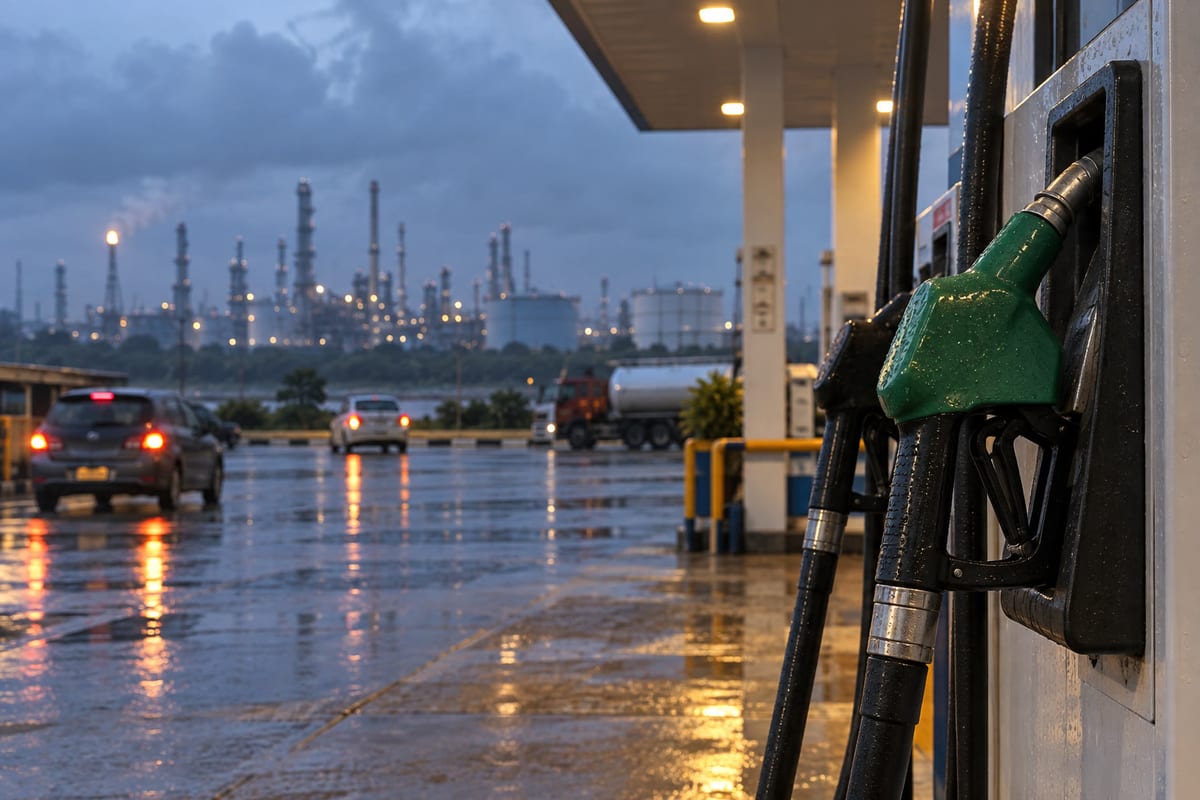 Editorial illustration of the fuel supply chain from refinery to pump; FuelPrice (AI-generated).
What ICRA’s report says
ICRA’s 23 Sep 2026 thematic report says the escalation of the West Asian conflict and disruption risks on key supply routes have pushed crude prices higher. Its assessment covers Indian Oil Corporation, Bharat Petroleum Corporation and Hindustan Petroleum Corporation, the three state-run fuel retailers whose marketing margins are under pressure while domestic pump rates remain unchanged.
According to ICRA’s estimate reported by The Economic Times and Moneycontrol, the combined daily loss at the current price relationship is about ₹530 crore. The estimate is based on marketing margins, so it should not be read as a reported net loss in the companies’ financial statements. It describes the gap between the cost environment and the prices at which fuel is being marketed.
Why the margin has turned negative
Retail fuel rates do not automatically change every time an international crude benchmark moves. OMCs buy, refine, transport and market fuel through a chain in which costs, product prices, taxes, inventory and policy decisions all matter. When crude and product costs rise faster than the retail price, the marketing margin can turn negative even though the customer sees no change at the pump.
ICRA said the Indian crude basket rose to $117.4 per barrel on 21 Sep 2026, from an average of around $66 per barrel in 2025–26. The Economic Times also reported that Brent had cooled to around $99 per barrel on 23 Sep, showing why a single day’s movement should not be treated as a settled trend. The relevant question for OMCs is whether the higher-cost period lasts long enough to affect cash flow and working capital.
Refining margins have offered some support. ICRA said Singapore gross refining margins stayed above $10 per barrel after the crisis began, helped by refinery outages, inventory drawdowns and tighter product supply. That support does not automatically erase losses in the marketing business, particularly when the retail price is held below the cost pressure being measured.
What this means for drivers and fleet operators
The first point for private motorists is that the ICRA report does not change the price displayed at a fuel station. Fuel prices were reported as unchanged on 23 Sep 2026, so a driver’s immediate bill still depends on the local rate and the litres purchased. The new information is about what may sit behind that stability: OMCs are carrying a larger gap between input costs and retail realisation.
For a monthly commute or a long-distance run, the practical way to track exposure is to record litres used and the local pump rate rather than react to a headline about crude alone. The fuel cost calculator can help estimate a trip from those two inputs. A change in the per-litre rate would flow directly into the cost of every litre bought, while the impact on a household or fleet depends on its actual consumption.
Fleet operators should also watch the diesel side separately from petrol. ICRA’s estimate puts the negative diesel marketing margin at about ₹9 per litre, but that is an industry estimate and not a guaranteed change in the rate charged to any particular vehicle. Route length, payload, idling, mileage and the state-level tax structure still determine the operator’s actual fuel bill. Current city-wise rates are available through FuelPrice’s live fuel prices page.
Is a petrol or diesel price hike confirmed?
No. ICRA is a rating and research agency, not the authority that announces India’s retail petrol and diesel prices. Its conclusion is conditional: if crude remains high and retail rates are not revised, OMC profitability and cash flow could face greater pressure. That is an assessment of risk, not a notification of a price increase.
This is a materially different development from FuelPrice’s earlier report that recorded petrol and diesel prices unchanged on 23 Sep as Brent moved below $100. That earlier FuelPrice price update remains the reference for the pump-rate position; the ICRA report adds the estimated margin and cash-flow impact for the companies supplying that market.
LPG adds another pressure point
ICRA separately estimated domestic LPG under-recovery at about ₹300 per cylinder in September 2026, after an estimated ₹500 per cylinder in the first quarter of 2026–27. It also put the cumulative negative LPG buffer at ₹61,940 crore as of 30 Jun 2026. This matters because the OMC picture is not limited to petrol and diesel: a weak LPG realisation can reduce the benefit of stronger refining or fuel-marketing performance elsewhere.
The report said the outcome for OMC earnings in 2026–27 will depend on crude prices, product cracks, retail price revisions and government support for LPG under-recoveries. Those are the variables to watch, rather than assuming that today’s unchanged rate guarantees either a hike or a cut tomorrow.
What to watch next
- Whether the Indian crude basket and Brent remain elevated over several trading sessions.
- Whether OMCs revise retail petrol and diesel rates or continue absorbing the pressure.
- Whether the government announces support or policy changes for LPG under-recoveries.
- Whether fuel-rate changes begin to show up in freight, delivery and public-transport cost calculations.
For trip planning, readers can pair the latest pump rate with the road-trip planner to review distance, fuel use and route timing before a journey. The immediate message from ICRA’s report is measured: pump prices are unchanged as of 23 Sep, but the cost pressure behind them has become large enough to watch closely.
This article is for general information only and is not financial, insurance or legal advice.