The Organization of the Petroleum Exporting Countries (OPEC) has lowered its forecast for India's 2026 oil-demand growth to 40,000 barrels per day (b/d), from 60,000 b/d in its September assessment. The revision does not announce a petrol or diesel price change, but it keeps road mobility, manufacturing and farm activity at the centre of India's fuel outlook.
Key takeaways
- OPEC's October 2026 Monthly Oil Market Report puts India's oil-demand growth at 40,000 b/d, down from 60,000 b/d in the previous month's view.
- India's total oil demand is expected to rise by around 40,000 b/d to 5.7 million b/d in 2026, according to the report.
- OPEC links gasoline demand with road mobility and vehicle sales, while diesel demand is tied more closely to manufacturing and agriculture.
- The forecast is not a pump-price order. Petrol and diesel prices in India remain market-determined, so drivers should track actual city prices separately.
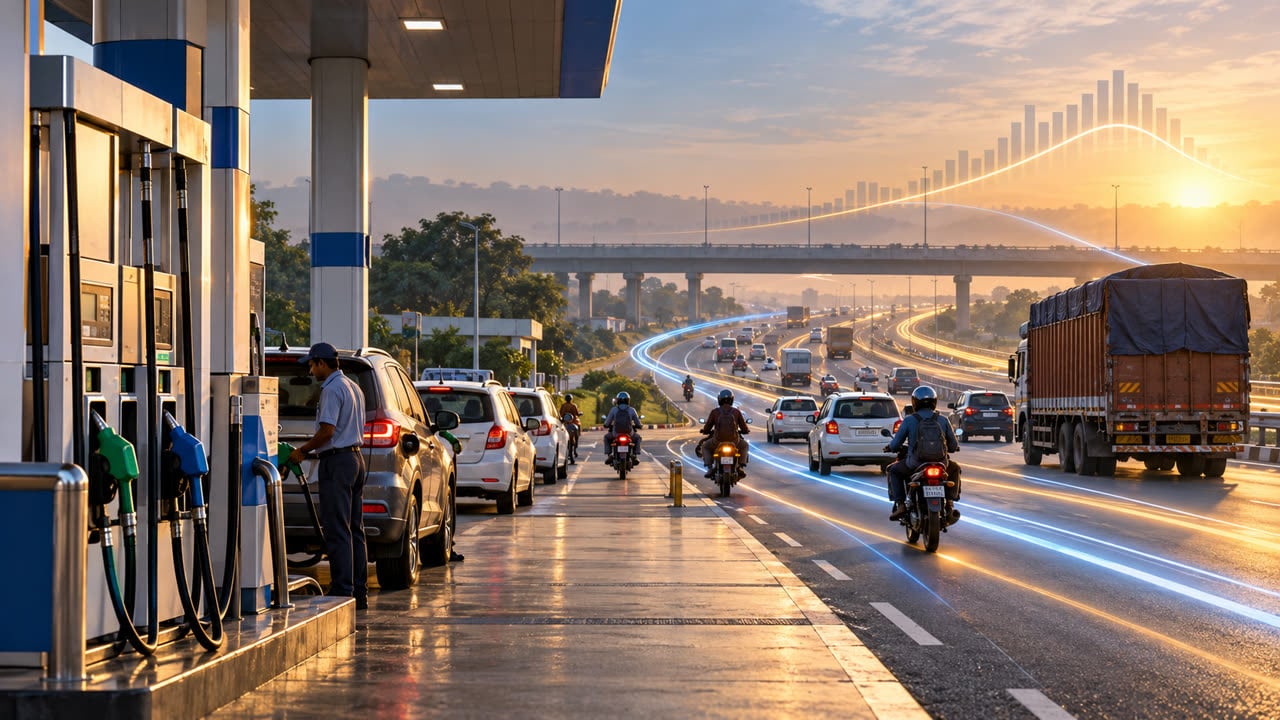
Illustration: an Indian fuel station and road traffic represent road-based fuel demand; this is a representative editorial visual, not an official OPEC photograph.
What OPEC changed in its India outlook
OPEC's October report, released on 13 October 2026, revised the pace at which it expects Indian oil consumption to expand in 2026. The new estimate is 40,000 b/d, compared with 60,000 b/d in the September assessment. In practical terms, the revision is a slower growth outlook, not a claim that India's fuel use will fall.
The same report expects India's overall oil demand to increase by around 40,000 b/d to 5.7 million b/d in 2026. OPEC's assessment identifies gasoline and diesel as the main demand drivers. It says gasoline use is supported by road mobility and robust vehicle sales, while diesel demand is linked to manufacturing and agriculture. Demand for liquefied petroleum gas and naphtha is expected to ease, according to the India-specific reporting on the report.
That distinction matters. A demand forecast is an outlook prepared from economic and sector signals; it is not a new tax, a fuel-allocation rule or a direction to Indian oil companies to change prices. The figure can also be revised as new consumption, economic and market data arrives.
Why this matters to Indian drivers
For private motorists and two-wheeler users, the immediate takeaway is that OPEC's revision does not itself change the price shown at a petrol pump. India's Ministry of Petroleum and Natural Gas says petrol prices have been market-determined since 26 June 2010 and diesel prices since 19 October 2014, with oil marketing companies taking pricing decisions. The framework is explained on the ministry's product-pricing page.
Fuel demand can still affect the wider environment in which prices move. Road traffic, vehicle sales, factory output, agricultural activity, crude-oil prices, refining conditions, freight costs, taxes and the rupee can all matter at different times. OPEC's lower growth estimate therefore gives readers context, but it cannot be converted into a rupees-per-litre prediction without a separate, current price assessment.
For the number that affects a household budget today, check the relevant city and fuel on FuelPrice's live fuel prices hub. When planning a specific journey, use the fuel cost calculator with the vehicle's realistic mileage and the current pump rate. That keeps the calculation tied to the trip rather than to a global forecast.
What fleet operators and businesses should watch
Diesel's connection with manufacturing and agriculture is the most useful operational signal in the report. A slower demand-growth forecast does not remove diesel exposure for trucks, buses, construction equipment or farm machinery; it suggests that the pace of additional consumption may be more restrained than OPEC previously expected.
Operators can separate the outlook into two decisions. First, monitor the actual fuel rate on the routes where vehicles run. Second, measure litres consumed per trip, idle time, payload and route distance instead of using a national demand forecast as a proxy for operating cost. FuelPrice's road-trip planner can help structure route planning, while the final fuel bill still depends on the vehicle and pump rate used.
The same logic applies to vehicle buyers. OPEC's reference to road mobility and vehicle sales shows why petrol and diesel consumption is watched as a mobility indicator, but it does not establish that a particular car or bike will be cheaper to run. Buyers need the model's verified efficiency, fuel type, expected use and local price when comparing ownership costs.
What to watch next
The next useful checks are revisions in later OPEC reports, India's official consumption data and the daily pricing decisions of oil marketing companies. A sustained change in road traffic, industrial output or farm activity could alter the demand picture, while international crude and freight conditions can move independently of India's consumption trend.
For now, the responsible reading is measured: OPEC has reduced its estimate of India's 2026 oil-demand growth, but the report does not predict a specific petrol or diesel price move. Drivers and fleet managers should use it as background for planning and use dated local prices for decisions about today's journey or monthly fuel budget.
Sources
- OPEC — Monthly Oil Market Report, October 2026 — 13 Oct 2026
- India Live — OPEC cuts India's 2026 oil demand growth forecast to 40,000 barrels per day — 13 Oct 2026
- The Hindu (syndicated copy) — OPEC cuts India's 2026 oil demand growth forecast to 40,000 barrels per day — 13 Oct 2026
- Ministry of Petroleum and Natural Gas — Marketing: Product Pricing — updated 29 Sep 2026