Pune traffic police have announced phased closures on 17 major road stretches for the Ganesh Visarjan processions on 25 September 2026, with diversions around the central city, according to reports by The Indian Express on 23 September and The Times of India on 24 September. A citywide heavy-vehicle entry ban will run from 12:01 am on 25 September until midnight on 26 September, so commuters, cab users and goods operators need to plan around the procession corridors.
The restrictions are temporary and are intended to keep the immersion processions, emergency vehicles and pedestrians moving safely. They are also dynamic: a road may close or reopen as a procession passes, so a normal route through central Pune may not remain available for the full day.
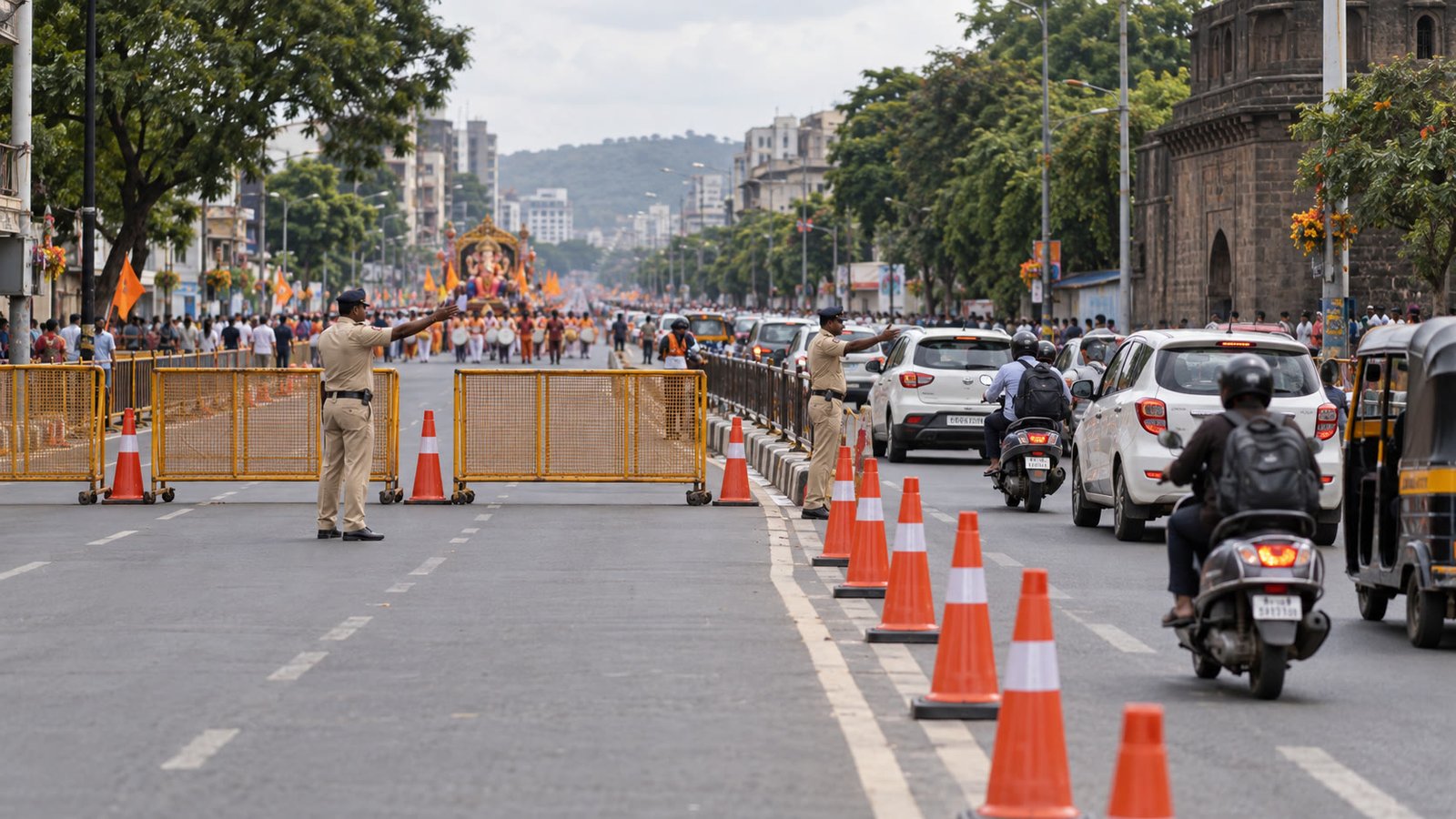
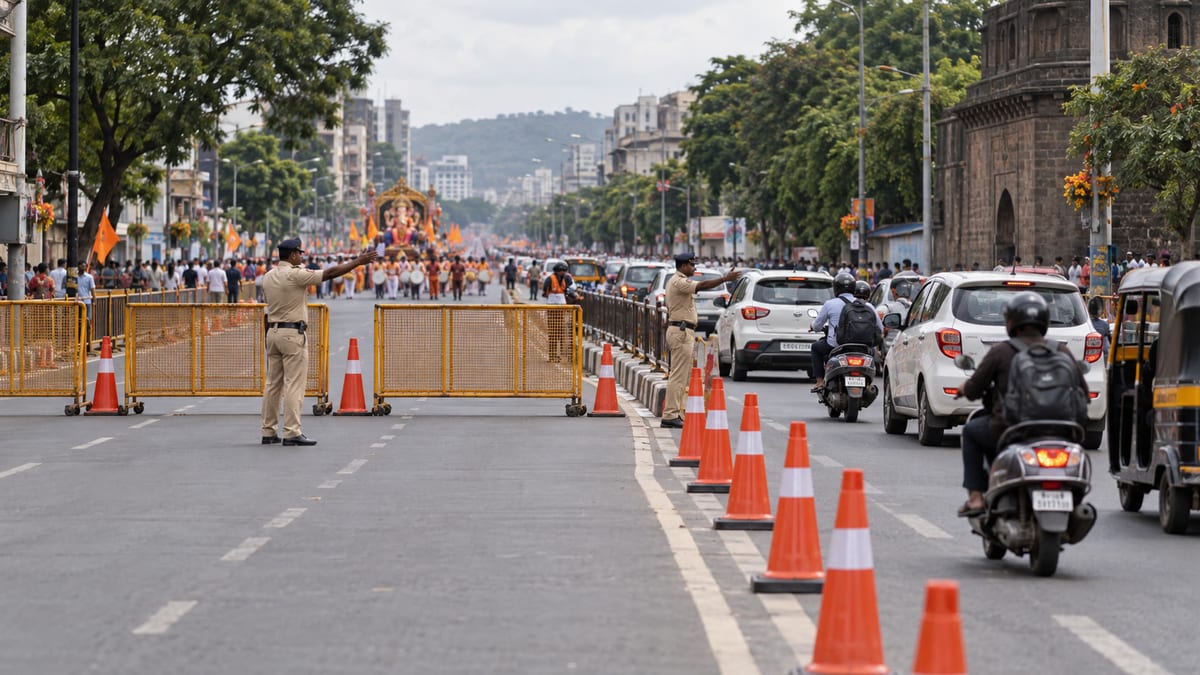 AI-generated editorial illustration of Pune traffic diversions during Ganesh Visarjan; FuelPrice.
Key takeaways
- 17 major road stretches: Closures begin in phases from 5 am on 25 September 2026 and continue as the processions move, as reported by The Indian Express and The Times of India on 23–24 September 2026.
- Heavy vehicles barred: All heavy vehicles are to stay out of Pune city from 12:01 am on 25 September until midnight on 26 September 2026, a 48-hour restriction reported by The Indian Express, The Times of India and the Free Press Journal.
- No parking from Thursday night: No-parking restrictions begin at 11 pm on 24 September 2026 on key procession roads and continue until the immersion procession ends.
- Plan for alternatives: Police have identified an alternative ring route and 26 designated parking locations; central-city movements will be regulated at diversion points.
What changes on 25 September
The main immersion activity is centred on Laxmi Road, Tilak Road, Kumthekar Road and Kelkar Road, but the traffic plan extends well beyond those four corridors. The first closures are scheduled from 5 am on 25 September, followed by additional restrictions through the morning and noon. Police may alter the sequence depending on crowd levels and the speed of the processions.
| Start time on 25 Sep | Key stretches affected | What drivers should expect |
|---|---|---|
| 5 am | Shivaji Road and Laxmi Road | Early closure begins on two routes leading into the central procession area. |
| 9 am | Tilak Road, Bagale Road and Guru Nanak Road | Central-city movement begins to be diverted around the procession routes. |
| 10 am | Bajirao, Kumthekar, Ganesh, Kelkar and Shastri roads | More links into the main immersion corridor close in stages. |
| 11 am | Jangli Maharaj Road and Fergusson College Road | Western approaches are regulated as the procession advances. |
| Noon | Karve, Bhandarkar, Pune-Satara, Solapur and Prabhat roads | South and east approaches face further restrictions. |
The timing sequence above is cross-checked against road-plan reports from The Indian Express and Punekar News, both dated 23 September 2026. It is not a guarantee that every stretch will remain closed continuously: the traffic police said controls will be applied according to the movement of the procession and prevailing traffic conditions.
Where Pune drivers will be diverted
For motorists trying to cross the central city, the designated ring-road route links the Karve Road and Nal Stop side with Law College Road, Senapati Bapat Road, Ganeshkhind Road, Shivajinagar and the university area before connecting towards Satara Road and Volga Chowk. Police will regulate traffic at junctions such as Jhansi Rani Chowk, the Kakasaheb Gadgil statue, Sant Kabir Chowk, Seven Loves Chowk, Volga Chowk, Nal Stop and Goodluck Chowk.
There are separate controls on the Dhayari Phata–Nanded Phata side from 11 am to midnight on 25 September 2026. In Keshavnagar, Mundhwa and Sasane Nagar–Hadapsar, one-way arrangements and diversions begin from 6 am on 25 September and continue until the procession clears, according to reports by The Times of India and the Free Press Journal.
Drivers arriving from outside Pune should use the FuelPrice road-trip planner before leaving, then check the live police route status rather than relying on a usual city shortcut.
Heavy vehicles, parking and emergency access
The citywide heavy-vehicle restriction begins at 12:01 am on 25 September and ends at midnight on 26 September 2026. The order affects goods and other heavy vehicles entering Pune city; transport operators should treat the period as a delivery-planning constraint and confirm access with their consignee before dispatch.
No-parking rules begin at 11 pm on 24 September 2026 along key sections of Laxmi, Kelkar, Kumthekar, Tilak, Shivaji, Shastri, Jangli Maharaj, Karve and Fergusson College roads. The Free Press Journal reported that police, fire brigade, ambulance and other authorised emergency vehicles are exempt where required. Do not leave a vehicle on a procession route simply because the road is still open when you arrive.
Police have arranged 26 parking locations for visitors, including college grounds and other designated sites near the central city. Use only marked parking areas, keep access lanes clear and expect the walking distance to be longer than on a normal visit. Parking availability can change as crowds build.
What to check before setting out
The Pune City Police has launched a live Ganpati Visarjan tracking and diversion portal showing procession movement, road status and parking information. Check it shortly before departure because the control plan is movement-based. News On AIR also reported on 24 September 2026 that Pune’s security and traffic arrangements include diversions on major roads and heavy-vehicle restrictions during the immersion period.
For a trip that must continue through the city, leave time for a longer bypass and keep the vehicle fuelled before entering a restricted area. The latest fuel prices page can help with the day’s rate, while the fuel cost calculator can show how a longer diversion changes the planned trip cost. These tools do not replace the police advisory; they help quantify the practical effect of a route change.
Why this matters for everyday mobility
The plan is relevant beyond festival visitors. Office commuters, school vehicles, cabs, two-wheelers, delivery fleets and intercity travellers may all encounter moving barricades or a temporary one-way arrangement. A route that is technically open can still take longer when traffic is redirected at several consecutive junctions.
For private drivers, the useful distinction is between a fixed road closure and a procession-led restriction. Avoiding the central corridors during the busiest window may be simpler than trying to find a last-minute shortcut. For fleet and goods operators, the 48-hour heavy-vehicle ban is the clearest hard constraint; route, loading and delivery schedules should be checked against it before a vehicle enters Pune.
The restrictions should ease after the immersion procession passes, but the exact reopening time is not fixed in advance. Drivers should follow barricades and police instructions on the ground, use the official tracker for live changes and keep the designated parking and emergency-access rules in mind.
Sources
- The Indian Express — Pune Ganesh procession traffic: Check full list of closed roads, parking sites — 23 Sep 2026
- Punekar News — Pune Ganpati Visarjan 2026: Roads Closing From 5 AM—Check Your Route Before Leaving — 23 Sep 2026
- The Times of India — Ganesh immersion processions on Friday: Key roads shut, traffic diversions across city; heavy vehicles banned for 48 hours — 24 Sep 2026
- Free Press Journal — Pune Ganpati Visarjan: Traffic Police Announce Diversions, No-Parking Zones - Here's All You Need To Know — 24 Sep 2026
- News On AIR — Pune makes elaborate security arrangements for Ganesh idol immersion procession — 24 Sep 2026
- Pune City Police — Live Ganpati Visarjan Tracking — accessed 25 Sep 2026