India's September vehicle market is showing strong festive-season momentum in brokerage and dealer checks, but the figures being reported are forecasts rather than final sales data. That distinction matters for buyers: demand may support faster movement of popular models, while input-cost pressure can keep price changes in play.
Key takeaways
- Separate September reports point to positive passenger-vehicle demand, but their growth estimates do not match.
- Yes Securities was reported on 26 Sep 2026 as expecting 15–16% year-on-year passenger-vehicle retail growth; Nomura's estimate reported on 29 Sep 2026 was 26%.
- Analysts link the outlook to festive demand, a low comparison base and refreshed model line-ups, while uneven monsoon conditions remain a risk.
- For buyers, the useful checks are delivered price, vehicle stock age, waiting time, powertrain running cost and charging or refuelling access.
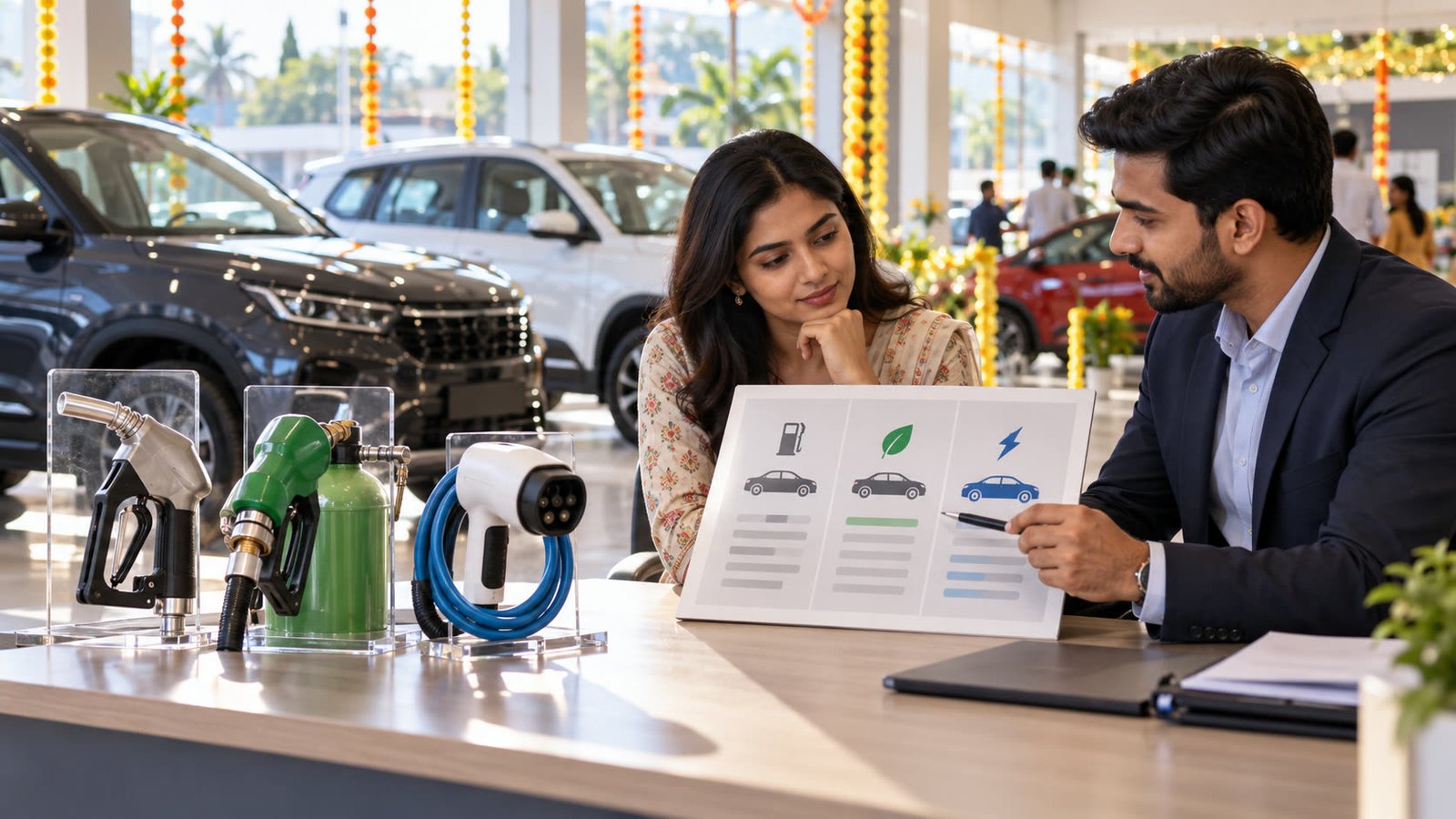
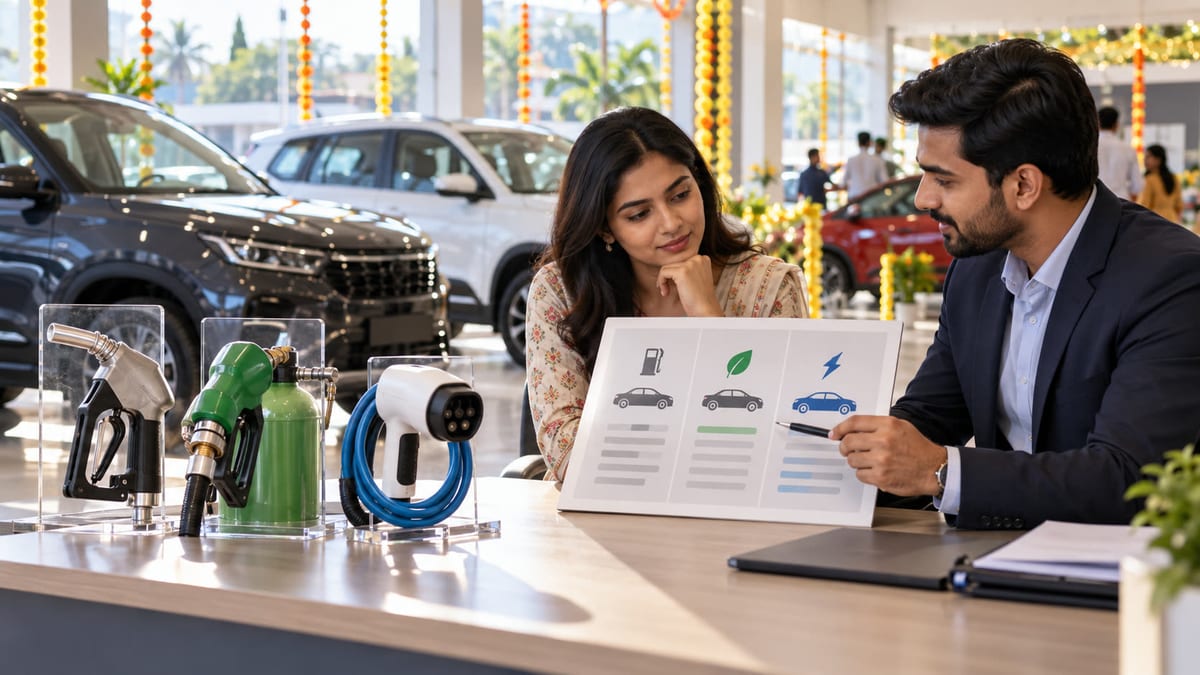 Illustrative editorial image of a buyer comparing powertrain choices; no specific vehicle model is shown. Credit: FuelPrice editorial illustration.
What the latest September reports say
Three recent research-led updates describe a healthy September market, but they are not measuring the same thing or using the same assumptions. The comparison below keeps the attribution visible and avoids presenting an estimate as a confirmed industry result.
| Report covered by | Measure | September view | What it signals |
|---|---|---|---|
| Public TV / ANI, 26 Sep 2026 | Passenger-vehicle retail | 15–16% growth forecast | Steady demand, with monsoon risk |
| Moneycontrol, 29 Sep 2026 | Passenger-vehicle retail | 26% growth estimated | Broad-based demand after dealer checks |
| Business Today, 29 Sep 2026 | Passenger vehicles and M&HCVs | More than 20% growth seen by analysts | Festive stocking and a low base |
The gap between the mid-teens estimate and the higher forecasts is not a contradiction that can be silently resolved. Yes Securities' channel check, as reported by Public TV, described passenger-vehicle retail growth of 15–16% for September and flagged uneven rainfall as an emerging risk. Moneycontrol reported Nomura's September 28 report, which estimated passenger-vehicle retail growth of 26% and wholesale growth of 21%. Business Today separately reported dealer checks and brokerage views that put passenger vehicles and medium and heavy commercial vehicles above 20% for the month.
These are reported expectations from research houses, not a confirmed September registration or dispatch total. The next official industry releases will show how much of the showroom interest converted into deliveries and registrations.
Why the comparison base matters
September 2026 is being compared with a period when some Indian buyers delayed purchases before the revised GST rates took effect on 22 Sep 2025. That makes a year-on-year jump look stronger than it might in a normal comparison year. Business Today also noted that Choice Institutional Equities expected strong September growth on this low base, while cautioning that the headline rate should be read alongside actual demand and channel conditions.
The official August baseline was already strong. The Society of Indian Automobile Manufacturers said on 15 Sep 2026 that domestic passenger-vehicle sales reached 4,39,309 units in August 2026, up 36.5% from August 2025. Financial Express reported the same SIAM data and noted that the previous year's low base was an important part of the comparison. That is wholesale industry data, whereas dealer retail data reflects registrations; the two should not be treated as interchangeable.
FADA's August retail release, reported by Business Standard on 7 Sep 2026, showed passenger-vehicle registrations at 4,02,398 units, up 16.14% year-on-year, with dealer inventories still elevated ahead of the festive period. The FADA release also marked alternative fuels as an important part of the market mix. Together, the wholesale and retail indicators explain why September forecasts are positive while still needing a cautious read.
What the outlook means for vehicle buyers
Popular variants may move faster
Strong enquiries do not mean every model will face a long wait. Demand is usually uneven across body styles, fuel types, colours and variants. A buyer comparing a popular trim should ask for the expected delivery window in writing and check whether the quoted vehicle is already in stock or is yet to be produced. Stock age and the manufacturing month matter when comparing a festive offer with the delivered price.
Higher demand can also reduce the need for broad discounts, but it does not confirm that every dealer or model has stopped offering benefits. Treat any offer as model- and variant-specific, and compare the final on-road figure rather than a headline discount.
Price pressure remains a watch point
Public TV's report on the Yes Securities channel check cited selective price increases of 0.3–0.4% as a response to raw-material costs. Moneycontrol reported Nomura's warning that higher steel, copper and crude prices could add to input-cost pressure and raise the risk of further original-equipment-maker price increases. These are reported sector risks, not a confirmed price revision for every brand or vehicle.
Before booking, keep the quotation, validity date, ex-showroom price, insurance, registration, accessories and delivery charges separate. That makes it easier to identify whether a later change is a genuine price revision or a change in optional add-ons.
Powertrain choice has a running-cost effect
Fuel and charging costs can change the ownership calculation even when the purchase price looks similar. Use the fuel cost calculator for a typical commute or trip, then check current petrol, diesel and CNG prices for the cities where the vehicle will run. EV buyers can also compare nearby options in the state-wise EV charging directory. The calculation should use the vehicle's realistic efficiency, expected monthly distance and local access to fuel or charging.
Two-wheelers, commercial vehicles and fleet users
The September outlook is not uniform across segments. Business Today reported analysts saw two-wheeler sales growing at a slower single-digit pace, while medium and heavy commercial vehicles were expected to grow by more than 20%; tractor sales were seen declining by more than 20% in the same report. Moneycontrol's Nomura report also described stronger medium and heavy commercial-vehicle retail growth than passenger vehicles, while warning that tractor volumes faced a high-base and calendar effect.
For fleet and transport operators, stronger commercial-vehicle demand can affect delivery slots, stock availability and the timing of any price revision. It is worth separating vehicle availability from the operating-cost decision: compare fuel or charging access, payload needs, route distance and maintenance support. Operators planning festive-season routes can use the road-trip planner alongside a fuel-cost estimate.
What to watch next
The key test is whether September showroom enquiries convert into final registrations and manufacturer dispatches. Watch the next company sales releases and the forthcoming industry retail data for that confirmation. Until then, the defensible conclusion is narrower: reported channel checks show strong festive-season interest, but the precise growth rate remains an estimate and the final result may differ by segment.
Sources
- Moneycontrol — Nomura retains 'Buy' on M&M, Hyundai India, Ather, TVS, Sona BLW as auto demand stays strong — 29 Sep 2026
- Business Today — Auto stocks to buy ahead of September, Q2 auto sales data — 29 Sep 2026
- Public TV / ANI — Passenger vehicle retail sales to grow 15-16 pc in September amid steady demand: Yes Securities — 26 Sep 2026
- SIAM — Auto Industry Performance of August-2026 — 15 Sep 2026
- The Financial Express — Auto sales hit record August levels, but high base may temper growth ahead — 15 Sep 2026
- FADA — August 2026 Vehicle Retail Data by Category — 7 Sep 2026