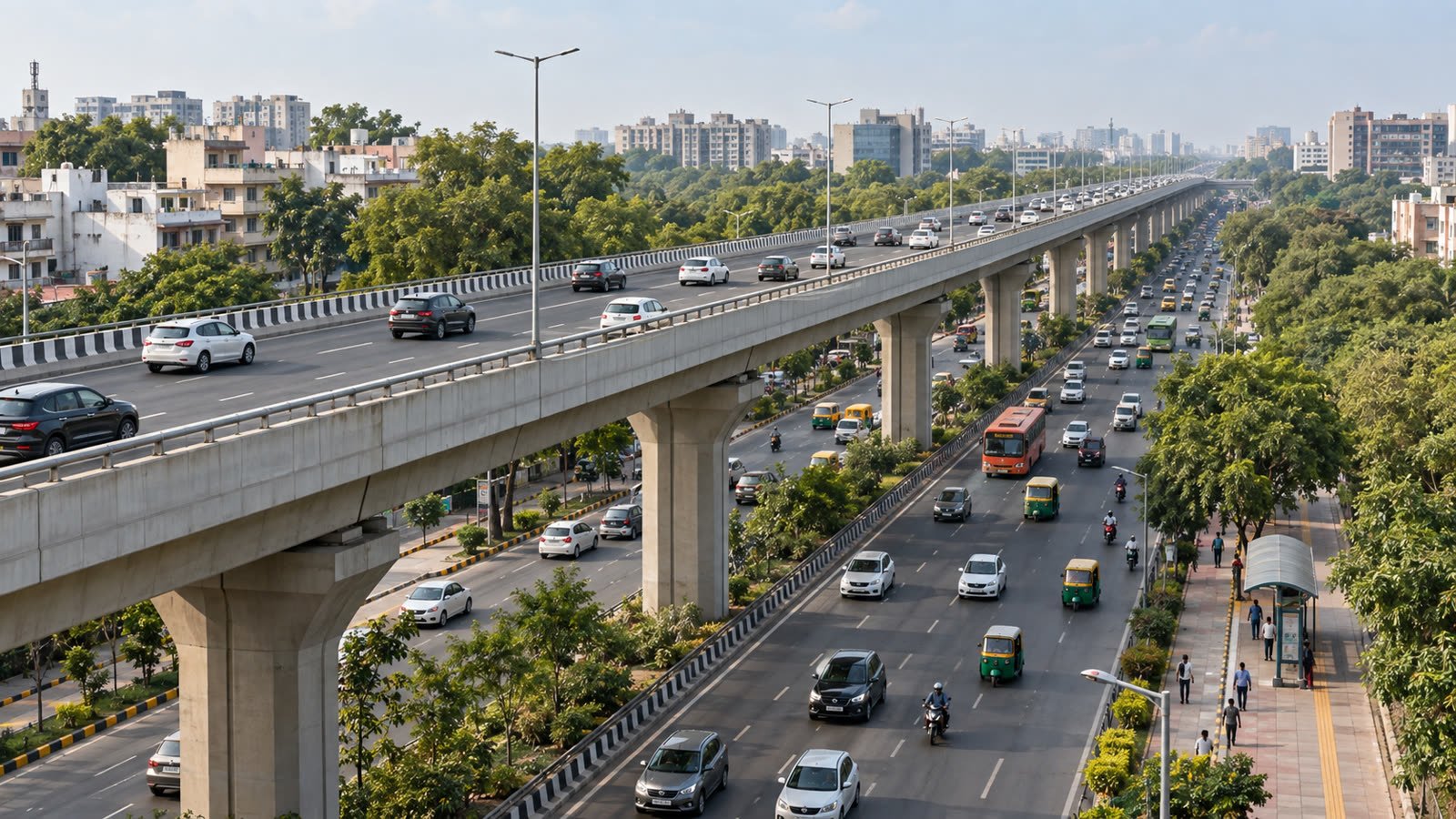
At its 70th governing body meeting on 23 Sep 2026, Delhi’s Unified Traffic and Transportation Infrastructure (Planning and Engineering) Centre (UTTIPEC) approved a proposed six-lane elevated corridor on Maa Anandmayee Marg, connecting the Outer Ring Road with the Mehrauli-Badarpur Road. The decision matters to daily commuters, buses, delivery vehicles and other road users because the project is designed to separate through traffic from busy junctions near Okhla. It is still a planned project, however, and not a road that is open for use.
Key takeaways
- The proposed Maa Anandmayee Marg corridor will run for 5.5 km and bypass 12 busy intersections.
- An underpass and roundabout are also planned at the Crowne Plaza intersection on Okhla Estate Marg.
- At Mukarba Chowk, the existing Road Over Bridge is to be widened from six to 10 lanes, alongside a new four-lane bridge.
- Multimodal access plans cover six Delhi Metro stations, with pedestrian and last-mile facilities around each station.
- No completion schedule, toll revision or immediate traffic diversion has been announced with the approval.
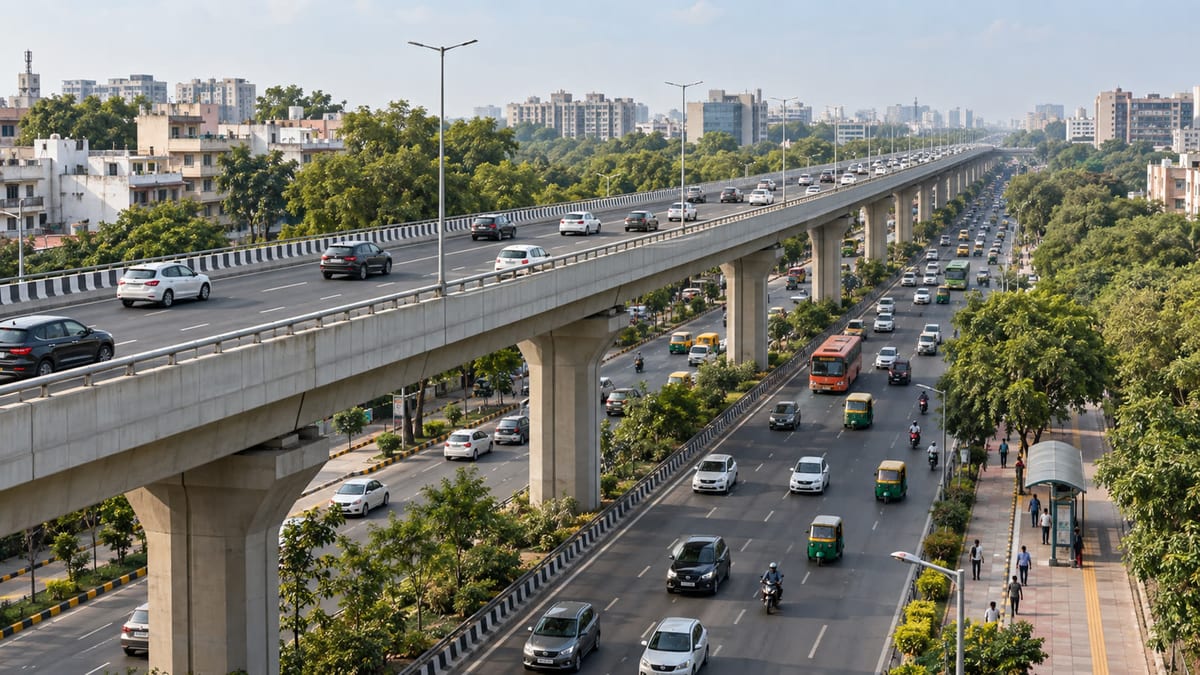 Illustrative editorial image of a proposed elevated corridor; generated for FuelPrice and not an official project photograph.
What UTTIPEC approved
The decision covers a group of road and public-transport access projects cleared at UTTIPEC’s 70th governing body meeting. Hindustan Times and NDTV Profit reported the approval on 24 Sep 2026 and 23 Sep 2026 respectively. The reports place the work at the planning and implementation stage, which is important for anyone trying to understand what changes now and what remains in the future.
Maa Anandmayee Marg and Okhla traffic
The largest project is a six-lane elevated corridor between the Outer Ring Road and Mehrauli-Badarpur Road. It is expected to bypass about 12 intersections and address congestion created by mixed traffic connected with the Okhla Phase I and Phase II industrial areas. An underpass and a roundabout at the Crowne Plaza intersection on Okhla Estate Marg are part of the same road intervention.
The intended benefit is route separation: through traffic could move above the junctions while the surface level has more room for pedestrians and other non-motorised transport. That is a design objective, not a confirmed travel-time saving. The official UTTIPEC project page identifies the corridor proposal and the Public Works Department as the agency, but the current reports do not provide a construction start date or opening date.
Mukarba Chowk and NH-44
The package also includes a separate decongestion plan for Mukarba Chowk in northwest Delhi. The existing Road Over Bridge on the Outer Ring Road is proposed to expand from six lanes to 10 lanes. A new four-lane Road Over Bridge would cross the Delhi-Sonipat railway line and connect Jahangirpuri Industrial Area with Sanjay Gandhi Transport Nagar.
Officials cited in the reports expect the new bridge to divert around 20% of the traffic currently passing through Mukarba Chowk. The proposal is also intended to ease pressure on the Outer Ring Road towards Madhuban Chowk and on National Highway 44 near the junction. That percentage is an official expectation, not a measured result; it can only be tested after the work is built and operating.
What it means for commuters and fleet operators
For South Delhi, the practical promise is future route separation. Cars, buses, two-wheelers and commercial vehicles using the corridor would not all need to negotiate the same junctions, while surface-level space could be reorganised for walking, autos and pick-up or drop-off movements. A sanction does not alter the current route, though. Drivers should not assume that today’s journey time will fall or that navigation systems can use an elevated link before construction and commissioning.
For operators serving Okhla’s industrial areas, the project matters because stop-start movement at multiple intersections can add time and fuel use. The sources do not publish a distance, fuel-saving estimate or promised travel-time reduction, so fleet budgets should continue to use live road conditions. A route comparison can be planned with our road-trip planner, while fuel-use scenarios can be checked with the fuel cost calculator.
There is also no new toll or user fee in these approvals. The works are urban road and interchange projects, and the reports do not announce a tolling mechanism. If a current trip crosses a tolled road elsewhere in Delhi-NCR, use the toll-charge calculator with present fee data rather than treating this future project as a toll change.
Metro access is part of the same package
UTTIPEC also approved multimodal integration plans around six Metro stations: GTB Nagar, Sarita Vihar, Akshardham, Rohini West and Dr Baba Saheb Ambedkar Hospital, Malviya Nagar, and Shastri Park. The plans cover an area of about 300 metres around each station and focus on pedestrian movement, walkability, station access and last-mile connections.
Hindustan Times reported that these approvals complete all 31 multimodal integration plans prepared by the Delhi Metro Rail Corporation for its Phase I and Phase II corridors. For commuters, that last-mile element may be as important as the viaduct: a faster approach helps only when people can safely transfer between a vehicle, an auto, a bus and the Metro.
What happens next
The projects will move into subsequent planning and implementation by the respective agencies. That wording matters. The approval sets a planning direction, but it does not establish a completion date, construction start, project cost or opening date. More details should come through PWD, DDA and UTTIPEC documents, detailed design work, tendering, statutory clearances and traffic-management notices.
Before construction begins, drivers should watch for signed diversions and lane changes; none of those changes are in force from this approval alone. The reader takeaway is simple: Delhi has cleared a mobility plan with potential benefits for congested corridors and Metro access, but current drivers still need to follow existing routes and live traffic advisories.
Sources
- Hindustan Times — UTTIPEC approves multimodal integration plans for six Delhi Metro stations — 24 Sep 2026
- NDTV Profit — South Delhi Commute To Get Easier With New 5.5-Km Elevated Corridor; Six Metro Station Upgrades Planned — 23 Sep 2026
- Financial Express — Delhi to get 5.5 km elevated corridor across 12 intersections; 6 metro stations set for revamp — 24 Sep 2026
- UTTIPEC/DDA — Integrated Transit Corridor Development and street Network/Connectivity Plan for Maa Anandmayee Marg — 23 Jun 2026