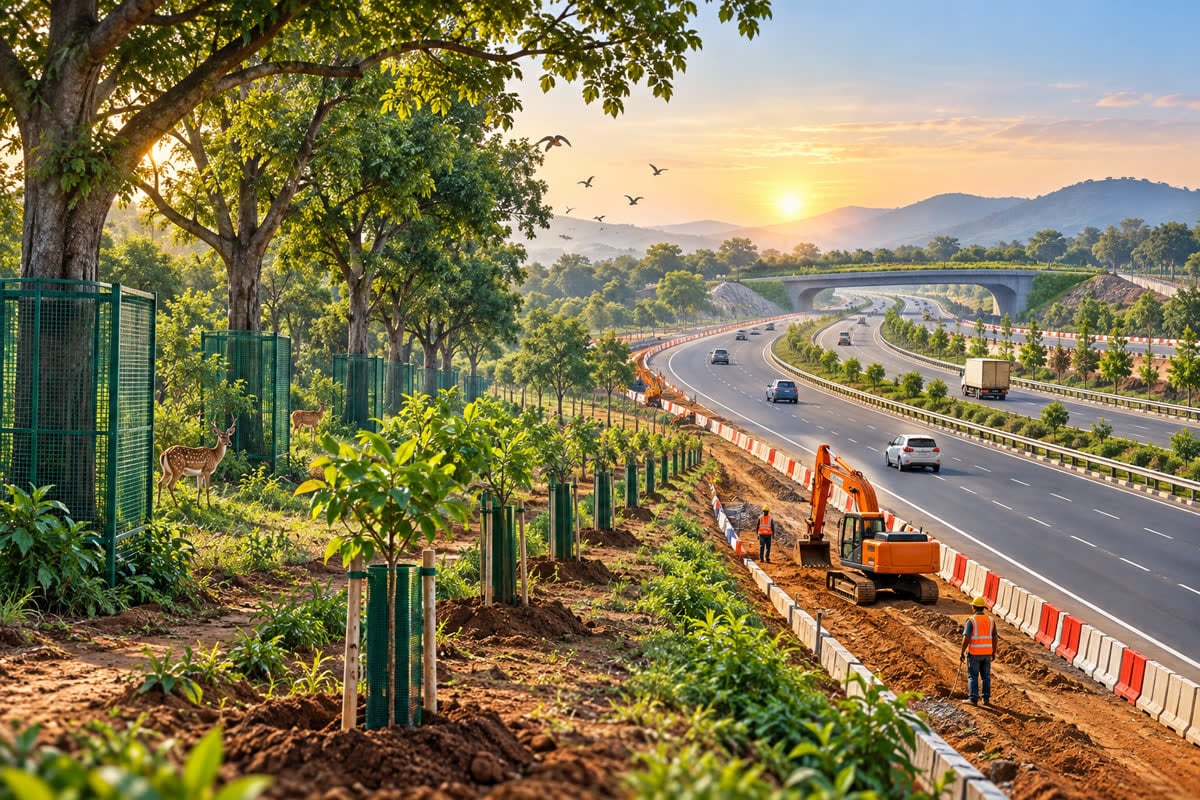
The Supreme Court on 8 October 2026 asked the Punjab government to submit by 27 November 2026 a proposal identifying adequate land for compensatory afforestation wherever the National Highways Authority of India (NHAI) needs land for road construction. For drivers, the immediate point is that this is a land-and-environment direction: the reports do not announce a new toll rate, FASTag rule or road-user charge.
The hearing matters most for the proposed Zirakpur bypass and the wider Chandigarh–Shimla travel corridor. The Tribune reported that the case is linked to a project connecting Zirakpur in Punjab with a toll plaza on the Chandigarh–Shimla highway in Haryana. The project’s next steps remain subject to the state’s response and further court directions.
Key takeaways
- Punjab has been asked to submit a land proposal and response by 27 November 2026, according to reports published on 8 October 2026.
- The Supreme Court also issued notice on NHAI’s challenge to Punjab and Haryana High Court directions restricting tree felling during road construction.
- The dispute is linked in the coverage to nearly 5,000 trees proposed for the Zirakpur bypass project.
- No new toll amount, FASTag rule or immediate route closure was announced in the reports; the next practical milestone is the state’s filing.
What the Supreme Court asked Punjab to do
A bench led by Chief Justice of India Surya Kant, with Justices Joymalya Bagchi and V. Mohana, asked Punjab to prepare a proposal for adequate land for compensatory afforestation in areas where land is required for NHAI road construction. The Tribune reported that the bench also sought the state’s response and directed NHAI to serve Punjab with a copy of its petition.
The direction follows NHAI’s challenge to Punjab and Haryana High Court orders that restricted the felling of trees during road work. Dainik Jagran, carrying PTI input, reported that NHAI told the court the restrictions were creating difficulties for public road projects. The Solicitor General also told the bench that compensatory planting is mandatory when trees are felled, while acknowledging that suitable land is not always available close to the affected site.
This is a procedural step, not a final approval to cut trees or a direction to open the bypass. The proposal and the subsequent hearing will determine how the competing requirements of road connectivity, statutory compliance and local environmental protection are handled.
Why the Zirakpur bypass is relevant to drivers
The reported dispute grew out of a public-interest challenge to tree felling for the proposed Zirakpur bypass. The Tribune said the project would connect Zirakpur with a toll plaza on the Chandigarh–Shimla highway, while the Dainik Jagran report also described the issue as one involving NHAI road construction and compensatory planting. The coverage refers to nearly 5,000 trees in connection with the project.
For people who regularly travel through the Chandigarh tricity, the significance is about future route choice rather than an immediate fare change. A completed bypass could alter how traffic is distributed around Zirakpur and the approaches towards Panchkula and Shimla. However, the 8 October 2026 reports did not announce a construction restart date, an opening date or a toll schedule.
That distinction matters because a court hearing can change the project’s compliance path without changing the road network on the same day. Drivers should therefore treat claims about a confirmed opening, a new toll plaza or a revised route as unverified unless they appear in a later NHAI, state-government or court update.
What the five-kilometre question means
During the hearing, the bench asked whether land for compensatory afforestation had been allocated within five kilometres of the places where trees were felled. NHAI said, as reported by The Tribune and Dainik Jagran, that land was available within that distance in some cases, but not in every case; in some locations, planting was being done elsewhere.
The distance question is important for local communities because the location of replacement planting affects whether a project retains green buffers and ecological continuity near the corridor. It does not, by itself, create a new five-kilometre rule for every highway project. In this hearing, it was a question from the bench and part of the information sought from the authorities.
Punjab’s forest-cover context
The reports published on 8 October 2026 quoted an earlier High Court observation that forest cover accounted for 3.67% of Punjab’s geographical area, compared with 4.87% for Rajasthan. Those figures were presented as context for the court’s concern about declining forest cover; they are not a new nationwide forest-cover survey announced in this hearing.
The background explains why the case has relevance beyond one bypass. Highway construction can improve travel time and regional connectivity, but the route, tree-felling and replacement-planting decisions shape the environmental conditions around that infrastructure. The Supreme Court’s direction asks the state and NHAI to put the land question on record before the next stage of the dispute.
What changes for drivers now
There is no reported change today to the toll payable on the Chandigarh–Shimla corridor or to FASTag use. Until a future notice confirms otherwise, motorists should not assume that the proposed bypass is open, that a new toll plaza is active or that an existing route has been diverted.
For a current journey, the road-trip planner can help compare available routes and travel times while the court process continues. If the trip includes a tolled national-highway section, use the toll-charge calculator to estimate the current route cost rather than relying on a future project’s proposed toll.
Fuel is another part of the decision for a corridor trip. The fuel-cost calculator can be used with the vehicle’s actual mileage and the latest applicable fuel rate; the eventual bypass distance and toll, if and when notified, can then be compared with the available route.
What to watch next
- Punjab’s proposal and response due by 27 November 2026.
- The Supreme Court’s next directions on NHAI’s challenge to the tree-felling restrictions.
- Any NHAI or state notice on construction activity, traffic management or the bypass timeline.
- A separate toll notification, if a fee plaza is planned for the completed road.
The practical takeaway is limited but clear: the Supreme Court has moved the land-for-compensatory-afforestation question to the Punjab government’s desk. For drivers, the route and toll position remains unchanged until an official project or traffic notice says otherwise.
Sources
- The Tribune — “NHAI road projects: SC seeks Punjab govt's proposal on land for compensatory afforestation” — 08 Oct 2026. Read source
- Dainik Jagran (PTI) — “सड़क निर्माण के लिए पेड़ कटाई पर सुप्रीम कोर्ट सख्त, पंजाब सरकार से मांगी पौधारोपण के लिए जमीन” — 08 Oct 2026. Read source