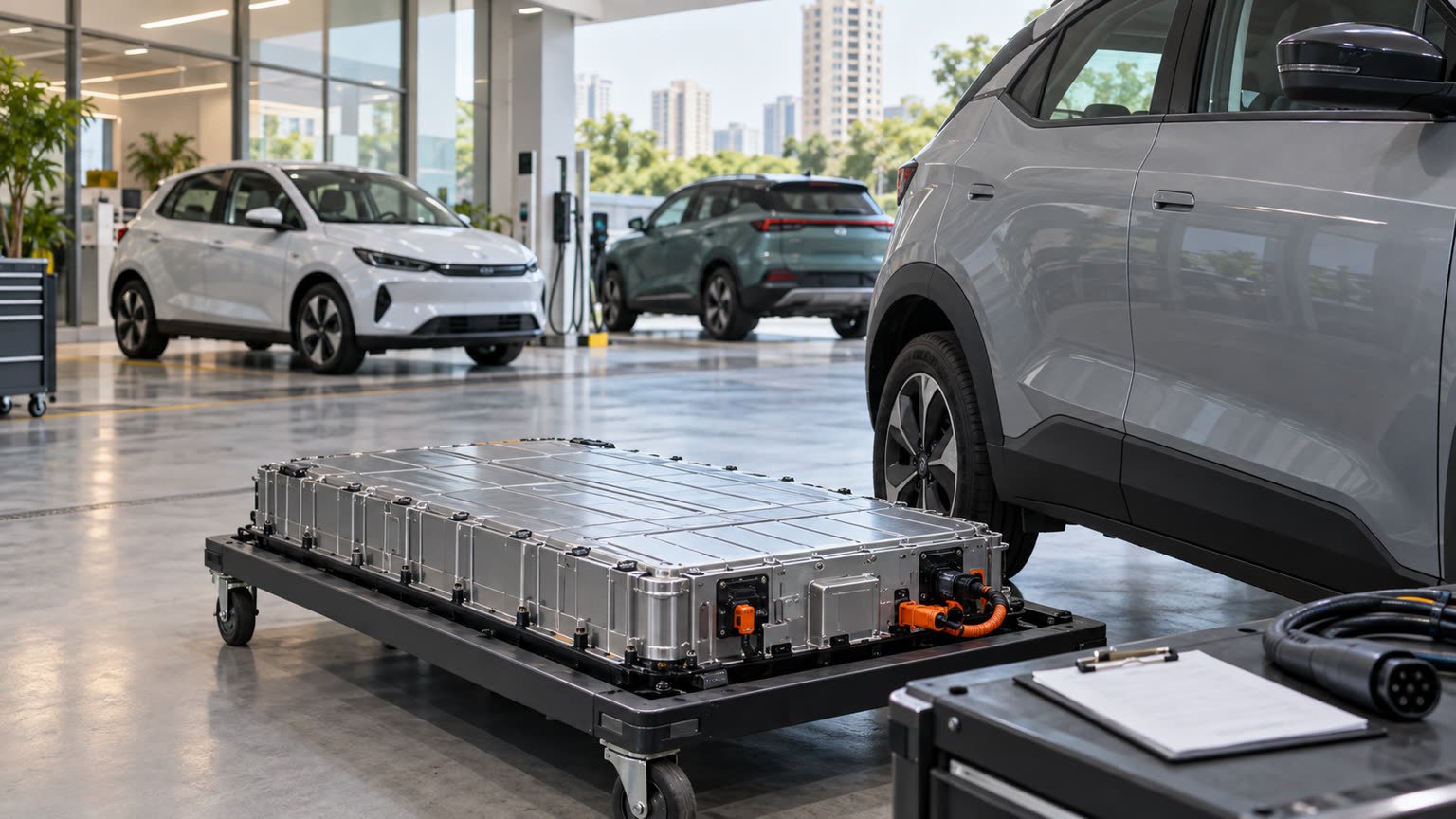
Tata Motors Passenger Vehicles expanded its Battery-as-a-Service (BaaS) programme across its entire electric-car range on 28 Sep 2026. Buyers can pay a lower ex-showroom price for the vehicle and finance or pay separately for battery usage, but the lower sticker price is not the complete ownership cost.
Key takeaways
- BaaS now covers six Tata EVs: Tiago.ev, Punch.ev, Nexon.ev, Curvv.ev, Sierra.ev and Harrier.ev.
- Reported entry vehicle prices under BaaS range from ₹4.69 lakh for the Tiago.ev to ₹14.49 lakh for the Harrier.ev, ex-showroom.
- The separate battery charge ranges from ₹2.60 per km to ₹5.90 per km under the stated usage assumptions.
- The model uses separate financing for the vehicle and battery; charging, insurance, road tax, maintenance and other ownership costs remain separate.
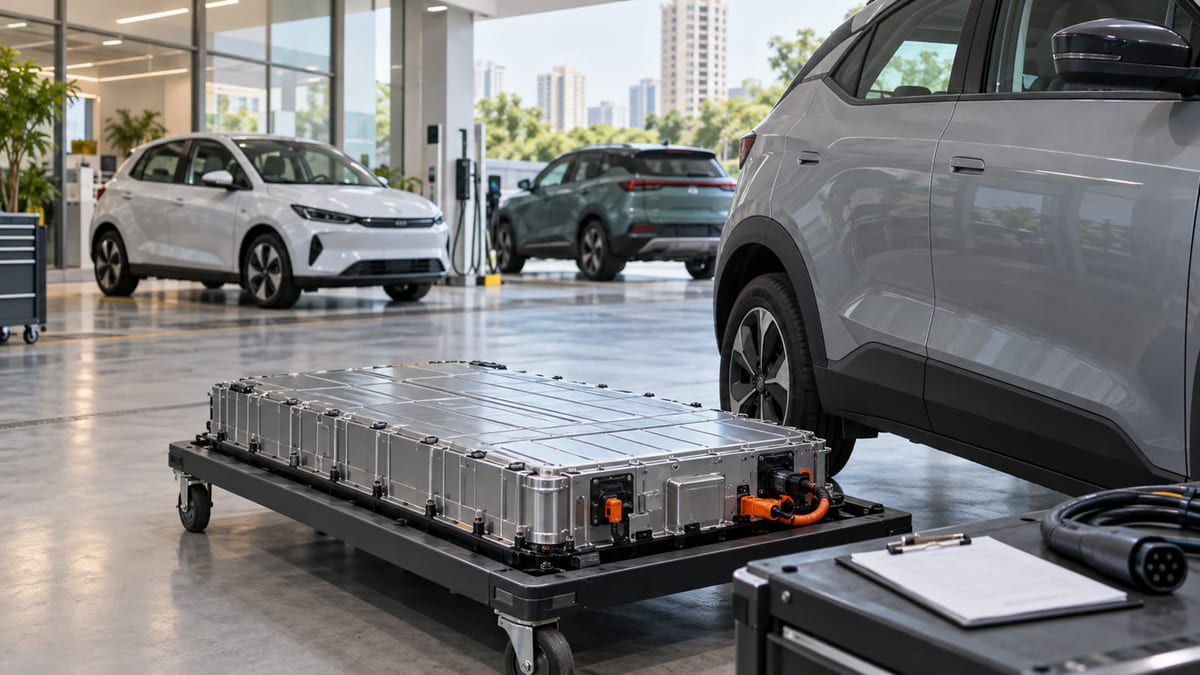 Detached battery pack beside electric vehicles in a service centre; FuelPrice editorial image, AI-generated.
What Tata’s BaaS expansion changes
Until this expansion, Tata’s BaaS option was available on the Tiago.ev and Punch.ev. The company has now added the Nexon.ev, Curvv.ev, Sierra.ev and Harrier.ev, giving buyers a choice across a small electric hatchback, compact SUV, coupe-style SUV and larger SUVs.
Under BaaS, the battery is not included in the upfront vehicle price. Autocar Professional and NDTV Profit describe the structure as a dual-loan arrangement: the car and battery are financed through separate accounts, with the battery component linked to usage. The battery equated monthly instalment or usage charge depends on factors such as battery size, down payment, tenure and the financier.
This is why a BaaS price should be read as an entry vehicle price, not as an on-road price or a guaranteed monthly ownership bill. Tata’s product terms also state that the finance product is subject to financier approval and that the displayed assumptions exclude charging cost and government levies.
Model-wise Tata EV BaaS prices
The following figures were reported on 28 Sep 2026 for entry-level variants. The standard figure is the starting ex-showroom price with the battery included; the BaaS figure is the vehicle price before the separate battery charge.
| Model | Battery | Standard price | BaaS vehicle price | Battery charge |
|---|---|---|---|---|
| Tiago.ev | 19 kWh | ₹6.99 lakh | ₹4.69 lakh | ₹2.60/km |
| Punch.ev | 30 kWh | ₹9.79 lakh | ₹6.59 lakh | ₹2.60/km |
| Nexon.ev | 45 kWh | ₹14.34 lakh | ₹8.99 lakh | ₹4.40/km |
| Curvv.ev | 55 kWh | ₹17.19 lakh | ₹10.99 lakh | ₹5.00/km |
| Sierra.ev | 63 kWh | ₹18.79 lakh | ₹11.99 lakh | ₹5.50/km |
| Harrier.ev | 65 kWh | ₹21.79 lakh | ₹14.49 lakh | ₹5.90/km |
The reported entry-price gap is largest for the Harrier.ev at ₹7.30 lakh, followed by the Sierra.ev at ₹6.80 lakh and the Curvv.ev at ₹6.20 lakh. The Nexon.ev’s upfront gap is ₹5.35 lakh. These are simple differences between the reported standard and BaaS vehicle prices; they are not claimed savings because the battery charge is paid separately over the financing or usage period.
What the per-kilometre charge means
The battery charges reported for the Punch.ev, Nexon.ev, Curvv.ev, Sierra.ev and Harrier.ev use an estimated 60 km daily run. The Tiago.ev figure uses an estimated 44 km daily run. Actual payments may differ with the selected variant, loan tenure, down payment, financier and applicable terms.
For a simple comparison, 1,000 km of monthly driving would produce a battery charge of ₹2,600 at ₹2.60 per km, ₹4,400 at ₹4.40 per km or ₹5,900 at ₹5.90 per km. This is arithmetic based on the reported rates, not a quoted EMI. It also excludes the electricity used to charge the car, along with insurance, road tax, servicing, tyres and finance costs.
That distinction matters when comparing a BaaS EV with a petrol or diesel car. A lower purchase figure can reduce the amount paid at the showroom, while a high monthly distance increases the separate battery bill. Drivers can compare the fuel-side cost of a conventional car using FuelPrice’s fuel cost calculator, then keep charging and battery charges as separate EV line items.
Who is affected by the new choice
The expansion is relevant to private buyers considering a Tata EV but trying to keep the initial vehicle price within a particular budget. It also gives existing EV shoppers more models to compare under the same broad ownership structure, rather than limiting BaaS to the Tiago.ev and Punch.ev.
For lower-mileage users, the per-kilometre component may be smaller in absolute rupee terms, but the entry price alone still does not show the full cost. For high-mileage users, the battery charge becomes a more important part of the monthly calculation because it rises with distance travelled. Commercial use is not covered by the stated personal-use terms on Tata’s product page, so fleet operators need separate confirmation rather than assuming the consumer BaaS structure applies.
What buyers should verify before comparing quotes
- Whether the quoted amount is the ex-showroom vehicle price or the final on-road price after road tax, insurance, TCS and other levies.
- Which battery capacity and vehicle variant the displayed per-kilometre charge refers to.
- Whether the battery payment is structured as a second loan, a usage-linked charge or another financier-specific product, and what tenure applies.
- How the battery charge is calculated for the expected monthly distance, including any minimum usage or contract conditions.
- Whether the offer is limited to personal use and whether the financier has approved the application.
- What is included in the battery arrangement and what remains outside it, including home charging, public charging, maintenance, insurance and repairs.
Buyers planning frequent highway travel should also account for charging stops and route coverage. FuelPrice’s state-wise EV charging directory can help identify the infrastructure question separately from the finance question.
What changes now
The immediate change is wider availability: Tata EV shoppers can now compare six model-specific BaaS entry prices instead of only two. The reported figures are introductory, entry-level, ex-showroom amounts as of 28 Sep 2026, and the final quote can vary by variant, financier and terms.
The practical takeaway is to compare the complete ownership stack: upfront vehicle price, battery payment, charging, insurance, road tax, service, tyres and finance. For a long-distance route, the road-trip planner can be used alongside the charging directory, but neither tool should be treated as a substitute for the financier’s final agreement or the dealer’s dated on-road quotation.
Sources
- Autocar Professional — Tata Motors Expands BaaS Across Entire EV Line-Up — 28 Sep 2026.
- NDTV Profit — Tata Motors PV Expands Battery-As-A-Service Across Entire EV Portfolio: Check Prices, Battery Costs — 28 Sep 2026.
- CarDekho — These Tata EVs Are Now More Affordable, As Tata Introduces BaaS Pricing On Nexon EV, Sierra EV, Harrier EV And More — 28 Sep 2026.
- Tata.ev — Tiago.ev product page and BaaS terms — accessed 29 Sep 2026.
This article is for general information only and is not financial, insurance or legal advice.