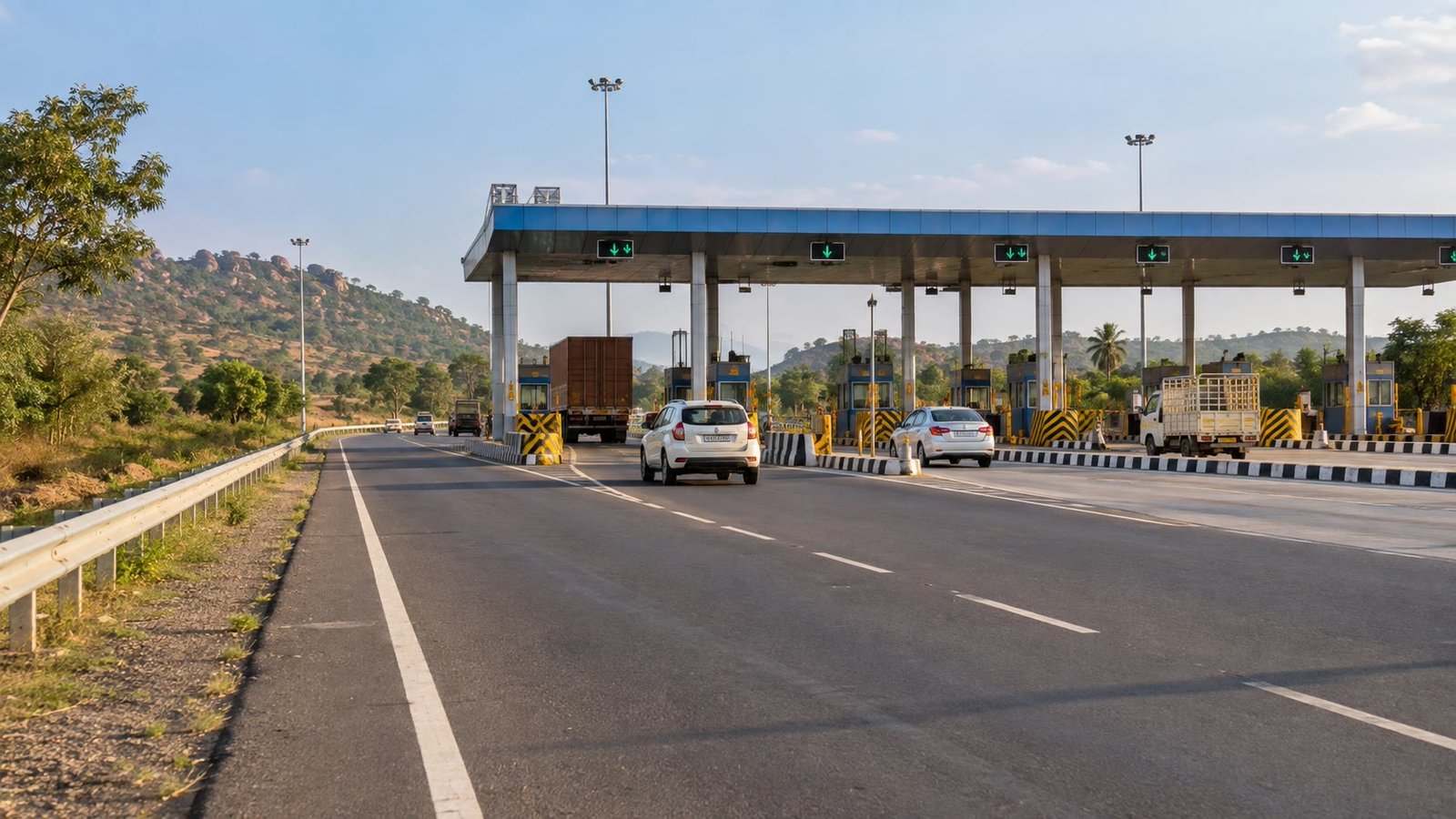
The Ministry of Road Transport and Highways (MoRTH) has notified the user-fee framework for the Valigonda–Thorrur section of National Highway 930P in Telangana. The notification authorises the National Highways Authority of India (NHAI) to collect the fee at a plaza near Choullaramaram, but the single-journey amount will be calculated and published by NHAI under the national highway fee rules.
For people who live near the plaza and use this corridor regularly, the immediately stated figure is a ₹360 monthly pass for 2026-27. That pass is for a non-commercial mechanical vehicle owned by a person who resides within 20 km of the plaza; it is separate from the ordinary one-way toll and is subject to annual revision.
- The notification is S.O. 5319(E), dated 28 Sep 2026.
- The fee plaza is at km 76.100 of NH-930P in Choullaramaram village, Yadadri Bhuvanagiri district.
- The notified base rate for a car, jeep, van or light motor vehicle is ₹0.65 per km for the 2007-08 base year.
- NHAI must calculate the actual charge from the completed section and revise it annually.
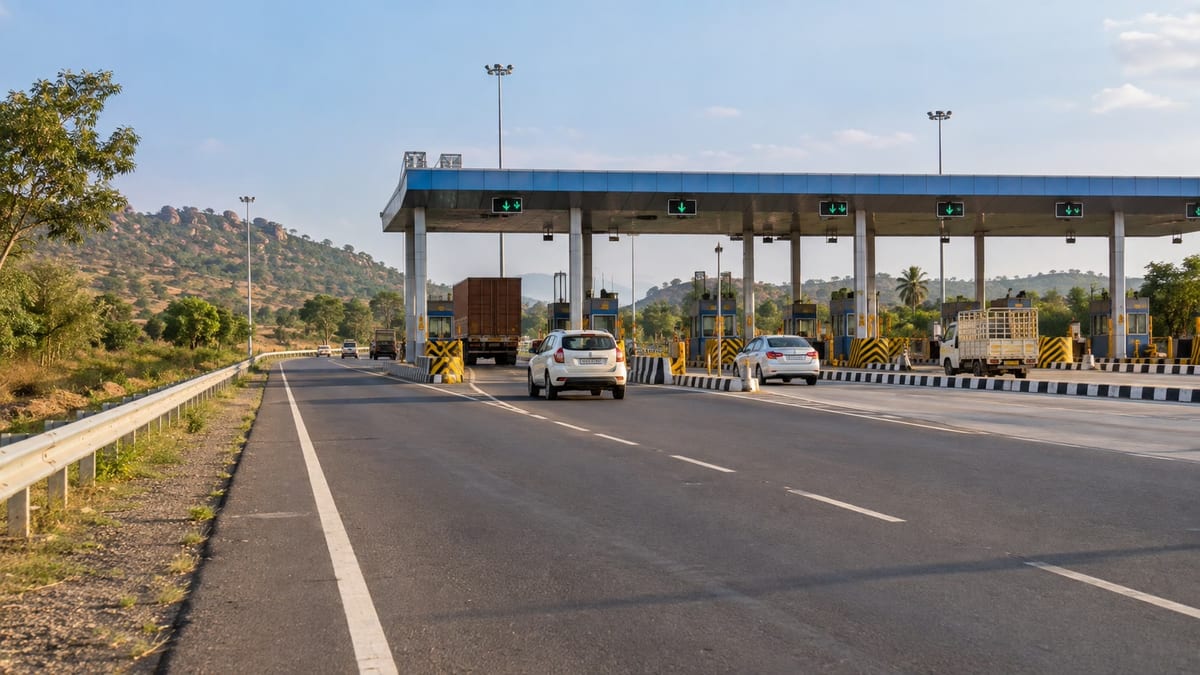 Representative toll-plaza visual for the NH-930P user-fee report; FuelPrice editorial illustration, AI-generated.
What the 28 Sep notification changes
The official Gazette notification covers the Valigonda–Thorrur section from design chainage km 39/180 to km 108/300. It sets the legal basis for user-fee collection and identifies the point where the fee will be collected. It does not turn the ₹360 local pass into a general toll rate for every driver.
The fee calculation covers a mix of road and structure lengths. For the two-lane section with paved shoulders, the notification applies 60% of the base rate to 68.112 km of road length and to 4.420 km of equivalent bridge length. A further 0.420 km of four-or-more-lane road length and 1.460 km of equivalent bridge length are charged at 100% of the relevant base rate.
| Vehicle category | Base rate per km | Notification basis |
|---|---|---|
| Car, jeep, van or light motor vehicle | ₹0.65 | 2007-08 base year |
| Light commercial vehicle, light goods vehicle or mini bus | ₹1.05 | 2007-08 base year |
| Bus or two-axle truck | ₹2.20 | 2007-08 base year |
| Three-axle commercial vehicle | ₹2.40 | 2007-08 base year |
| Oversized vehicle with seven or more axles | ₹4.20 | 2007-08 base year |
These are base rates, not a promise of the final amount that will be debited from a FASTag. Using the Gazette’s lengths and percentages, the car category works out to about ₹29.51 on a simple 2007-08 base-year calculation before NHAI’s completed-length calculation and annual revision. That arithmetic is useful for understanding the structure, but it should not be treated as the current payable toll.
Who can use the ₹360 monthly pass
Section 3 of the notification fixes the monthly-pass rate at ₹360 for 2026-27. Eligibility is narrower than simply being a local driver: the mechanical vehicle must be registered for non-commercial use, and the owner must reside within 20 km of the fee plaza. The rate is subject to revision every year, so the figure should be read with the stated financial year rather than as a permanent price.
The same notification also provides a multiple-journey structure. Two one-way journeys within 24 hours are available at one-and-a-half times the one-way fee. A 50-one-way-journey pass for one month is priced at two-thirds of the amount for 50 single journeys. The actual rupee amounts for these options will depend on NHAI’s published fee schedule.
What it means for daily trips and fleets
For a commuter living near Choullaramaram, the local monthly pass is the clearest number to track. A driver who crosses the plaza frequently should first confirm residence, vehicle-use category and the period for which the pass is valid. The notification does not say that the pass applies to commercial taxis, goods vehicles or national-permit vehicles.
For other private-car users, the practical effect is that a route that previously had no notified user-fee framework may acquire an additional trip-cost component once NHAI displays the final rate. Drivers can compare the toll with fuel and travel time in the toll-charge calculator before planning a regular journey.
Transport operators face a different calculation because the base rate rises by vehicle category. A two-axle bus or truck has a notified base rate of ₹2.20 per km, while an oversized vehicle with seven or more axles has a base rate of ₹4.20 per km. Commercial vehicles registered in the district where the plaza is located may qualify for a 50% fee, but only when no service road or alternative road is available and subject to the notification’s conditions.
That means fleet managers should wait for the displayed category-wise schedule and then add the confirmed toll to fuel, driver and turnaround costs. A route-level estimate can be paired with FuelPrice’s fuel cost calculator; neither tool should be populated with ₹360 unless the vehicle and owner meet the local-pass conditions.
What drivers should check before using NH-930P
- Look for NHAI’s displayed fee schedule at the plaza and confirm whether collection has begun before treating the notification as a live debit.
- Keep the vehicle’s FASTag active and linked to the correct registration details for electronic tolling.
- Check whether the vehicle falls under car, light commercial, two-axle, three-axle or oversized categories.
- If claiming the local pass, verify both the 20-km residence condition and non-commercial registration requirement.
- Do not assume the 50% commercial-vehicle provision applies where a service road or alternative route is available.
Route users can also compare the corridor’s expected toll, fuel and travel-time choices in the road-trip planner once NHAI publishes the operational rate.
What to watch next
The next useful update is NHAI’s public fee display and any notice stating when collection begins. The Gazette says NHAI will calculate the actual amount from the completed length, revise the rates annually under Rule 5 and publish the schedule in English and a vernacular newspaper. It also requires the rates to be displayed for users under Rule 12.
Drivers should therefore distinguish between the Gazette’s legal notification, the base-year vehicle rates and the final current toll. The ₹360 figure is already specified for eligible local non-commercial vehicle owners for 2026-27, while the single-journey charge remains a number to confirm from NHAI’s displayed schedule. For now, the useful preparation is to identify the fee plaza, check eligibility and avoid using the local-pass figure as a blanket estimate for every trip.