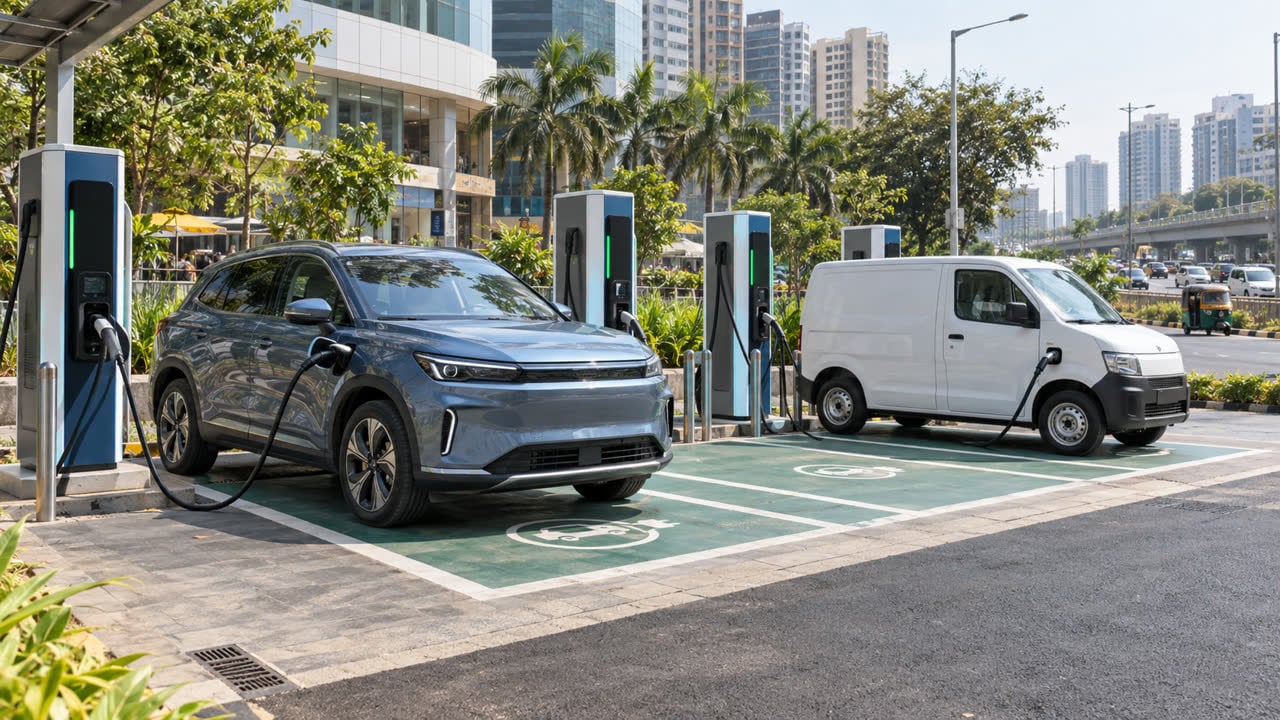
Tata Power EZ Charge has commissioned a 24/7 public EV charging hub at New Mahakali Nagar in Malvani, Malad West, Mumbai. The addition matters because private EV owners and commercial fleets now have another fast-charging stop in a busy western-Mumbai corridor, although drivers still need to check live availability and the applicable session tariff before they arrive.
Key takeaways
- The new Malad hub has eight dedicated parking bays and four fast-charging units.
- Its charger mix is one 120 kW unit and three 60 kW units, with the latter upgradable to 120 kW.
- The station is reported to operate 24/7, with no parking charges, and is open to public and fleet EV users.
- All four chargers support the CCS2 standard and include an auto-charging feature.
- Tata Power's reported network exceeds 2,400 charging points across Maharashtra, including more than 1,800 across Mumbai and Navi Mumbai.
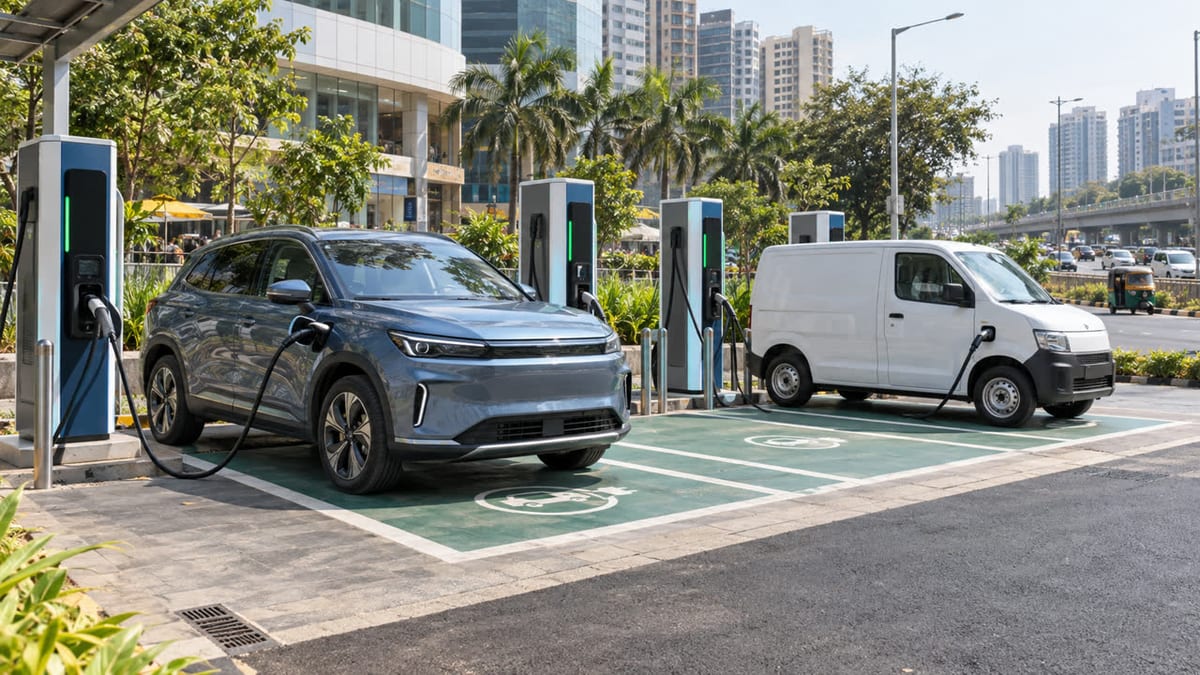 Representative AI-generated editorial illustration of an urban EV charging hub; not an official Tata Power photograph.
What Tata Power added in Malad
Two specialist auto and technology publications reported on 24 Sep 2026 that Tata Power EZ Charge had commissioned the facility at New Mahakali Nagar, Malvani. The site is positioned near Mindspace Business Park and Infinity Mall, placing it close to office, retail and local-commuting traffic rather than on a remote highway stop.
The reported layout includes eight dedicated bays and four high-capacity fast chargers. One charger is rated at 120 kW, while three are rated at 60 kW and can be upgraded to 120 kW. The units support CCS2 connectors and include auto-charging, which is intended to reduce manual authentication steps for compatible sessions.
What the charger mix means for drivers
A charger's kW rating is its maximum delivery capability, not a promise that every vehicle will receive that output. The actual rate depends on the vehicle's own charging limit, battery state of charge, temperature, session settings and any load-management controls at the site. A car that cannot accept 120 kW will not charge faster simply because it is connected to the 120 kW unit.
That makes the Malad hub most useful when the vehicle, connector and route all line up. CCS2 support covers a broad range of electric cars and commercial vehicles, but owners should still check their vehicle's inlet and maximum DC charging input before planning around the fastest unit.
The reports say the site has no parking charges, but that should not be read as free electricity. They do not state a single universal charging tariff for every vehicle or session. Users should confirm the current price, payment method and any idle-time condition in the Tata Power EZ Charge app before plugging in.
FuelPrice readers can also use the state-wise EV station directory to compare charging options when a Malad stop is not convenient.
Who the Malad hub is likely to help
For private owners, a public fast charger in a commercial neighbourhood can be useful between home-charging sessions, especially for residents without a dedicated parking socket. The location may also suit drivers who combine charging with work or shopping, although the practical benefit depends on bay availability at the time of arrival.
Fleet operators are another clear audience. A 24/7 site with multiple bays can give electric delivery vans, taxis and other commercial vehicles a place to recharge outside normal office hours. That does not remove the need for shift planning: a charger can be operational and still have a queue during demand peaks, so fleet managers should treat the app's live status as more useful than the headline charger count.
Network context: useful, but not a guarantee
According to the two same-day reports, the addition takes Tata Power EZ Charge's Maharashtra footprint to more than 2,400 charging points, with more than 1,800 across Mumbai and Navi Mumbai. Those figures show why a directory and live-status map matter: a large network can offer more route choices, but the nearest point is not automatically the fastest, available or compatible one.
The reported Maharashtra total is a network count, not a measure of simultaneous capacity. Chargers can differ by location, output, connector, operating conditions and access rules. For longer journeys, drivers should build a backup option into the route rather than assume that one station will always be free.
What EV users should check before heading there
- Open the EZ Charge app and confirm that the Malad location is visible, operational and showing an available connector.
- Check whether the vehicle uses CCS2 and whether its DC charging system can make use of the available power.
- Review the current charging price, payment flow and any idle-time terms; the no-parking-charge detail does not set the electricity tariff.
- Allow for the possibility of a queue during commuter or fleet peaks, even though the hub is listed as operating around the clock.
- Use the FuelPrice road-trip planner to map a longer journey with a charging fallback, and compare an equivalent petrol or diesel route with the fuel-cost calculator.
What to watch next
The immediate question for users is not only how many chargers have been installed, but how reliably the site shows availability, how sessions are priced and how quickly vehicles can move through the bays. Those details will determine whether the hub becomes a dependable stop for regular commuters and fleets.
For now, the Malad opening is a local infrastructure gain rather than a blanket answer to Mumbai's charging needs. Its value is clearest for drivers who can verify the connector, power compatibility, price and live status before making the detour.