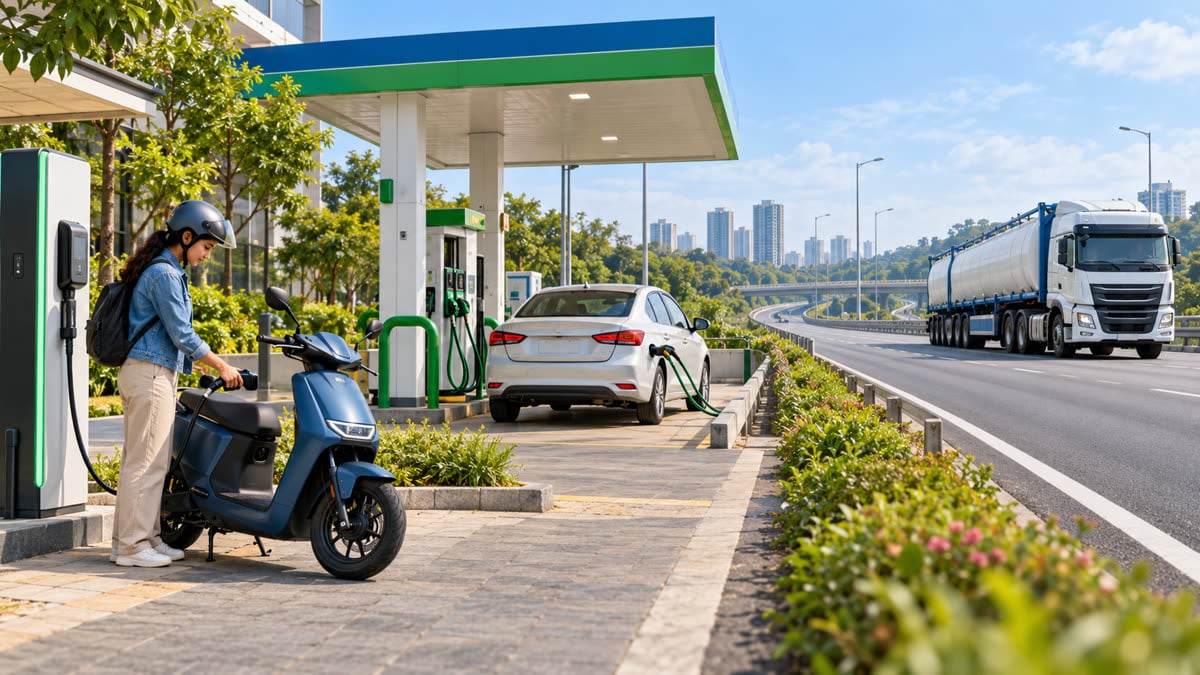
India's road-fuel transition may not have one winner. A study released by The Energy and Resources Institute (TERI) on 30 Sep 2026 calls for a segmented approach in which electric vehicles (EVs), compressed natural gas (CNG) and liquefied natural gas (LNG) are matched to different vehicle types, operating patterns and infrastructure instead of one fuel being treated as the universal replacement.
Key takeaways
- TERI assessed petrol, diesel, CNG, electricity and LNG across six vehicle segments.
- The study sees strong potential for EVs in smaller and urban mobility, continued relevance for CNG in passenger and commercial applications, and a role for LNG in suitable long-haul freight.
- Economic suitability is the strongest overall factor, alongside infrastructure readiness, life-cycle performance, affordability and energy security.
- The findings are a research-backed recommendation, not a new government mandate or a direction to buy one type of vehicle.
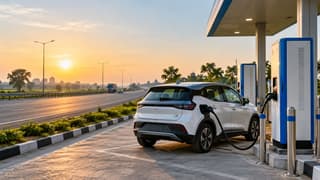
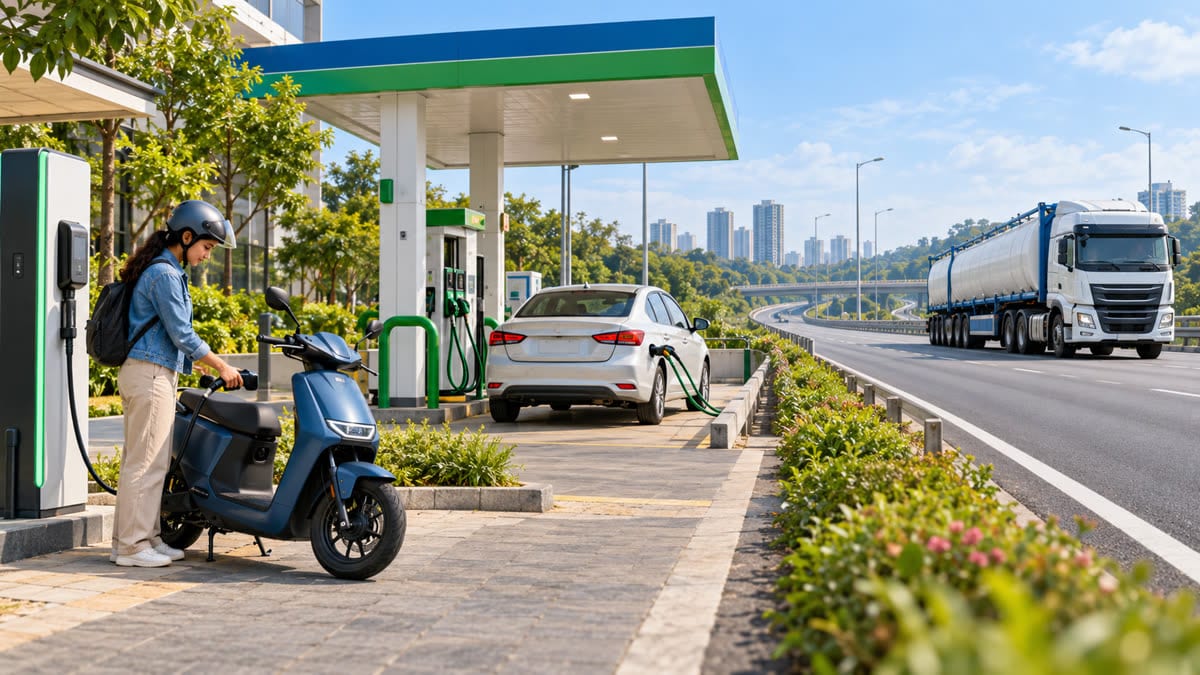 Illustrative editorial illustration of EV, CNG and long-haul mobility in a multi-fuel road transition. Credit: FuelPrice editorial illustration; not a photograph of a specific vehicle or station.
What the TERI study examined
TERI's assessment covered five fuel and technology pathways—petrol, diesel, CNG, electricity and LNG—across six segments: two-wheelers, three-wheelers, private four-wheelers, commercial four-wheelers, light commercial vehicles and heavy-duty vehicles. It compared them across technical, environmental, economic, social and geopolitical considerations rather than looking only at tailpipe emissions or the fuel price at the pump.
That distinction matters because a vehicle's practical cost depends on more than its energy source. The study also considered infrastructure readiness, vehicle characteristics, affordability, operating conditions and energy security. TERI said economic considerations were the strongest overall determinant of technology suitability. Independent reports by ETAuto and Autocar Professional described the same fleet-specific conclusion: no single fuel performs best across every category.
For a private driver, the useful starting point is the vehicle's actual duty cycle. Daily distance, traffic, passenger load, access to charging or refuelling and the time available between trips can change the result. A broad national trend should not be treated as a personal running-cost estimate; readers can use the fuel cost calculator with their own distance and mileage assumptions.
What it means for different vehicle users
Urban two-wheelers and smaller vehicles
TERI's release highlights strong potential for electric mobility in smaller and urban segments. This points to use cases where trips are predictable, vehicles return to a known parking location and charging can be planned around the daily schedule. For an urban rider, the practical question is therefore not simply whether an EV has a claimed range, but whether reliable charging is available at home, work or along the regular route. FuelPrice's state-wise EV charging directory can help readers check the infrastructure context before comparing models.
Passenger cars, taxis and light commercial vehicles
The study sees CNG retaining relevance across several passenger and commercial applications. CNG can remain practical where refuelling access, vehicle utilisation and local operating costs fit the duty cycle. That is a segment finding, not a promise that every CNG car will cost less for every owner. Current rates vary by city and state, so readers comparing a CNG vehicle with a petrol or electric alternative can start with CNG prices across Indian states and then test their own usage.
For taxis, buses and light commercial fleets, the comparison also includes downtime. A lower energy cost is less useful if the vehicle's route or operating schedule does not match the available refuelling or charging network. The TERI approach is valuable here because it brings operating practicality and infrastructure into the same assessment as environmental performance.
Long-haul freight and heavy vehicles
LNG has a more targeted role in the study: suitable long-haul freight applications where range, payload and refuelling time remain important. Battery-electric trucks may work well on predictable, depot-based routes, but long-distance freight requires corridor-scale charging, sufficient payload after battery weight and commercially workable turnaround times. TERI's finding is not that electric trucks cannot improve; it is that the right technology depends on the route and load.
Why a one-size-fits-all policy is difficult
India's road transport system includes short urban trips, high-use three-wheelers, taxis, regional delivery vehicles and heavy trucks travelling across states. They do not face the same constraints. A technology that works for a scooter used on a fixed city commute may not suit a private car parked outdoors, a taxi that runs throughout the day or a truck that must maximise payload.
The study therefore calls for a phased, fleet-specific and region-sensitive transition. It also treats infrastructure as more than a station-count exercise: location, accessibility, operating capacity, charging time and refuelling time determine whether a vehicle is usable in practice. This has a direct implication for public spending and private investment: charging, CNG supply and LNG corridors need to be planned around real vehicle use rather than only headline installation numbers.
What changes now for drivers and buyers
Nothing automatically changes because a research institute has released a study. TERI's findings do not by themselves alter fuel prices, registration requirements or purchase eligibility. They are a proposal for a more technology-neutral policy framework and a way to compare trade-offs as infrastructure and vehicle costs evolve.
A careful comparison can include:
- the vehicle's daily distance, route pattern and expected annual use;
- where it can be charged or refuelled, and how long that stop takes;
- passenger or cargo requirements, especially for commercial work;
- purchase, service, insurance and financing costs over the period of use; and
- local energy prices and the availability of support when travelling outside the home city.
For a longer trip, the road-trip planner can help organise route assumptions, but fleet operators still need their own data on payload, turnaround and corridor access.
What to watch next
The next question is whether policymakers and industry groups act on the study's proposed framework. TERI has called for differentiated decisions by vehicle category, continued development of CNG and CBG infrastructure where justified, selective LNG corridors and better alignment between charging investment and actual usage. Those are recommendations, not confirmed rule changes.
For readers, the takeaway is straightforward: India's clean-mobility transition is likely to be more segmented than a simple petrol-to-EV switch. EVs may fit many predictable urban uses, CNG may remain relevant for passenger and commercial work where the network supports it, and LNG may serve selected freight corridors. The right comparison is the one that includes the vehicle's route, workload, infrastructure and total cost—not just its label.
Sources
- TERI — “TERI Unveils Landmark Study Charting a Segmented, Multi-Fuel Pathway for India's Vehicular Energy Transition” — 30 Sep 2026
- ETAuto — “TERI study sees diesel phase-down in India's road transport transition” — 30 Sep 2026
- Autocar Professional — “No Single Fuel Can Drive India's Auto Transition: TERI Study” — 30 Sep 2026