Uttar Pradesh has set a second-phase target to identify 1,500 locations for public electric vehicle (EV) charging stations under the PM E-DRIVE scheme, according to reports on the state review meeting. For EV owners, the announcement points to a larger future charging map, but it does not mean 1,500 new chargers are open to drivers today.
Key takeaways
- The Phase 2 target is to identify 1,500 suitable locations for charging stations across Uttar Pradesh.
- Reports said 99 MoUs have been signed against 238 identified sites in the first phase, with 139 still pending.
- Districts are being asked to shortlist public places, offices, bus stations, industrial parks, educational institutions, malls, dhabas and parking areas.
- The announcement is a planned expansion, not a live-station list or a guarantee that every proposed site will open soon.
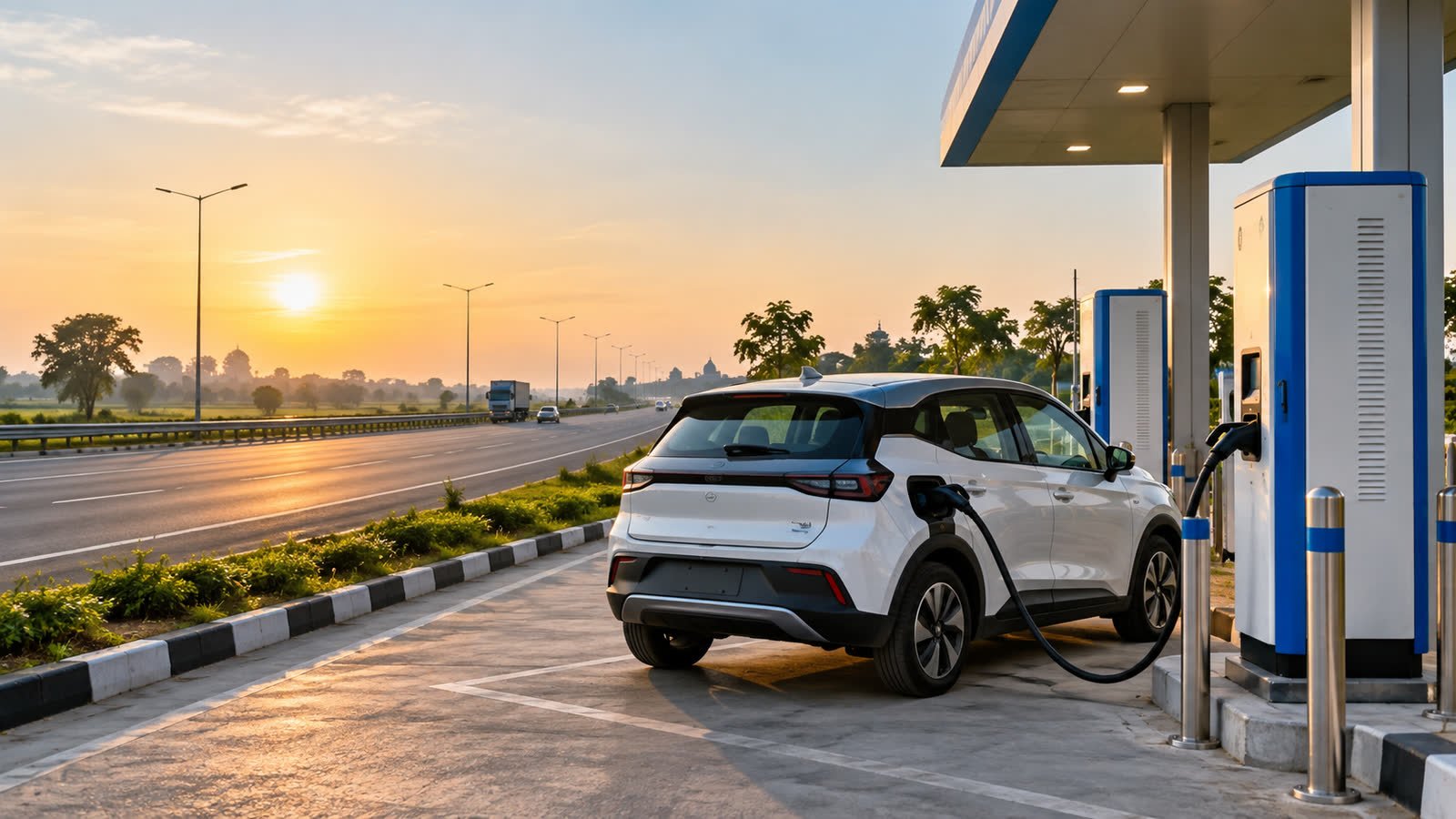
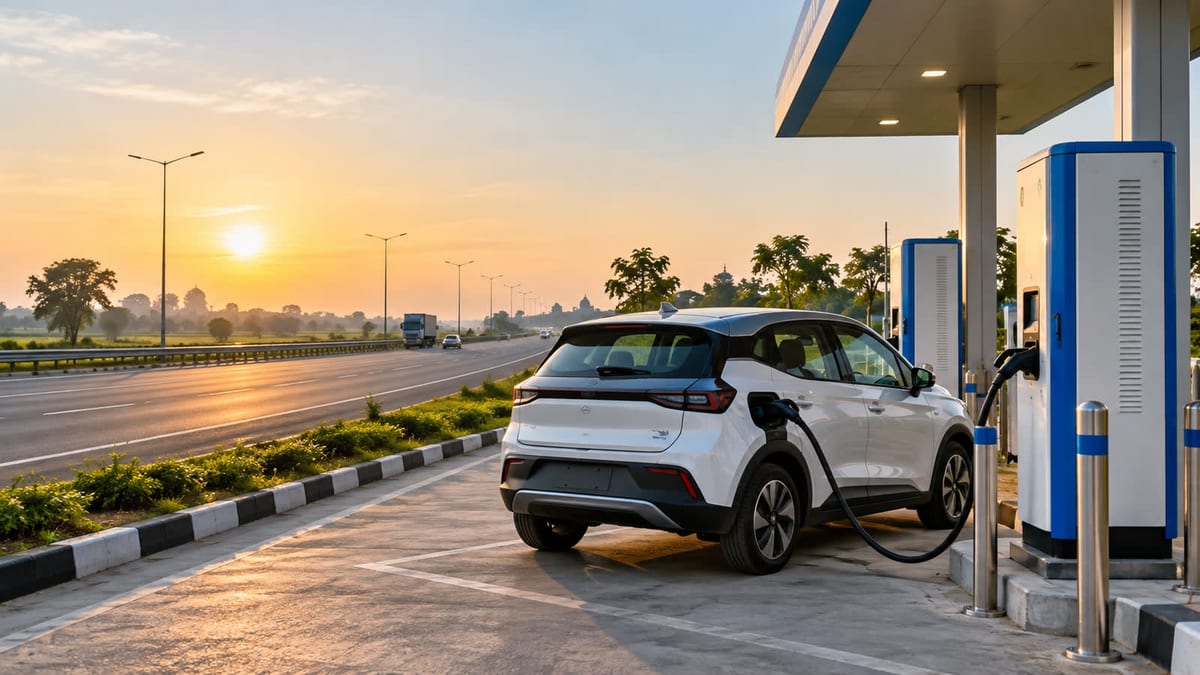 Illustrative visual of a public EV charging site beside an Indian highway; AI-generated by FuelPrice for representation.
What Uttar Pradesh has announced
The Times of India reported on 1 Oct 2026 that Chief Secretary S.P. Goyal reviewed the state’s charging-station work and was told that 99 MoUs had been signed for 238 identified locations under PM E-DRIVE. The report said the remaining sites were to be taken up quickly. UP Plus, in a report dated 30 Sep 2026, also said 139 agreements were pending.
The new part of the update is the second-phase target. District magistrates have been directed to identify suitable sites and send proposals to the concerned department. The wording matters: the immediate task is location identification and proposal-making, not the commissioning of 1,500 operating chargers.
Uttar Pradesh is already using a formal procurement route for public charging infrastructure. The state’s official e-procurement portal lists a UP Renewable and EV Infrastructure Ltd (UPREV) tender for setting up public charging stations under PM E-DRIVE. That supports the existence of an active rollout process, while the latest review reports describe the next planning target.
Why the target matters to EV users
Public charging availability can decide whether an EV is convenient beyond the home-to-office route. A wider spread of sites across cities, highways and roadside destinations could give private drivers, electric two-wheeler users, taxis and delivery fleets more options when a home charger is unavailable or a trip exceeds the vehicle’s practical range.
For an EV owner planning a trip in Uttar Pradesh, the useful question is not only how many locations have been announced, but which ones are actually powered, accessible and listed for public use. The state-wise EV station directory can help readers check available charging options as the network develops.
A location target is not the same as charger availability
The first-phase figures show why drivers should separate planning targets from operating infrastructure. An identified site still needs agreements, electrical connection, equipment installation, testing, payment access and ongoing operation before it becomes a dependable stop. Even after a station opens, connector compatibility, queue time, opening hours and uptime can affect a real journey.
That gap is especially important for fleet operators. A depot, office or industrial-park location may be useful for scheduled charging, while a highway-facing site is more relevant to intercity travel. The final mix of locations and charger types will determine whether the rollout helps short urban trips, long-distance travel, commercial vehicles, or all three.
Where the next sites may come up
UP Plus reported that officials were asked to consider public places, large government offices, bus stations, industrial parks, educational institutions, malls, dhabas and parking areas for the second phase. This is broader than a highway-only plan and could place charging closer to destinations where vehicles already stop.
However, a proposed location still has to work in practice. District authorities and implementing agencies will need to assess land access, power availability, traffic entry and exit, safety, parking space and the operating model. A site that is difficult to enter or has insufficient electrical capacity may add less value to a driver than a smaller but reliable station on a busy route.
What changes now for trip planning
There is no immediate change to an EV’s range, charging time or current station availability because of this announcement. Until individual sites are commissioned and published as operational, drivers should plan using currently available stations and keep a charging buffer for diversions, queues or a non-working unit.
- Check that the charging point is shown as operational before starting a long trip.
- Confirm the connector type, payment method and expected charging speed for the vehicle.
- Keep a backup stop where the route has long stretches between public chargers.
- Recheck the route when a new station is announced; a proposal is not yet a usable stop.
The road-trip planner can help organise stops and route timing. Drivers comparing an EV with a petrol or diesel vehicle can also use the fuel cost calculator to establish a fuel baseline; the actual EV cost will depend on home charging, public tariffs, charger type and the vehicle’s consumption.
What to watch next
The next meaningful milestones are district proposals, approvals, signed agreements, electrical connections, station commissioning and the publication of live operating details. A useful government or operator update would identify the district, site, charger type, access hours and payment arrangements rather than only repeat the statewide target.
For now, the 1,500-location figure is best read as a planning signal. It shows that Uttar Pradesh wants to move from the first phase of site identification towards a much wider network, but the benefit to EV drivers will be measured by live, reliable chargers. Until that information is available, the announcement is relevant to future route coverage rather than a reason to change a trip planned for today.
Sources
- UP sets target of 1,500 EV charging stations — The Times of India, 1 Oct 2026.
- UP Chief Secretary sets 1,500-site target for EV charging stations — UP Plus, 30 Sep 2026.
- Setting Up of Public Charging Stations under PM E-DRIVE Scheme for Electric Vehicles in Uttar Pradesh — Uttar Pradesh eProcurement portal, 4 Sep 2026.