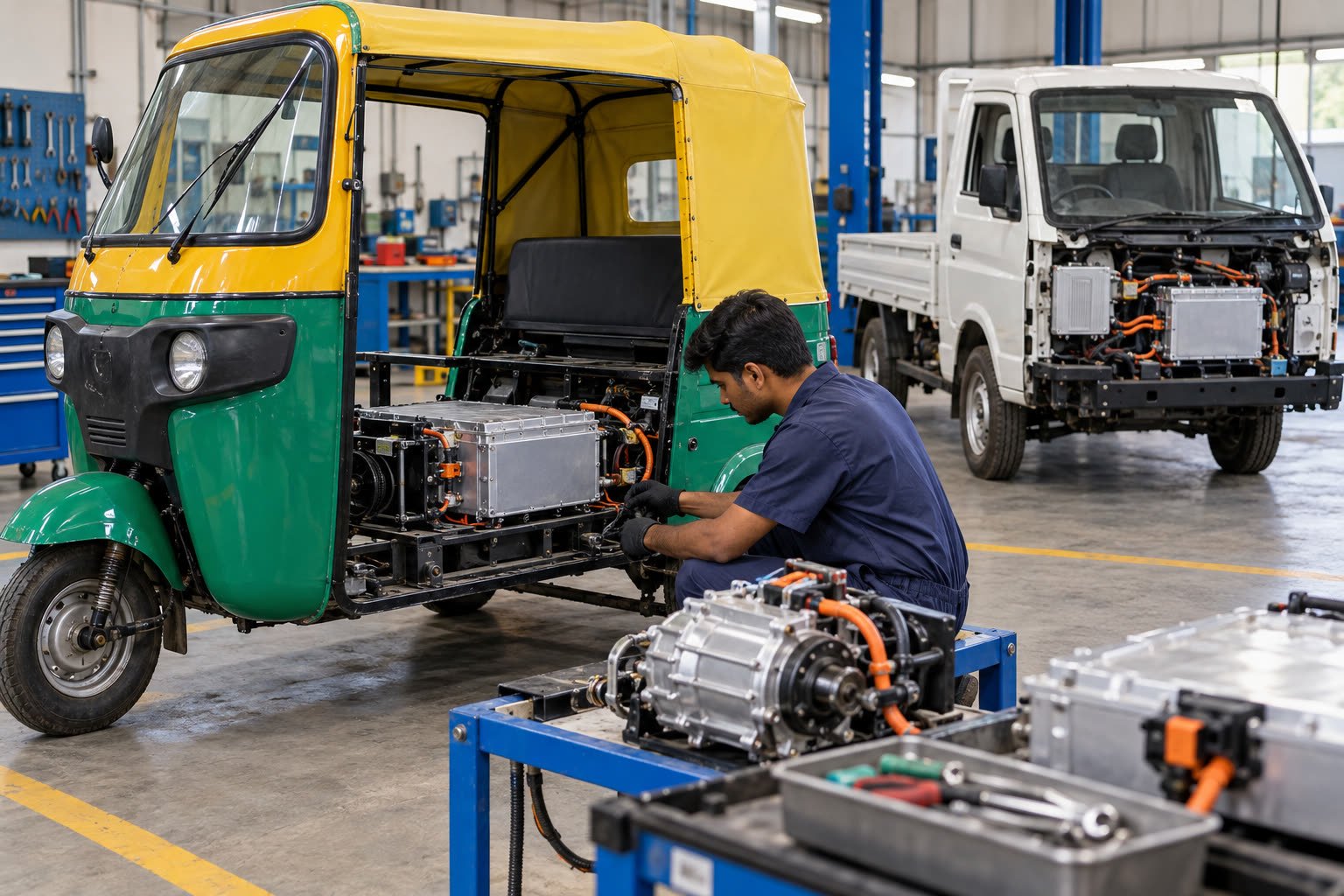
Tsuyo Manufacturing has called for government incentives for electric-vehicle conversion kits, arguing that retrofitting existing commercial vehicles could widen fleet electrification. The proposal is not a new subsidy or approval: as of 26 Oct 2026, it is a company request, while any retrofit still has to meet India's approval, installation and registration requirements.
Key takeaways
- Tsuyo's incentive request is a reported company proposal, not a confirmed government policy or open subsidy scheme.
- The company has discussed retrofit opportunities for three-wheelers and light commercial vehicles, but a discussed kit is not automatically a commercially available or approved product.
- The published PM E-DRIVE categories focus on electric vehicles and vehicles supported under the scheme; they do not set out a general conversion-kit incentive.
- Conversion work still needs the applicable approval, an authorised installer and the required vehicle-record update.
- Fleet operators need to compare downtime, payload, range, charging access, service support and insurance treatment alongside the conversion price.
What Tsuyo is asking for
ETAuto reported on 26 Oct 2026 that Tsuyo Manufacturing wants incentives for batteries and electric-vehicle conversion kits. The report frames the opportunity around existing commercial vehicles, including three-wheelers and light commercial vehicles, rather than only the purchase of new electric vehicles.
Motown India separately reported the same day that Tsuyo is looking at electric-vehicle retrofits, particularly for three-wheelers and commercial vehicles, and that the company believes incentives should extend to conversions. That independent report also points to the practical issues that determine whether a retrofit works for a fleet: conversion cost, battery prices, regulatory approvals, charging access and service support.
That distinction matters for readers. Tsuyo's position is a request for policy support; it is not evidence that the government has approved a new incentive, that a particular kit is available for purchase, or that a converted vehicle will deliver a guaranteed saving.
What current central EV support says
The Ministry of Heavy Industries' official PM E-DRIVE explainer lists support categories such as electric two-wheelers, three-wheelers, trucks, ambulances, buses and public charging infrastructure. Its published categories do not contain a general line for conversion kits. That means fleet owners should not assume that a new vehicle incentive automatically applies when an existing petrol, diesel or CNG vehicle is converted.
The scheme position can change through an official notification, and state-level programmes may use different rules. Until a competent authority publishes an applicable provision, Tsuyo's proposal should be described as proposed support rather than a benefit that a fleet can claim. The official scheme explainer is therefore more useful as a boundary: it shows what the current central programme publicly names, while leaving the policy question raised by Tsuyo unresolved.
Retrofit is a regulated vehicle alteration
A conversion is not only a battery-and-motor purchase. The Ministry of Road Transport and Highways' AIS-123 Part 3 requirements address electric propulsion kits, including the role of an authorised installer, the tools and records needed for installation, and continuing checks related to the converted vehicle. A workshop's ability to fit hardware is not, by itself, proof that the completed vehicle meets the applicable requirements.
Vehicle records matter too. Parivahan's official Form 22D is the application for endorsement of alteration or retrofitment. It asks the owner to have the conversion details recorded by the registering authority in accordance with the applicable compliance documents. A fleet considering a retrofit should keep the kit approval reference, installer details, invoices, test or compliance papers and the updated registration record together.
Insurance should be checked as a separate part of the process. Ask the insurer how the altered powertrain, declared use, vehicle value and policy documents will be handled, because coverage and pricing depend on the insurer, product and vehicle profile. The article does not treat an approval or a policy proposal as a promise of insurance acceptance.
What it could mean for commercial fleets
For a fleet with serviceable vehicles, a compliant conversion could eventually offer a way to change the powertrain without replacing every vehicle at once. Reusing the body and operating base may also reduce the disruption of a full fleet replacement. Those are potential operating advantages, not guaranteed savings; the result depends on the kit, vehicle condition, route, payload, charging pattern and maintenance contract.
The first comparison should be the whole-life cost. Set the proposed conversion cost, installation downtime, financing or lease impact, battery warranty, service visits and end-of-life plan against the existing vehicle's fuel and maintenance costs. A fleet can use the fuel-cost calculator to establish a current route or monthly fuel baseline, then compare it with the expected electricity and charging arrangement supplied by the converter. The calculation should use the fleet's real duty cycle rather than a brochure range.
Charging is equally important. A vehicle that returns to a depot can have a different operating case from one that runs continuously between towns. Check the state-wise EV charging directory for route and depot coverage, and use the road-trip planner to think through charging stops and usable range on representative routes. These tools cannot certify a conversion, but they can expose an operational mismatch before a fleet commits.
What to check before a conversion
- Approval: identify the applicable type-approval or kit-compliance reference for the exact vehicle variant and intended use.
- Installer: confirm that the installer is authorised for that kit and can provide installation records and post-fitment support.
- Registration: establish how the alteration will be endorsed in the registration record and what documents the registering authority requires.
- Operations: compare usable range, payload, charging time, route availability, downtime and service response with the vehicle's actual duty cycle.
- Risk and warranty: clarify battery, motor and controller warranties, accident or water-damage handling, fitness or permit implications, and the insurer's documentation requirements.
What to watch next
The next meaningful development would be an official policy response, a state or central incentive that expressly covers conversion kits, or a commercially available kit with the required approvals and documentation. Fleet pilots could also show whether retrofit economics work outside a demonstration setting.
Until then, the useful takeaway is simple: Tsuyo has put conversion incentives on the policy agenda, but fleet owners should treat the idea as a reported proposal. The decision point is not just whether a battery can replace an engine; it is whether the complete, documented conversion can operate legally, reliably and economically on the fleet's real routes.
Sources
- ETAuto — Tsuyo seeks incentives for EV conversion kits, says policy support can unlock demand — 26 Oct 2026
- Motown India — Tsuyo Manufacturing eyes world-class EV Tech — 26 Oct 2026
- Ministry of Heavy Industries / PIB — PM E-DRIVE Scheme and Promotion of Electric Mobility — 28 Jul 2026
- Ministry of Road Transport and Highways — AIS-123 Part 3 with amendments — accessed 27 Oct 2026
- Parivahan — Form 22D: Endorsement of Alteration/Retrofitment — accessed 27 Oct 2026