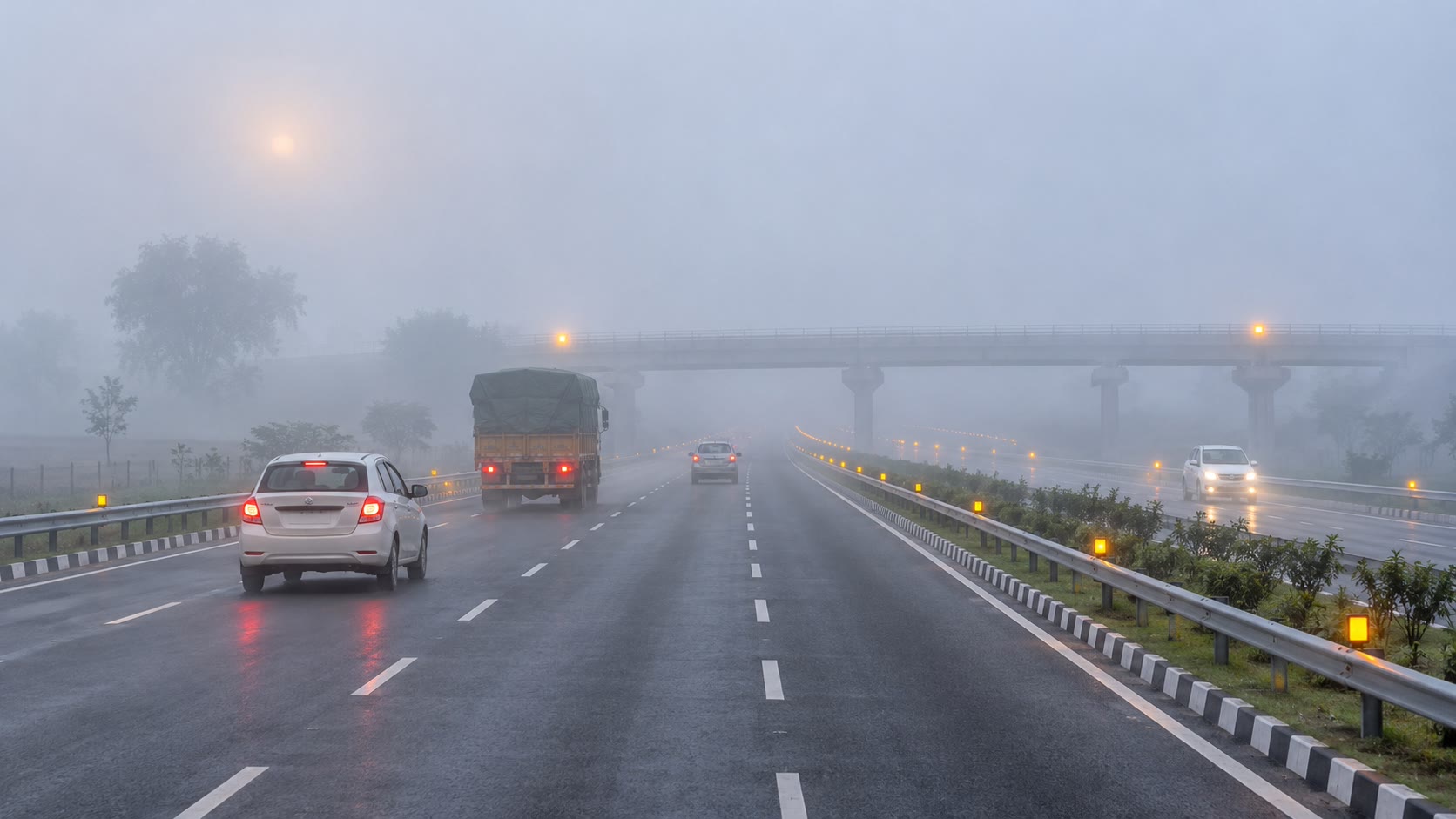
Uttar Pradesh will enforce lower winter speed limits on five state expressways from 15 Nov 2026, with light motor vehicles capped at 80 km/h during the day and 60 km/h at night. The Uttar Pradesh Expressways Industrial Development Authority (UPEIDA) says the fog-season measures are intended to reduce crashes when visibility falls, and will run until 15 Feb 2027 or until fog conditions return to normal, whichever comes first.
The change covers the Agra-Lucknow, Purvanchal, Bundelkhand, Gorakhpur Link and Ganga expressways. UPEIDA also says its Advanced Traffic Management System (ATMS), fog patrols and emergency teams will support enforcement and incident response. The immediate takeaway for motorists is simple: a trip that normally relies on the regular expressway limit may take longer, especially at night or in dense fog.
Key takeaways
- The revised caps start on 15 Nov 2026 and are scheduled through 15 Feb 2027, or until fog conditions improve.
- Light motor vehicles, including cars and jeeps, are limited to 80 km/h by day and 60 km/h at night.
- M-2 and M-3 passenger vehicles face 60 km/h by day and 50 km/h at night; freight vehicles face 50 km/h and 40 km/h.
- UPEIDA plans 24x7 patrol, ambulance and emergency support, warning systems and ATMS-based monitoring.
What changes from 15 November
The official UPEIDA update dated 12 Nov 2026 sets separate limits by vehicle category and time of day. Daytime is treated as 8 am to 8 pm and night-time as 8 pm to 8 am in the reported schedule. Drivers should follow the lower limit displayed on the route if a variable message sign or local warning gives an additional restriction.
| Vehicle category | Day limit | Night limit |
|---|---|---|
| Light motor vehicles and M-1 vehicles | 80 km/h | 60 km/h |
| M-2 and M-3 passenger vehicles | 60 km/h | 50 km/h |
| Freight vehicles | 50 km/h | 40 km/h |
In this classification, M-1 broadly covers cars, jeeps and private vehicles with up to eight passenger seats. M-2 and M-3 cover passenger vehicles such as buses and larger people carriers, while freight vehicles are in the N category. The limits are caps, not target speeds: visibility, traffic, roadworks and posted instructions may require a slower pace.
Which routes are covered
The measure applies to five UPEIDA-linked corridors: the Agra-Lucknow Expressway, Purvanchal Expressway, Bundelkhand Expressway, Gorakhpur Link Expressway and Ganga Expressway. The authority's plan is not a blanket rule for every road in Uttar Pradesh; a driver entering another corridor should check the operator's signs and current advisory before assuming that the same limit applies.
The timing matters for return journeys and commercial movement. UPEIDA is preparing for winter visibility problems on corridors that carry long-distance passenger traffic, goods vehicles and festive-season travel. Lower night-time limits can affect arrival estimates for inter-city trips, while freight operators may need more schedule margin for loading windows and driver rest without treating the speed cap as a reason to extend duty hours.
What it means for a real trip
Motorists should budget extra time rather than trying to recover time through overtaking or sudden acceleration. Fog, slower traffic and controlled movement can add delay even when the road itself is open. Use the road-trip planner to build a route with a practical time buffer, particularly if the journey includes a night section.
Expressway tolls and state-operated corridors are separate from the speed-limit order. Checking the route in the toll-charge calculator can help keep the toll budget distinct from fuel and delay costs. If a slower or more congested journey changes the fuel estimate, compare the distance and vehicle-efficiency assumptions in the fuel cost calculator.
There is no reliable single rupee figure for the fuel effect of slower fog-season travel. A lower cruising speed can reduce high-speed fuel use for some vehicles, but queues, stop-start movement, cold starts and detours can offset that difference. The useful comparison is the reader's actual vehicle, route and expected traffic—not a generic mileage claim.
Safety and enforcement arrangements
UPEIDA says the five corridors will have 24x7 monitoring and additional patrol teams, ambulances, patrol vehicles and emergency support during the fog period. It also lists fog lights, reflective tape, warning signs and blinkers among the measures to be deployed, with public announcements and displays at toll plazas.
The authority's update says vehicles will be guided towards safe locations when visibility falls below 50 metres. That is especially relevant to drivers who may otherwise continue at normal expressway speed after the road ahead disappears into mist. A clean windscreen, low-beam lighting, functioning fog lamps and a larger following gap are practical checks before entering a fog bank; high-beam glare can make visibility worse for the driver and other road users.
What drivers and fleet operators should check
- Confirm the corridor and the latest UPEIDA message before departure, especially for a night journey.
- Use the posted speed limit and keep enough distance to stop within the visible road ahead.
- Allow for slower travel at toll plazas, safe holding areas or sections where visibility is below 50 metres.
- Fleet managers should update arrival estimates and avoid building a schedule that assumes the normal speed limit can be maintained.
What to watch next
The current schedule runs from 15 Nov 2026 to 15 Feb 2027, subject to fog conditions normalising earlier. Drivers should watch UPEIDA's route-level messages for any temporary holding, diversion or enforcement update, because winter visibility can vary sharply between sections of the same corridor. The present announcement changes speed and safety management; it does not announce a new toll rate.
Sources
- UPEIDA official account — winter fog-safety and revised speed-limit update — 12 Nov 2026
- Amar Ujala — Vehicles Will Not Be Able To Travel At High Speeds During Fog — 25 Oct 2026
- NDTV India — UP's five major expressways to follow lower winter speed limits — 25 Oct 2026
- Hindustan Times — Winter safety guidelines: UP expressways to enforce lower speed limits — 25 Oct 2026