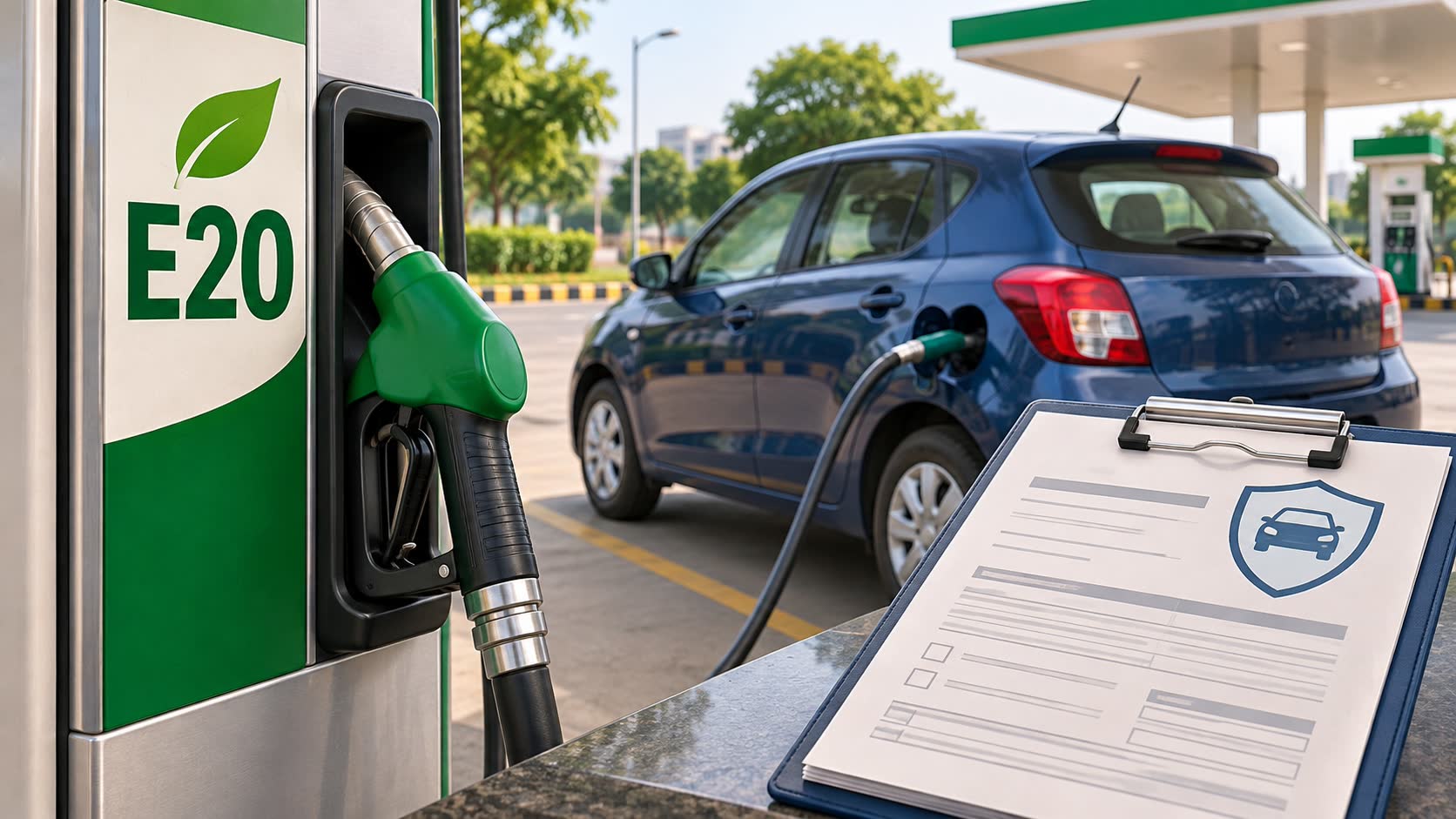
Using E20 petrol does not, by itself, cancel a valid motor-insurance policy in India, according to the government clarification and insurer guidance cited in a 13 Nov 2026 NDTV report. The practical distinction for owners is that an active policy is not the same as automatic cover for every mechanical or fuel-system repair.
Key takeaways
- E20 petrol is a blend of 20% ethanol and 80% conventional petrol.
- Government and insurer clarifications say filling E20 does not automatically invalidate motor insurance or justify rejecting a claim solely because of the fuel type.
- That does not turn every engine or fuel-system problem into an insured event; gradual deterioration and mechanical breakdown are commonly treated separately under policy terms.
- Official mileage guidance says some vehicles may see a 3–5% fuel-economy reduction, but the actual effect depends on the vehicle and operating conditions.
What is confirmed about E20 and insurance
E20 petrol contains 20% ethanol and 80% petrol. A fresh NDTV explainer published on 13 Nov 2026 said using the blend does not automatically invalidate a motor-insurance policy and that a claim cannot be rejected merely because the vehicle was filled with ethanol-blended petrol.
The government has made the same distinction in its official material. A PIB backgrounder dated 5 Jul 2026 lists the claim that insurers refuse E20-related claims and records the government and industry position that E20 has no impact on insurance or warranty validity in India when the fuel is used to the applicable specification. A 16 Jun 2026 Moneycontrol report also recorded the PIB Fact Check clarification that motor-insurance policies remain valid with E20.
This is a clarification of how fuel type relates to policy validity, not a promise that every repair bill will be paid. The claim still has to be assessed under the policy, the reported cause of damage and the vehicle's prescribed fuel requirements.
Policy validity is different from engine-damage cover
Motor insurance generally responds to insured events such as accidental damage, theft and other risks listed in the policy. It usually does not cover gradual wear, ordinary deterioration or a mechanical breakdown simply because a component has stopped working. Both the latest NDTV report and a 29 Jul 2026 Mint explainer make this separation between policy validity and mechanical-damage coverage.
In practical terms, an insurer should not treat the use of approved E20 petrol alone as proof that a policy has become invalid. At the same time, an owner should not assume that any later fuel-system or engine problem is automatically covered. The relevant questions are what happened, whether it was sudden or gradual, whether the vehicle was used within the manufacturer's fuel specification, and what exclusions or add-ons are written into the policy.
For a broader checklist of policy dates, renewal records and no-claim bonus documents, see the car insurance policy dates and renewal guide.
How much can mileage change?
There is no single mileage penalty that applies to every car or two-wheeler. The PIB's 10 Jul 2026 E20 FAQ says some vehicles may experience a 3–5% reduction in fuel economy and also notes that driving style, tyre pressure, servicing and air-conditioner use can have a larger real-world effect.
The range is not a promise of loss for every vehicle. It shows why the correct comparison is the same vehicle, same route pattern and similar traffic conditions over more than one refill. A vehicle's fuel specification and calibration matter more than its registration year alone.
Illustration, not a mileage guarantee: if a car normally returns 20 km/l and the low end of the government-cited 3% reduction applied, its calculated mileage would be about 19.4 km/l. A 200 km trip would then use about 10.31 litres instead of 10.00 litres, or roughly 0.31 litres more. To translate your own observed mileage into rupees, use the fuel cost calculator with the current price and your actual trip distance.
Fuel quality is a separate question
The insurance clarification should not be confused with a finding that every fuel sample or every vehicle will behave identically. On 7 Nov 2026, the Ministry of Petroleum and Natural Gas said 893 E20 samples collected across 27 states and Union Territories were within the prescribed 19–21% ethanol range under IS 17021. NDTV reported the same ministry statement while noting that the response followed competing claims about testing in Karnataka and a dispute over sampling methodology.
For drivers, the useful takeaway is that a compliant E20 supply and a vehicle's individual compatibility are separate checks. Fuel quality is controlled against a standard; mileage, service condition and claim assessment remain vehicle- and policy-specific.
What vehicle owners can check now
- Read the fuel-compatibility sticker, owner's manual or manufacturer guidance before treating an older vehicle's mileage change as an E20 fault.
- Compare tank-to-tank results over several refuels. Record the date, odometer reading, litres filled and route conditions instead of relying on one short trip or the dashboard estimate.
- Keep service records, fuel receipts, repair invoices and any diagnostic report if a vehicle develops a fuel-system or engine problem. NDTV's 13 Nov report said such records can help establish the nature and cause of damage during claim assessment.
- Check the policy wording for mechanical breakdown, wear-and-tear, fuel contamination and engine-protection provisions. The live fuel prices page can be used separately to see the current city rate when comparing running costs.
The reader takeaway
E20 petrol is not a reason to assume that motor insurance has disappeared. The confirmed position is narrower and more useful: approved E20 use alone does not cancel policy validity, but a mechanical repair still has to meet the policy's coverage and causation tests. Checking the vehicle's fuel specification, measuring real mileage and preserving service evidence gives owners a clearer basis for any later warranty or insurance conversation.
Sources
- E20 Petrol Mileage, Insurance: What Car Owners Must Know Before Refuelling — NDTV, 13 Nov 2026.
- Ethanol Blending in India: Policy Evolution, Key Milestones and Frequently Raised Concerns — Press Information Bureau, 5 Jul 2026.
- Ethanol Blended Petrol Programme: Frequently Asked Questions — Press Information Bureau, 10 Jul 2026.
- E20 Petrol Supplied by PSU Oil Marketing Companies Meets Prescribed Quality Standards; 893 Samples Across 27 States and UTs Found Compliant — Press Information Bureau, 7 Nov 2026.
- After Karnataka Charge, Centre Says E20 Petrol Meets Prescribed Standards — NDTV, 7 Nov 2026.
- Will using ethanol-blended petrol affect your car insurance? Here's what experts say — Mint, 29 Jul 2026.
- Will your motor insurance policy remain valid with E20 fuel use? Govt clarifies — Moneycontrol, 16 Jun 2026.
This article is for general information only and is not financial, insurance or legal advice.