Traffic was temporarily disrupted at the Veduru Pavuluru toll plaza on the Vijayawada West Bypass after truck drivers and toll staff disagreed over whether vehicles carrying material for government works should pay user fee on 4 Oct 2026. Police intervened, asked the drivers to pay the applicable toll and cleared the obstruction, according to reports; the episode does not describe a new blanket toll exemption for government-project trucks.
- The reported dispute took place at Veduru Pavuluru on the Vijayawada West Bypass section of NH-16 on 4 Oct 2026.
- Drivers said their tipper trucks were carrying material for a government transport project and claimed an exemption.
- The Times of India described a dispute involving a few drivers, while Disha Daily reported around 20 tipper lorries blocking six toll gates.
- NHAI’s official toll FAQ describes a narrower exemption for vehicles used by NHAI or a government organisation for specified national-highway work.
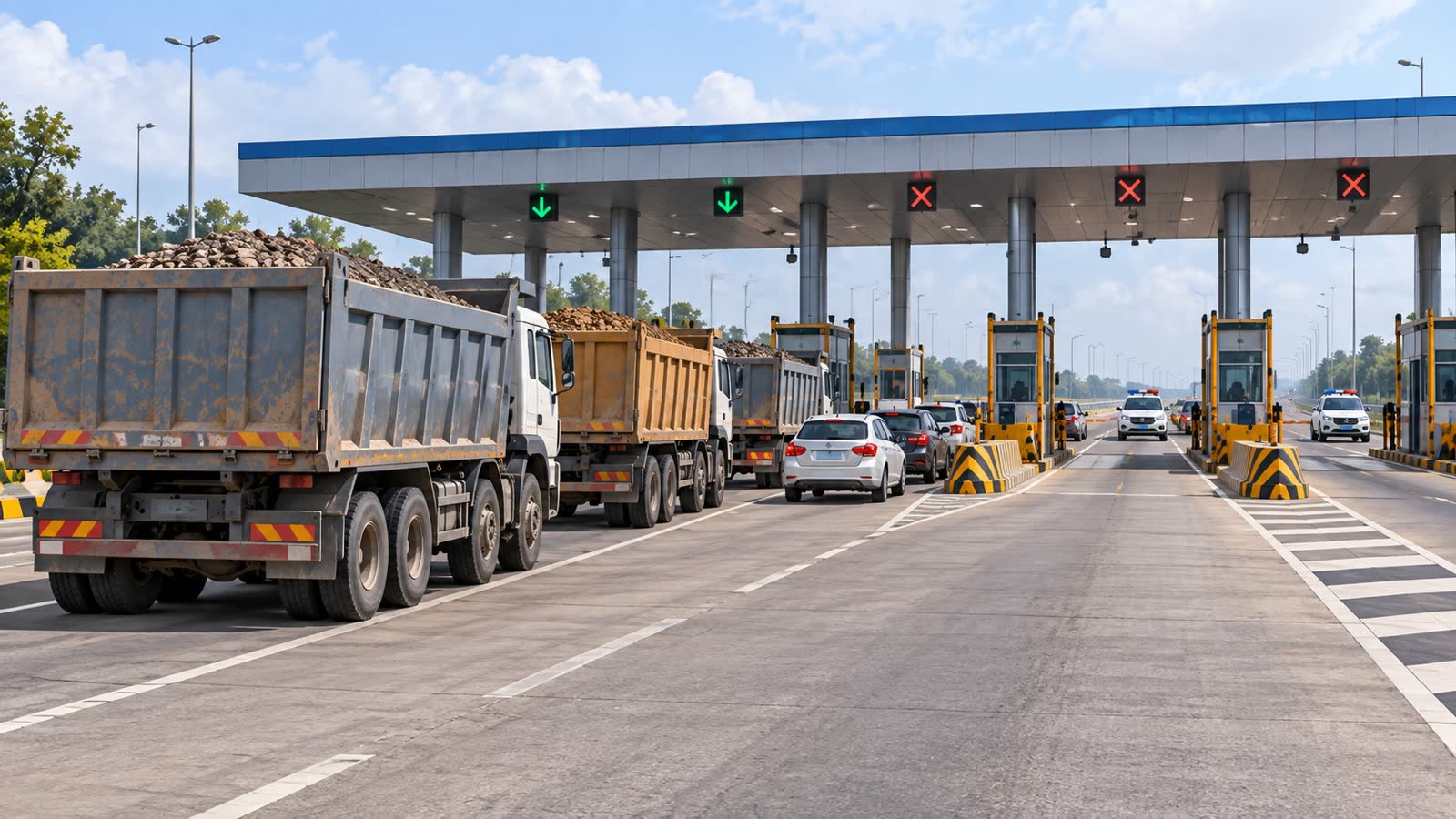
 Illustrative AI-generated editorial image of freight traffic at a toll plaza; it is not a photograph of the reported Vedurupavuluru incident. Credit: FuelPrice.
FuelPrice’s reading: This is a reported local toll incident, not a confirmed change to India’s toll-exemption rules. For transporters, the useful question is whether the specific vehicle, operator and highway work qualify under an existing exemption, and what documents the toll authority will accept.
What happened at the toll plaza
The Times of India reported on 4 Oct 2026 that a heated argument broke out between truck drivers and toll-plaza staff at Veduru Pavuluru. The drivers reportedly refused to pay, saying they were transporting material required for government works. When staff insisted on payment, trucks were positioned near the toll gates and traffic on NH-16 was temporarily affected.
Disha Daily’s report, also dated 4 Oct 2026, gave a different description of the scale: it said about 20 tipper lorries were stopped across six toll gates on the Eluru–Guntur route. It also said the drivers argued that they were moving soil for a government transport project and therefore should not be charged. Because the two reports describe the number of vehicles differently, the scale of the blockage should be treated as reported rather than independently established.
Both accounts agree on the outcome. Gannavaram police intervened, traffic was restored, and the drivers were told to pay the applicable fee and move the vehicles. Disha Daily reported that the drivers were asked to keep the receipts and seek recovery from the relevant transport organisation or contractor. Neither report gives a toll amount or says that a permanent exemption was introduced after the incident.
What NHAI’s exemption guidance says
The National Highways Toll Information System’s official NHAI toll FAQ says the exemption under the government notification dated 3 Dec 2010 is available only when NHAI or another government organisation uses the vehicle for inspection, survey, construction or operation of national highways, or for their maintenance.
That wording is narrower than a general claim that any privately operated truck carrying material for a government-funded project can pass a toll plaza without payment. The FAQ also states that government officers are not automatically exempt merely because they are government officers. The vehicle’s use and the organisation using it matter.
On the information published about Veduru Pavuluru, there is no cited NHAI circular or concessionaire order confirming an on-the-spot waiver for the trucks involved. The police instruction to pay first and preserve the receipt therefore appears to have been the practical resolution of that dispute, not a ruling that all project vehicles must always pay or that none can ever be exempt.
Why this matters to drivers and fleet operators
A toll dispute can create a cost beyond the fee itself. A queue on a bypass can increase idling, add fuel use, delay a delivery window and push a driver onto a slower route. No verified delay duration or toll amount was published for this incident, so a rupee loss should not be inferred from the reports.
For a planned journey, use FuelPrice’s toll charges and trip cost calculator to separate the expected user fee from fuel cost. That makes it easier to compare the cost of staying on the tolled route with a diversion, without treating an unverified exemption claim as a saving.
If a temporary queue or local closure changes the route, the road-trip planner can help map the revised journey. Drivers using NH-16 around Vijayawada should check current traffic information before departure, especially when a dispute is still being cleared at a toll facility.
For a private contractor or fleet, the work order should make clear who bears toll charges and how reimbursement is handled. A FASTag transaction record can show that a payment was made, but it does not by itself prove exemption eligibility. FuelPrice’s FASTag guide covers balance, payment and transaction checks that can help with record-keeping.
What to check before relying on an exemption
- Confirm with the project authority or toll concessionaire whether the vehicle and the stated work fall within the applicable exemption category.
- Carry the written authorisation, work order or other documents the authority has asked for; a driver’s verbal description of the cargo may not be enough at the lane.
- Keep the FASTag active and retain the toll receipt if payment is made while the eligibility question is resolved.
- Do not block a toll lane during a dispute. Record the plaza, time, vehicle details and receipt, then raise the issue with the concessionaire, project authority or the relevant NHAI project office.
What to watch next
The reported traffic interruption was cleared on 4 Oct 2026, but the incident may prompt a clarification if the project authority or toll operator issues one. Until an official instruction says otherwise, the safer reading is that an exemption must be established for the specific vehicle and use; carrying material for a government-linked project is not, on the available evidence, a universal toll waiver.
For other road users, the immediate takeaway is simple: allow time for possible toll-lane delays, keep payment records and verify any exemption through the authority responsible for the project. A later NHAI or Ministry of Road Transport and Highways clarification would be the source to watch for any broader rule change.