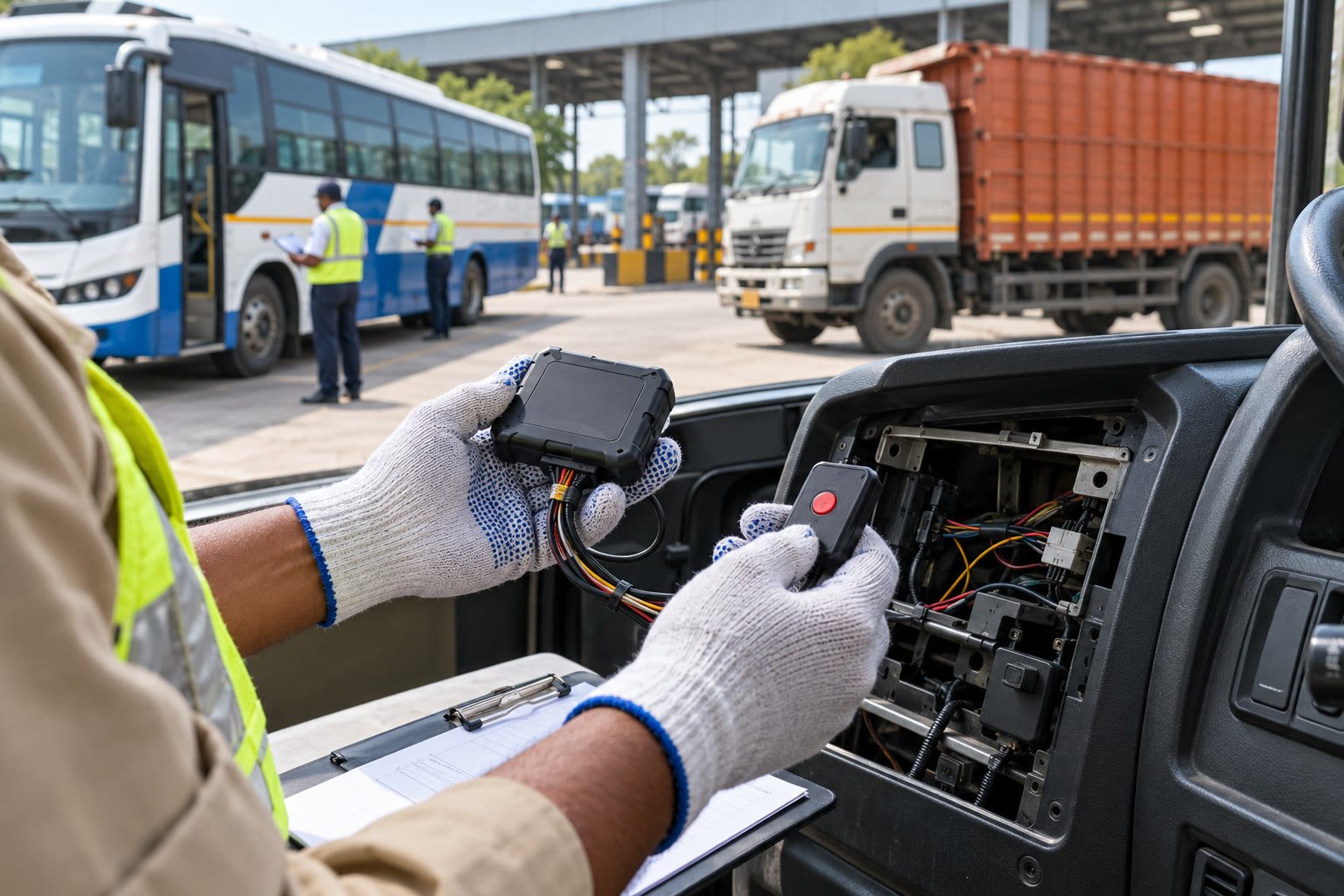
Bus, truck and cab operators have raised concerns that state-level limits on suppliers for mandatory vehicle-location tracking devices (VLTDs) can reduce vendor choice and increase compliance pressure. The central framework still requires an AIS-140-compliant tracking device and emergency buttons for specified public-service vehicles, so fleet owners need to separate the safety requirement from the supplier process used in each state.
The issue was reported by The Times of India on 4 Oct 2026. It is a reported operator concern, not a nationwide announcement that the VLTD rule has been withdrawn or changed. The practical question for a fleet is whether the chosen device is type-approved, accepted by the relevant state system and activated correctly before registration, permit or fitness checks.
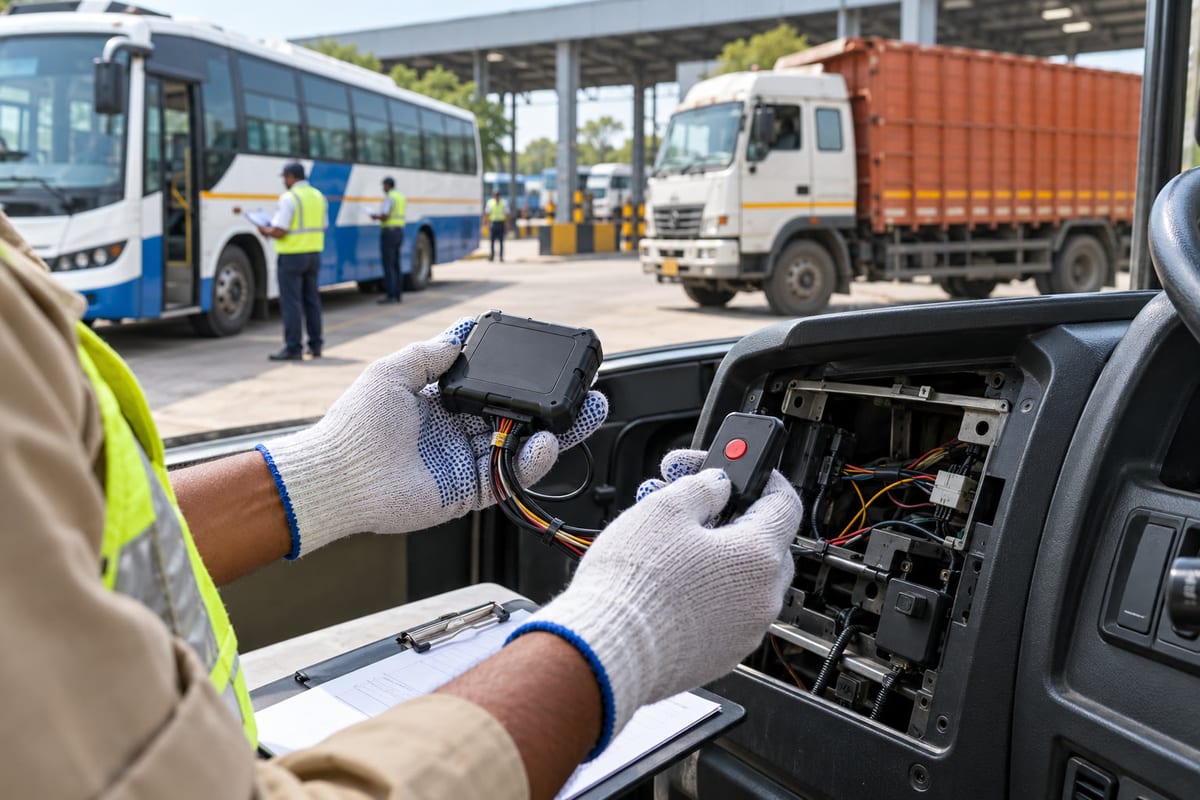 Illustrative compliance-inspection image showing generic tracking hardware; it is not an official photograph of a specific vendor, vehicle or government inspection. Credit: FuelPrice editorial illustration.
Key takeaways
- Operators have reported that some states or state-linked processes may limit the suppliers available for VLTD fitment.
- The central requirement remains a compliant vehicle-location tracking device and one or more emergency buttons for specified public-service vehicles.
- Uttar Pradesh’s official VLTD portal requires vendor registration or enlistment and asks for type-approval, conformity-of-production and company documents.
- A quote for a device should be checked for hardware, installation, connectivity, backend activation, warranty and replacement support separately.
- No final Ministry of Road Transport and Highways advisory changing vendor choice was identified in the current report, so any proposed clarification remains expected rather than confirmed.
What the current report says
The Times of India reported that owners of buses, trucks and cabs were facing difficulty installing mandatory VLTDs because some states were allowing only a limited set of vendors. The report said bus operators had alleged that Uttar Pradesh was effectively restricting competition by linking each bus make to one supplier. It also said the Bus Operators Confederation of India had raised similar concerns about limited supplier choice in Haryana and Delhi.
Those claims are attributed to operators and sources in the report. They should not be read as a final finding against a particular department or vendor. The same report said the road transport ministry could issue an advisory asking states to preserve choice among type-approved manufacturers. Until such an advisory is issued, operators should rely on the written procedure published by their own transport authority and keep a record of any refusal or requirement imposed during fitment.
What the central VLTD rule requires
The Ministry of Road Transport and Highways introduced the vehicle-location tracking and emergency-button requirement through G.S.R. 1095(E), dated 28 Nov 2016. A Ministry summary published by the Press Information Bureau says the requirement applied from 1 Apr 2018 to public-service vehicles, with specified exemptions including two-wheelers, e-rickshaws, three-wheelers and transport vehicles for which a permit is not required. The Ministry later stated that new public-service vehicles registered after 1 Jan 2019 had to carry the device and emergency button under Rule 125H of the Central Motor Vehicles Rules.
The rule is about a functioning safety and monitoring system, not just a box attached to a dashboard. The Uttar Pradesh government’s official Vehicle Location Tracking and Emergency Alert System portal describes the solution as AIS-140 certified and connects it to real-time location, emergency alerts, monitoring centres and VAHAN-related processes. That is why a generic GPS unit or an unverified aftermarket tracker should not automatically be treated as proof of compliance.
Why vendor choice matters to fleets
A state-approved or state-enlisted supplier may be responsible for more than the device itself. The quotation can include installation, a SIM or connectivity plan, backend registration, emergency-button wiring, testing, activation, maintenance and replacement. If an operator is directed to one supplier, the fleet may have less ability to compare those service terms even when multiple manufacturers have type-approved products.
The official Uttar Pradesh portal shows the compliance steps that a vendor must pass: registration or enlistment, a one-time compatibility test with the backend, a valid Type Approval Certificate, a valid Conformity of Production certificate and company-identification documents. These are useful checks for operators elsewhere too, although each state can publish its own workflow. The device’s approval and the supplier’s ability to activate it in the relevant state system should be recorded separately.
For a fleet manager, the immediate cost risk is not only the purchase price. A device that cannot be activated, cannot communicate with the state backend or lacks support during a breakdown can delay registration or remove a vehicle from service. A cheaper quote without the required installation, connectivity period or emergency-button support may therefore not be comparable with a complete compliance package.
What bus, truck and cab owners should check now
- Confirm the vehicle category and whether Rule 125H applies to that vehicle and its permit status.
- Ask the supplier for the device’s type-approval and conformity-of-production documents, plus the written state acceptance or enlistment reference.
- Get an itemised quote covering the tracker, emergency button, installation, connectivity, backend activation, warranty and replacement terms.
- Check that the device identifier is linked to the correct vehicle record and that the emergency button is tested before the vehicle is dispatched.
- If a state process appears to limit choice, ask for the written circular, vendor list or technical reason and keep the response with the vehicle file.
Operators should also separate compliance spending from normal running costs. The fuel-cost calculator can estimate the fuel component of a route budget, while the road-trip planner can help compare distance and travel time for scheduled passenger or freight work. Neither tool replaces the state’s approval or activation process, but both help prevent a device quotation from being confused with the vehicle’s full operating cost.
What happens next
The current development is a reported dispute over implementation and supplier access, not a confirmed relaxation of the VLTD mandate. A future ministry advisory could clarify whether states may maintain an enlistment process, how many type-approved suppliers must be available, and which costs or services may be bundled with fitment. Until then, the safest record for a fleet is the current rule, the state portal instructions, the device certificates and the activation proof.
The reader takeaway
Fleet owners still need to meet the VLTD and emergency-button requirement where it applies. The new concern is whether a state’s vendor process gives operators a meaningful choice among compliant suppliers. Check the technical approval, state acceptance, backend activation and full support terms in writing before paying for installation, and treat any promised ministry clarification as proposed until it is officially published.
Sources
- The Times of India, “States restrict VLTD vendors, bus owners flag fewer choices & steep prices”, 4 Oct 2026
- Press Information Bureau and Ministry of Road Transport & Highways, “GPS Tracking System for Vehicles”, 7 Feb 2019
- Government of Uttar Pradesh Transport Department, “Vehicle Location Tracking & Emergency Alert System”, accessed 4 Oct 2026
- Ministry of Road Transport & Highways, “General Guidelines for Implementation of State-wise Monitoring Centre for VLT Devices as per AIS-140”, 15 Jan 2020