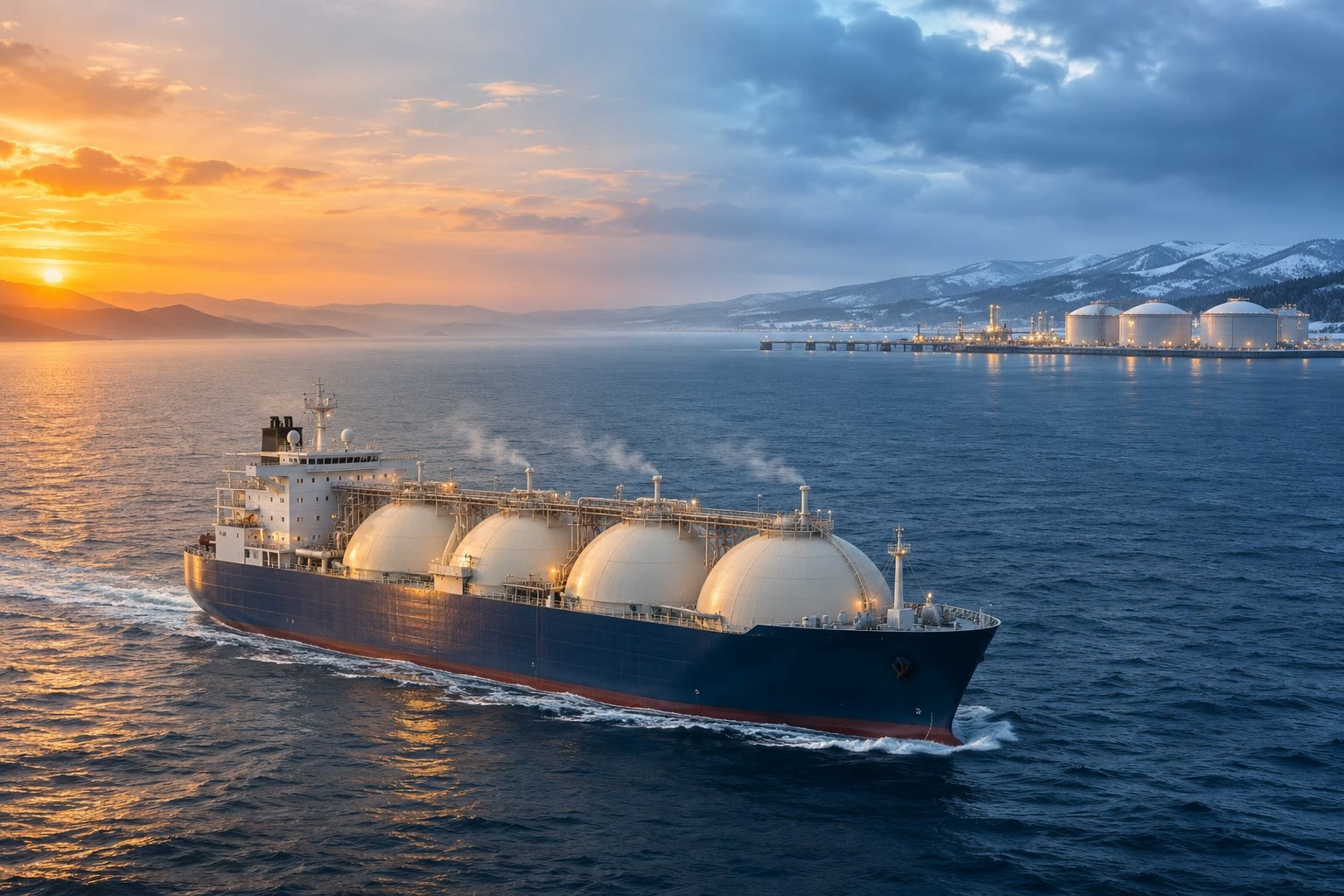
A 5 November Reuters analysis says a forecast milder winter across major East Asian gas markets could reduce heating demand and free liquefied natural gas (LNG) cargoes for Europe. If that weather outlook holds, it could ease competition for spot LNG this winter, but it does not remove Europe's low-storage and supply-route risks.
The development matters because LNG is traded across regions rather than consumed in isolated national markets. A change in heating demand in Japan, South Korea, Taiwan or northern China can alter where flexible cargoes are sold, affecting European gas availability, wholesale prices and the cost of energy-intensive transport and industry.
Key takeaways
- Reuters reports that above-normal winter temperatures are forecast across several major East Asian LNG-consuming economies.
- Lower heating demand in Asia could leave more spot cargoes available for European buyers, but this is a forecast, not a confirmed supply increase.
- European Union gas storage was 74.1% full on gas day 3 November, according to AGSI+ data, leaving a thinner-than-usual buffer for the heating season.
- Disrupted Gulf LNG flows and a colder-than-expected winter could quickly reverse any relief from milder Asian weather.
Why East Asian weather matters to Europe
Gas buyers in East Asia are among the most influential participants in the global LNG market. When winter temperatures fall sharply, utilities and traders in the region tend to compete more aggressively for spot cargoes, particularly supplies that can be redirected between the Atlantic and Pacific basins.
The Reuters analysis says forecasts point to significantly above-normal temperatures between December and March across several East Asian economies, with a strong El Niño pattern helping shape the outlook. The Japan Meteorological Agency separately says the unusually strong El Niño conditions are expected to continue through the boreal winter. That supports the direction of the weather signal, although seasonal forecasts remain probabilistic and can change as winter approaches.
If households, power generators and industrial users in Asia need less gas for heating, some buyers may defer spot purchases or accept fewer prompt cargoes. That could leave more flexible LNG available for Europe, where utilities are trying to rebuild inventories after entering the winter with a smaller cushion.
Europe still has a storage problem
The possible Asian demand reprieve should not be mistaken for a return to comfortable supply conditions. The International Energy Agency has already warned that European storage is entering the 2026-27 heating season at its lowest level in more than a decade. It also said global LNG supply is under pressure from the disruption to Gulf flows and that competition for flexible cargoes could intensify during periods of high demand.
AGSI+ data cited on the 3 November gas day put European Union storage at 74.1% full. A separate report of the Reuters analysis also described storage as around three-quarters full. The exact pace of withdrawals and injections will depend on temperature, wind generation, pipeline flows, LNG arrivals and industrial demand.
FuelPrice has already explained the broader storage risk in its earlier report on Europe's winter gas buffer. The new point is that the balance may now be influenced not only by Europe's weather and damaged Gulf supply routes, but also by whether Asian buyers need to draw heavily on the same flexible cargo pool.
What could deliver relief — and what could reverse it
Several conditions sit behind the potential improvement. The warmer forecast has to persist through the part of winter when heating demand is normally strongest. Lower Asian demand must translate into actual changes in cargo nominations rather than simply lower prices for a short period. And the remaining LNG supply chain must be able to move those cargoes to Europe without a new shipping, terminal or geopolitical disruption.
The downside risks are equally clear. A cold spell in Japan, South Korea or northern China could bring buyers back to the spot market quickly. Europe could also see sharper withdrawals if temperatures fall, wind output is weak or pipeline deliveries disappoint. The IEA's assessment makes clear that flexible global trade improves resilience, but it also means one region's shortfall can raise competition elsewhere.
What this means for energy users
For households and businesses that buy gas directly, the weather scenario could eventually reduce wholesale pressure if it lowers demand at the same time that cargo availability improves. It is not a promise of cheaper bills. Retail tariffs, contracts, storage charges, currency movements and local taxes determine how much of any wholesale change reaches the end user.
For road users, LNG-market news is not a direct same-day signal for petrol or diesel prices. Natural gas can influence electricity generation, industrial production and the operating cost of LNG- or CNG-powered fleets, but those effects pass through contracts and time lags. Drivers can use FuelPrice's live fuel-price hub to check local petrol and diesel rates rather than treating a gas-market forecast as a pump-price update.
Transport operators watching fuel exposure can also compare a route's estimated consumption in the fuel cost calculator. That is a more useful way to test how a change in the fuel price they actually buy could affect a trip than relying on a headline about international LNG cargoes.
What to watch next
The next meaningful signals are the direction of European storage withdrawals, updated temperature forecasts for East Asia and the arrival schedule for flexible LNG cargoes. Traders will also watch the spread between European and Asian benchmark prices, because it helps determine where a marginal cargo is most likely to go.
Readers should treat the warmer Asian winter as a possible source of relief, not as a settled market outcome. A forecast can soften competition, but it cannot by itself repair lost export capacity or refill European storage. If the weather stays mild and cargoes move smoothly, gas-market pressure may ease; if either assumption fails, Europe will remain exposed to global LNG competition.
Reader takeaway
The fresh development is a change in the risk balance, not a reversal of the energy shock. Milder East Asian weather could leave more LNG for Europe, but Europe's low storage and disrupted Gulf supply mean the region still needs favourable weather, reliable shipping and steady arrivals to avoid another price surge.
Sources
- Reuters, “Warm Asian winter could ease Europe's LNG squeeze,” 5 Nov 2026
- International Energy Agency, “Low storage buffers in Europe could prolong global gas market tightness well into 2027,” 3 Nov 2026
- GIE AGSI+ data via Gas-Risiko, “European gas storage levels,” 3 Nov 2026
- Japan Meteorological Agency, “El Niño Outlook (October 2026–April 2027),” 9 Oct 2026
This article is for general information only and is not financial, insurance or legal advice.