National Highways Authority of India (NHAI) has placed a revised alignment for the proposed six-lane Zirakpur–Panchkula bypass before the Punjab and Haryana High Court. Reports published by The Tribune on 17 Oct 2026 and Hindustan Times on 16 Oct 2026 say the route could save more than 1,900 trees but add ₹65 crore to the project and extend its timeline; the bypass is not yet approved or open to traffic.
Key takeaways
- NHAI’s reported alternative alignment shifts the bypass towards the Ghaggar side while keeping the main start and end points unchanged.
- The proposal could avoid the felling of more than 1,900 trees, but would increase the project estimate by ₹65 crore and take longer to complete.
- The official PPPAC project record lists a 19.2-km, six-lane bypass with an estimated capital cost of ₹1,878.31 crore in its 15 Jan 2025 record.
- Technical consultations are expected before the next Punjab and Haryana High Court hearing on 28 Oct 2026.
- There is no immediate route, toll or fuel-price change for drivers: the bypass remains a proposal under judicial consideration.
What NHAI has proposed
The latest plan keeps the bypass’s broad connections but moves the alignment further towards the Ghaggar side. NHAI counsel presented the revised route to a division bench of the Punjab and Haryana High Court, along with a re-evaluation report containing an afforestation and plantation plan, according to The Tribune.
Hindustan Times reported that the new alignment would connect the same broad endpoints: the Patiala–Zirakpur side of NH-7 and the old Panchkula side of NH-5. The planned corridor is intended to give Shimla-bound traffic a way around the Zirakpur bottleneck and provide an alternate route for traffic moving towards Ambala or Delhi.
The project’s approved design is a 19.2-km, six-lane bypass. The official PPPAC record dated 15 Jan 2025 puts its estimated capital cost at ₹1,878.31 crore. The current media reports describe the earlier estimate as about ₹1,800 crore or ₹1,878 crore and say the alternative would add ₹65 crore; the final revised project cost has not been approved in the court proceedings reported so far.
The trade-off: less tree loss, more time and cost
The reason for the revision is a dispute over the ecological impact of the proposed corridor. Petitioners have raised objections to large-scale tree felling near Peer Muchalla and argued that the new route could still affect forest areas. The court has indicated that permission for large-scale felling cannot be granted mechanically and that the project’s wider public importance must be balanced against the need to reduce tree loss.
That makes the latest development a proposal, not a clearance. The reported saving of more than 1,900 trees is NHAI’s likely assessment for the alternative alignment, while the ₹65-crore increase and longer timeline are also proposal-stage figures. The final route, forest permissions, compensatory plantation details and construction schedule remain subject to further review.
| Project detail | Reported position | Source basis |
|---|---|---|
| Latest alignment | Proposed shift towards the Ghaggar side; broad endpoints remain the same | The Tribune, 17 Oct 2026; Hindustan Times, 16 Oct 2026 |
| Potential tree saving | More than 1,900 trees, according to NHAI’s presentation and affidavit as reported | The Tribune and Hindustan Times |
| Additional cost | ₹65 crore, with a longer completion timeline | The Tribune and Hindustan Times |
| Base project | 19.2 km, six lanes; ₹1,878.31 crore estimated capital cost | Official PPPAC record, 15 Jan 2025 |
| Next step | Technical consultations and minutes before the 28 Oct 2026 hearing | The Tribune, 17 Oct 2026 |
What the bypass could mean for drivers
The bypass is designed to remove through-traffic from the Zirakpur bottleneck rather than simply add another local road. The Tribune reported a project objective of reducing travel time on the Zirakpur–Panchkula corridor from 35 minutes to 17 minutes. That is a future planning target, not a time saving available today, and actual performance would depend on the final alignment, junction design, construction quality and traffic conditions after opening.
For private drivers and bus operators, a functioning bypass could make the Chandigarh–Panchkula–Shimla approach more predictable by separating through movements from local congestion. For freight and commercial operators, the benefit would be measured in route reliability, idling time and fuel consumed in queues. The current proposal does not announce a toll fee, so no new toll cost can be calculated yet.
Until the legal and engineering process is complete, drivers should continue to plan around the existing road network. The road-trip planner can help compare the current corridor with an alternate route when congestion is expected.
What changes now for toll and trip costs?
Nothing changes immediately at the toll booth. The reports concern a revised project alignment, not a new toll notification, a completed road or a diversion order. Existing routes, toll charges and fuel prices continue to apply until a future operating plan is formally announced.
If the bypass is eventually built, the final toll decision would need to be read with the route length, access points and vehicle class. Drivers can use the toll-charge calculator to check current route estimates, but it cannot include a road that is not yet operational.
A longer or slower existing route can also change the cost of a trip through extra distance and idling. The fuel cost calculator is useful for comparing those current alternatives; it should not be used to treat the proposed 17-minute project target as a guaranteed saving.
What to watch next
The immediate checkpoint is the technical consultation between NHAI and the parties opposing the present alignment. The Tribune reported that the discussions will examine the most feasible option and that minutes are expected to be placed before the High Court at its next hearing on 28 Oct 2026.
Readers should then watch for a final alignment, any court direction on tree felling and compensatory afforestation, a revised sanctioned cost, and a construction schedule. Until those steps are settled, claims about the bypass opening date, future toll amount or exact travel-time saving remain unconfirmed.
Frequently asked questions
Is the Zirakpur–Panchkula bypass open?
No. The road is still a proposed project under judicial consideration. The latest development is NHAI’s alternate alignment presented to the High Court.
Will drivers pay a new toll because of this proposal?
No new toll has been announced in the reports used here. Any future fee would depend on the final project and operating notification.
How much time could the bypass save?
The project objective reported by The Tribune is a reduction from 35 minutes to 17 minutes on the corridor. That is a planning estimate, not a current or guaranteed saving.
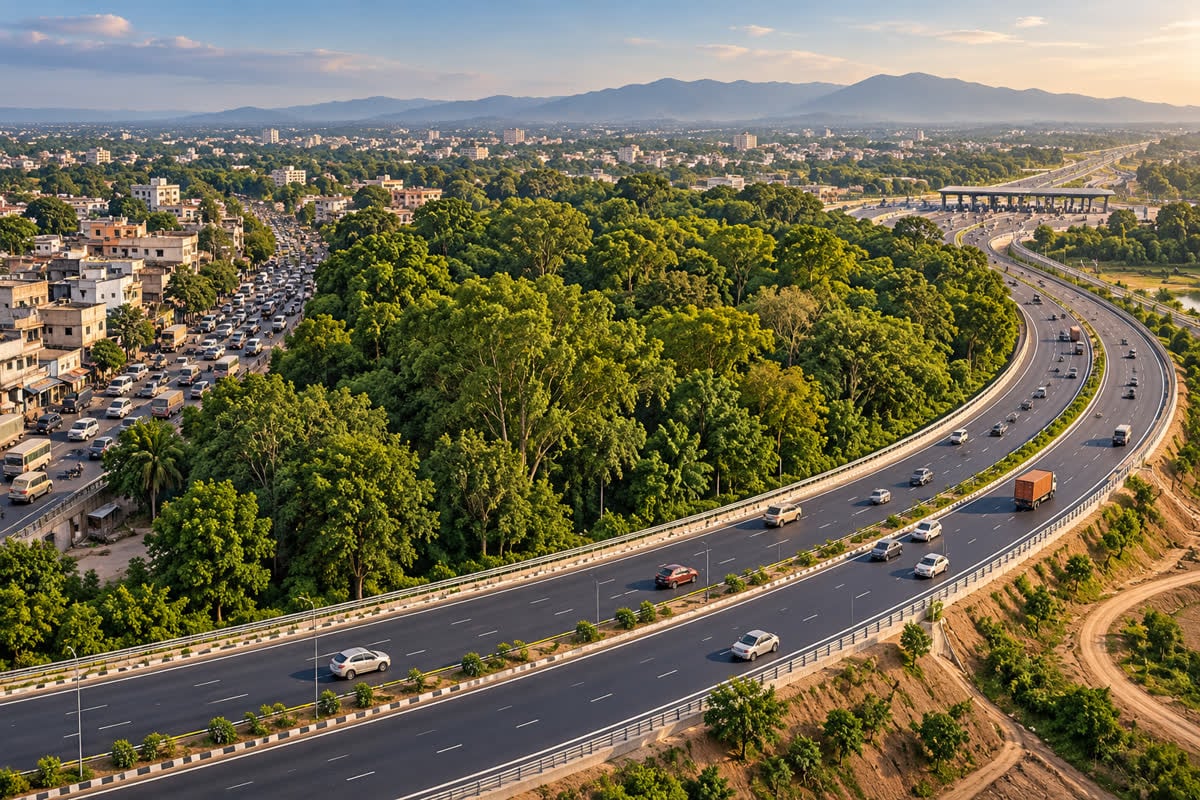
Illustrative visual: AI-generated editorial concept of a proposed bypass and greenbelt; not a photograph or map of the actual Zirakpur–Panchkula alignment.
Sources
- The Tribune: “Zirakpur-Panchkula bypass: NHAI proposes Rs 65-crore detour to high court to save 1,900 trees” — 17 Oct 2026
- Hindustan Times: “Zirakpur bypass project | NHAI’s new alignment plan to save 1,900 trees from the axe” — 16 Oct 2026
- PPPAC: “Six-lane Zirakpur Bypass in the state of Punjab & Haryana on Hybrid Annuity Mode” — 15 Jan 2025