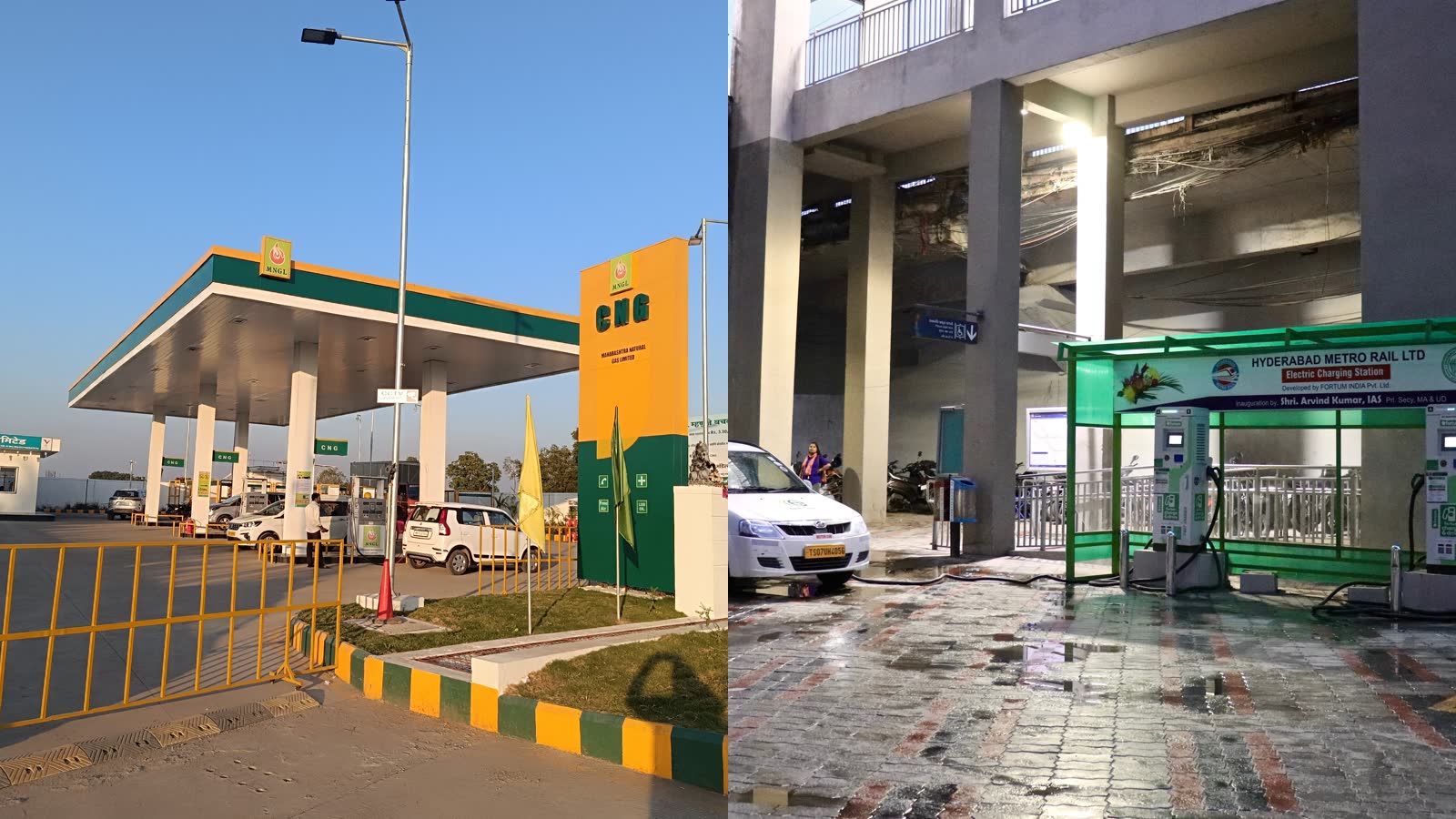
CNG and electric cars can both reduce the running cost of city driving, but they solve different problems: CNG depends on nearby filling stations, while an EV depends on reliable access to home or public charging. This guide shows how to compare them with dated Delhi price inputs, a reusable per-km formula, a monthly example and a checklist that works in any Indian city.
The most important takeaway is to compare the complete cost of the energy used for your actual driving pattern, not just the price displayed per litre, kilogram or kilowatt-hour. A CNG car can be practical for frequent inter-city travel, while an EV can have a much lower energy cost when home charging is available; public charging can produce a very different result.
Key takeaways
- CNG and EV running costs must be calculated per kilometre using the vehicle's measured efficiency.
- For a dated Delhi snapshot, petrol was ₹102.12 per litre on 08 Oct 2026 and CNG was ₹86.98 per kg from 29 Aug 2026.
- A current Jio-bp Pulse subscription example lists ₹20.25 per kWh before GST; the operator's FAQ says 18% GST is added to the charging tariff.
- Home charging can change an EV comparison substantially, while public charging prices and availability vary by operator, state and charger.
- Break-even depends on the actual on-road price gap, annual kilometres, efficiency, service costs and whether charging is mostly at home or in public.
- Before comparing, check fuel and charger access around home, work and the routes you use most.
Why this comparison is useful now
Recent market reporting gives the comparison a current trigger without making the day's sales number the decision rule. JATO Dynamics' 07 Oct 2026 analysis put CNG at 23% and electric cars at 9% of September passenger-vehicle registrations. A separate Vahan-based classification published on 09 Oct gave CNG/LPG at 18.8% and battery-electric cars at 8.6%. The difference comes from coverage and fuel-category definitions, but both point to more buyers evaluating alternatives to petrol and diesel.
That is why a lasting guide is more useful than a rewrite of the market update. Prices, tariffs, traffic, charging access and the car's actual efficiency matter more to a household than a national share. The method below lets a reader replace the example inputs with local numbers.
Start with cost per kilometre
Use one formula for every powertrain. For petrol or CNG, divide the current price by measured distance per litre or kilogram. For an EV, multiply the electricity tariff by the energy used per kilometre, or divide the tariff by the vehicle's km per kWh figure.
- Petrol cost per km: petrol price per litre ÷ petrol km per litre.
- CNG cost per km: CNG price per kg ÷ CNG km per kg.
- EV cost per km: charging price per kWh ÷ EV km per kWh.
Keep the units consistent. Do not compare ₹ per kg directly with ₹ per litre, and do not use a brochure range as if it were a measured city result. The FuelPrice fuel-cost calculator can organise the same calculation for a trip; for a purchase decision, repeat it with your monthly kilometres and real refill or charging records.
Dated Delhi inputs for the example
The table uses Delhi only to make the arithmetic transparent. PPAC's official archive recorded the IOCL outlet petrol price at ₹102.12 per litre on 08 Oct 2026, and the Economic Times reported the same Delhi price on 09 Oct 2026. IGL's current price page lists Delhi CNG at ₹86.98 per kg from 06:00 on 29 Aug 2026; Moneycontrol independently reported the same revision. Rates outside Delhi can differ, so check the latest FuelPrice fuel-price pages and the relevant city CNG operator before using the result.
| Input | Petrol | CNG | Public EV charging |
|---|---|---|---|
| Energy price used | ₹102.12/L, Delhi, as of 08 Oct 2026 | ₹86.98/kg, Delhi, effective 29 Aug 2026 | ₹20.25/kWh before GST in a Jio-bp Pulse Max subscription example, accessed Oct 2026 |
| Unit billed | Litre | Kilogram | Kilowatt-hour |
| Important qualification | State taxes and OMC prices vary by city and date | City gas distributor and supply area determine the rate | Operator price, plan, charger type and GST affect the final bill |
The Jio-bp example is not a national public-charging tariff. Its FAQ says the unit tariff is exclusive of 18% GST. Adding that tax to ₹20.25 produces ₹23.90 per kWh after rounding. A different app can show a different rate, and home charging is billed under the applicable state electricity tariff rather than this public-network example. The Bureau of Energy Efficiency also says home charging cost varies by state tariff and battery capacity.
Worked rupee example: 1,000 km in a city month
To show the method, assume a driver covers 1,000 km in a month and uses these deliberately simple budgeting inputs: 15 km per litre for petrol, 22 km per kg for CNG and 6 km per kWh for an EV. These are illustrative assumptions, not claims about a particular model. Replace them with the car's measured city efficiency. A certified figure can be a useful starting point, but traffic, air-conditioning, load, tyre pressure and driving style change the result.
| Powertrain | Example efficiency | Energy for 1,000 km | Price used | Monthly energy cost | Cost per km |
|---|---|---|---|---|---|
| Petrol | 15 km/L | 66.67 L | ₹102.12/L | About ₹6,808 | ₹6.81 |
| CNG | 22 km/kg | 45.45 kg | ₹86.98/kg | About ₹3,954 | ₹3.95 |
| EV on public charging | 6 km/kWh | 166.67 kWh | ₹23.90/kWh after illustrative GST | About ₹3,983 | ₹3.98 |
In this example, CNG and the public-charging EV are nearly level on energy cost because the assumed EV efficiency is paired with a relatively high public tariff. If the same EV could be charged at home at an effective ₹8 per kWh, the energy portion would be about ₹1,333 for 1,000 km, or ₹1.33 per km. That ₹8 figure is a what-if input, not a universal Indian tariff; use the rate on the electricity bill and include any applicable fixed or demand charges when estimating your own case.
For a more accurate result, record at least three refills or charging sessions. For CNG, use distance divided by kilograms dispensed. For an EV, use the energy shown on the charger invoice or the vehicle's charging record, then compare it with the distance added. This captures real driving better than a single brochure number.
How to calculate break-even
Break-even is not a fixed claim about CNG or EVs. It is a calculation using your actual on-road price difference and the per-kilometre saving.
- Write down the on-road price of the two shortlisted cars, including registration, insurance, accessories and a home charger or approved CNG equipment where applicable.
- Subtract the lower on-road price from the higher one. Call the result the upfront gap.
- Calculate the running-cost difference using local prices and measured efficiency.
- Divide the upfront gap by the per-kilometre saving to get approximate break-even kilometres.
- Recalculate if public charging replaces home charging, or if your annual distance changes.
For illustration, if a CNG car costs ₹1,00,000 more on the road than an otherwise comparable petrol car and the example saving is ₹2.86 per km, the energy-only break-even is about 35,000 km. If an EV is ₹2,00,000 more than a CNG alternative and home charging creates a ₹2.62 per-km saving against the example CNG cost, the energy-only break-even is about 76,300 km. These are arithmetic illustrations, not market price claims: service, insurance, tyres, financing, resale value and battery or gas-system warranty terms can move the actual ownership result.
What CNG ownership changes
- Refuelling routine: a CNG car can be refuelled at a station, but the useful question is whether a station lies near your home, workplace or regular corridor.
- City coverage: CNG prices and pump networks are local. A low price is less useful if a daily detour or queue adds time and distance.
- Variant and equipment: compare the exact factory-fitted or approved configuration, boot layout, warranty terms and service schedule rather than assuming every CNG version behaves the same way.
- Long-distance use: map refuelling points before a highway journey and keep a petrol fallback in the calculation when the vehicle has one.
- Measured efficiency: traffic, passenger load, air-conditioning and the petrol/CNG operating mix can make the real cost differ from a brochure figure.
What EV ownership changes
- Charging access: a dedicated parking place and permission to install a safe home charger can matter more than a small difference in advertised range.
- Tariff choice: BEE says charging cost varies by state tariff and battery capacity. Public operators add their own plan, service and tax components, so save the final app invoice.
- Time and route planning: check connector compatibility, charger power, live availability, payment method and a backup location before a long trip. The FuelPrice EV-station directory is a starting point for finding charging locations.
- Range budgeting: use a conservative city or highway estimate for your own car instead of treating a certified range as guaranteed distance in every condition.
- Service pattern: the powertrain service schedule differs from a combustion car, but tyres, brakes, suspension, insurance and accident repairs still remain ownership costs.
Which option fits which driving pattern?
- Home parking and regular city kilometres: compare an EV first with the home tariff, then test the result against public charging for days when home charging is unavailable.
- No dependable home charging: compare CNG station access and public EV charging on the routes you actually use, including waiting and detour time.
- Frequent highway travel: compare the density of CNG stations with the EV route plan, charging time and backup distance before focusing on per-kilometre cost.
- Low annual usage: give more weight to the upfront gap, insurance, service and resale assumptions because energy savings accumulate slowly.
- Commercial or high-use driving: include vehicle downtime, queueing, charging windows and the cost of keeping a second vehicle available.
For a route-specific budget, combine the FuelPrice road-trip planner with the fuel and toll estimate instead of using a national average. The answer can change between a weekday commute and a 500-km weekend journey.
What to check before deciding
- Write down actual monthly kilometres and split them into city, highway and occasional-trip driving.
- Record the latest petrol, CNG or electricity rate for your city and mark the date beside it.
- Measure real efficiency across several refills or charging sessions; keep the vehicle, route and load consistent where possible.
- Locate at least three practical CNG stations or EV chargers around home, work and the routes you use.
- Collect on-road quotes that show registration, insurance, charger or CNG equipment, accessories and any recurring plan cost separately.
- Run three EV cases: mostly home charging, a mixed home/public pattern and public charging only.
- Compare the service schedule, warranty, tyre size, insurance quote and expected downtime for the exact variants.
- Recalculate the break-even distance if fuel prices, charging plans or your annual kilometres change.
Frequently asked questions
Is an EV always cheaper to run than a CNG car?
No. An EV can be much cheaper on home charging, but a public-charging plan can bring its energy cost close to CNG or even above it. The answer depends on the tariff, efficiency and charging mix.
Is CNG better for highway driving?
It can be more convenient on a corridor with dependable CNG stations because refuelling is familiar and quick. An EV can work well on the same route when the charger locations, connector, uptime and charging time fit the journey; map the route before comparing the energy bill.
How do I calculate the running cost of an EV?
Divide the charging price per kWh by the car's measured km per kWh. If the vehicle uses 6 km per kWh and the final charging price is ₹23.90 per kWh, the energy cost is about ₹3.98 per km before other ownership costs.
Should I compare claimed mileage with claimed EV range?
Use both only as starting points. For a fair comparison, convert each to energy cost per kilometre and then replace the certified figures with measured results from your routes, traffic and climate.
Sources
- Petroleum Planning & Analysis Cell, “Important News — RSP of Petrol in Delhi as per IOCL outlet, 08 Oct 2026” (accessed 10 Oct 2026)
- The Economic Times, “Petrol Price in Delhi Today” (09 Oct 2026)
- Indraprastha Gas Limited, “CNG Retail Prices” (effective 29 Aug 2026; accessed 10 Oct 2026)
- Moneycontrol, “Delhi CNG price rises to Rs 86.98/kg from August 29; IGL cites LNG costs” (29 Aug 2026)
- Jio-bp pulse, “EV Charging” (current subscription examples accessed 10 Oct 2026)
- Jio-bp, “General Frequently Asked Questions — EV charging tariff and GST” (accessed 10 Oct 2026)
- Bureau of Energy Efficiency, “Electric Vehicle Charging Infrastructure — FAQs” (accessed 10 Oct 2026)
- JATO Dynamics, “Strong growth of more than 30% for India’s passenger vehicle market in September 2026” (07 Oct 2026)
- Flash Finance, “Car Sales by Fuel September 2026: Petrol, Diesel, CNG, EV Share” (09 Oct 2026; Vahan data analysis)
- Wikimedia Commons, “Compressed Natural Gas (CNG) Filling Station, Maharastra, India (1)” by K. Venkataramana, CC0 (photo 17 Dec 2024; accessed 10 Oct 2026)
- Wikimedia Commons, “Electric car charging station in Begumpet, Hyderabad” by iMahesh, CC BY-SA 4.0 (photo 30 Aug 2019; accessed 10 Oct 2026)