E20 petrol is a blend containing 20% ethanol and 80% petrol. This guide explains what that means for Indian car and bike owners, how to verify whether a vehicle is designed for the blend, and how to convert a possible mileage change into rupees. The practical takeaway is simple: the manufacturer’s fuel label or manual is more useful than a blanket rule based only on the vehicle’s registration year.
Key takeaways
- E20 means petrol blended with 20% ethanol; it is a fuel specification, not a separate engine type.
- A December 2025 parliamentary reply said vehicles sold before 1 April 2023 were compliant with E10, while vehicles sold after that date were E20 material compliant. The manufacturer’s sticker and manual remain the final check for a particular vehicle.
- An ARAI, IOCL and SIAM project reported a 5% to 6% fuel-economy decrease for tested two-wheelers and 2% to 3% for tested four-wheelers when E20 was compared with E10. Those are test findings, not a promise about every vehicle.
- For a 1,000 km month, a 2% to 3% change can add roughly ₹139 to ₹211 in the worked Delhi example below. Your measured mileage and city price will produce a different result.
- Do not replace fuel-system parts merely because a vehicle is old. Check compatibility, keep service records, measure mileage consistently and report suspected fuel-quality problems with the purchase receipt.
What E20 petrol changes
In E20, the “20” refers to the maximum ethanol share by volume and the remaining 80% is petrol. Ethanol is an oxygenated fuel component that can improve anti-knock performance, but it has a lower calorific value than petrol. That is why the amount of road distance obtained from a litre can move when the blend or the engine calibration changes.
The size of any change depends on the vehicle’s calibration, traffic, tyre pressure, load, air-conditioning use, maintenance and driving style. In July 2026, The Indian Express reported the road transport minister’s position that mileage may be affected because of ethanol’s lower calorific value, while saying the impact in most use cases should be marginal. That is a more useful framing than either “E20 damages every engine” or “E20 can never affect mileage”.
The current public debate is covered separately in FuelPrice’s E20 petrol vehicle-damage and mileage update. This guide goes one step further: it explains how to check your own vehicle and budget the fuel effect without treating a reported claim as a universal result.
Which vehicles need the closest check?
The Government’s answer to Lok Sabha Question No. 161, dated 11 December 2025, said the vehicle manufacturer defines E20 compatibility and should display it on the vehicle. The same answer gave a useful broad date split, but it does not replace an owner checking the exact model, engine and manufacture documentation.
| Vehicle information | Government position stated in the 11 Dec 2025 reply | Owner’s next check |
|---|---|---|
| Sold before 1 Apr 2023 | Described as E10-compliant in the parliamentary reply | Read the fuel sticker, owner’s manual and manufacturer guidance before assuming E20 suitability. |
| Sold after 1 Apr 2023 | Described as E20 material-compliant | Confirm the label and engine-specific manual; material compatibility is not the same as a guaranteed mileage figure. |
| Any vehicle with unclear records | Compatibility is defined by the manufacturer | Ask an authorised service point for written model-specific confirmation and retain it with the service file. |
The answer also said there was no requirement to phase out or retrofit non-compliant vehicles, and that normal wear and tear could be handled during routine servicing. That does not mean every old vehicle will feel identical on E20. It means an owner should use the vehicle maker’s instructions and symptoms, rather than buying a generic retrofit or part on an internet claim.
What the measured mileage data says
The ARAI Annual Report 2022–23 records an E20 project carried out with IOCL and SIAM on new and in-use two-wheelers and four-wheelers. Compared with E10, it observed the following fuel-economy changes:
| Tested vehicle group | E20 result versus E10 | How to use the figure |
|---|---|---|
| Two-wheelers | 5% to 6% decrease in fuel economy | Use it as a cautious budgeting range, then replace it with your own full-to-full measurement. |
| Four-wheelers | 2% to 3% decrease in fuel economy | Use it to stress-test a monthly fuel budget; do not treat it as a model-specific claim. |
These are dated laboratory and field-test findings reported by ARAI, not a promise that every E20-compatible vehicle will lose exactly the same percentage. The report also records that the tested vehicles passed mass-emission tests against their original compliance. Actual results can be obscured by congested traffic, short trips, low tyre pressure or an overdue service.
Worked rupee example: turning mileage into monthly cost
Use this formula: fuel cost = distance ÷ mileage × price per litre. The following is an illustration, not a forecast. PPAC listed Delhi petrol at ₹102.12 per litre as of 1 October 2026, and NDTV showed the same petrol price on 3 October 2026. Rates vary by city and can change, so check the latest city-wise fuel prices before using the result.
Assume a four-wheeler covers 1,000 km in a month and its measured baseline is 15 km per litre:
- Baseline fuel: 1,000 ÷ 15 = 66.67 litres.
- Baseline cost at ₹102.12 per litre: 66.67 × ₹102.12 = about ₹6,808.
- At a 2% mileage decrease, mileage becomes 14.70 km per litre. Fuel use is about 68.03 litres and cost is about ₹6,947, or ₹139 more.
- At a 3% mileage decrease, mileage becomes 14.55 km per litre. Fuel use is about 68.73 litres and cost is about ₹7,019, or ₹211 more.
The calculation shows why “mileage down by a few per cent” should be translated into a monthly number before making a maintenance or vehicle-change decision. To include distance, fuel type, mileage and tolls in one trip budget, use the FuelPrice fuel-cost calculator and replace the example inputs with your own records.
How to measure your vehicle’s real mileage
- Record the odometer or trip-meter reading and the fuel price before filling up.
- Fill to the same automatic cut-off point and keep the receipt. Note whether the outlet’s display identifies the product as E20 or another grade.
- Drive normally. Avoid comparing one traffic-heavy week with one open-highway week, because the route can matter more than a small blend-related difference.
- At the next refill, record litres dispensed and kilometres travelled. Divide kilometres by litres; do not rely only on the dashboard estimate.
- Repeat the same method across multiple refills while keeping tyre pressure, load and service condition broadly comparable. Look for a sustained pattern before asking for diagnosis.
What older car and bike owners should check
- Fuel label: look for the blend or compatibility marking on the fuel lid, body label or owner’s manual.
- Exact documentation: check the manufacture month, engine variant and the manufacturer’s model-specific guidance. A registration year alone can be a poor proxy for the build specification.
- Service condition: ask the service professional to inspect the fuel system if there is a new fuel smell, difficult starting, hesitation, warning light or a visible leak. Do not authorise parts replacement solely because a social post lists a generic fear.
- Fuel receipt: retain the bill, date, outlet and quantity if the vehicle develops an abrupt problem after refuelling. Sudden symptoms and gradual wear are different diagnostic questions.
- Quality complaint: IndianOil said in August 2026 that OMCs use supply-chain monitoring and fuel-quality checks for moisture and chloride concerns. Ask the outlet about its complaint and testing process instead of trying to diagnose contamination from colour or smell alone.
Insurance, warranty and buying decisions
The Ministry of Petroleum and Natural Gas said in its PIB clarification dated 12 August 2025 that using E20 does not affect the validity of vehicle insurance in India. That statement addresses the fuel-blend concern; it is not a substitute for reading the current policy wording or the manufacturer’s warranty terms for a specific repair or claim.
For a used petrol vehicle, ask for the manual, fuel-compatibility marking, service invoices and any manufacturer communication about the engine. For a new vehicle, compare the documented fuel specification and expected running cost with your own distance rather than treating a brochure mileage figure as a guarantee. Fuel cost, insurance, maintenance and finance are separate parts of ownership cost.
Planning a commute or road trip with E20
Fuel price is only one input. A longer route, low average speed, luggage and air-conditioning can alter fuel use, while a price difference between cities changes the rupee result. For a long drive, enter your measured mileage and current price in the road-trip planner, then keep the route’s tolls and a realistic fuel buffer visible in the same budget.
The government’s August 2025 clarification said its then-current roadmap committed to E20 up to 31 October 2026 and that any move beyond E20 would require further evaluation and consultation. That is the point to watch; owners should not assume a future blend change has already been approved or that a higher blend is automatically suitable for today’s vehicle.
E20 owner checklist
- Find the fuel-blend label and the exact compatibility statement in the manual.
- Record a full-to-full baseline using your normal route and driving pattern.
- Check the current city price on the day you budget, not an old screenshot.
- Run the distance ÷ mileage × price formula and test a small mileage range.
- Keep the refuelling receipt if symptoms appear immediately after a fill.
- Use the manufacturer or authorised service channel for model-specific diagnosis and document any advice.
Frequently asked questions
Can every older petrol car use E20?
There is no safe universal answer based only on age. The parliamentary reply described vehicles sold before 1 April 2023 as E10-compliant, but the manufacturer’s marking and manual define compatibility for the particular vehicle.
Will E20 reduce mileage?
It can, but the result varies. The ARAI project reported a 5% to 6% decrease for tested two-wheelers and 2% to 3% for tested four-wheelers versus E10; traffic, maintenance and driving conditions can produce a different real-world result.
Does E20 invalidate motor insurance?
The Ministry of Petroleum and Natural Gas said in its PIB clarification of 12 August 2025 that E20 use does not affect the validity of vehicle insurance in India. For a claim, keep the policy wording and the facts of the incident in view.
How do I calculate the extra monthly cost?
Measure your normal mileage, divide monthly kilometres by that mileage to get litres, and multiply by the current price per litre. Run the calculation again with a cautious lower-mileage assumption so the budget reflects uncertainty rather than a single untested figure.
Sources
- Ministry of Petroleum and Natural Gas, “E20 Rollout Based on Scientific Validation and Extensive Stakeholder Consultation”, 30 Jul 2026
- Lok Sabha, “Vehicles Compatible for E10 and E20 Fuel Standards”, 11 Dec 2025
- Automotive Research Association of India, Annual Report 2022–23, E20 fuel project
- Ministry of Petroleum and Natural Gas, “Response to Concerns on 20% Blending of Ethanol in Petrol and Beyond”, 12 Aug 2025
- IndianOil, “OMCs test for Moisture & Chloride presence in E20 Petrol”, 07 Aug 2026
- The Indian Express, “Nitin Gadkari: Mileage ‘marginally’ impacted by E20, but vehicle damage not a risk”, 10 Jul 2026
- Petroleum Planning & Analysis Cell, Delhi petrol and diesel retail selling prices as of 01 Oct 2026
- NDTV, “Petrol Price in New Delhi Today”, updated 03 Oct 2026
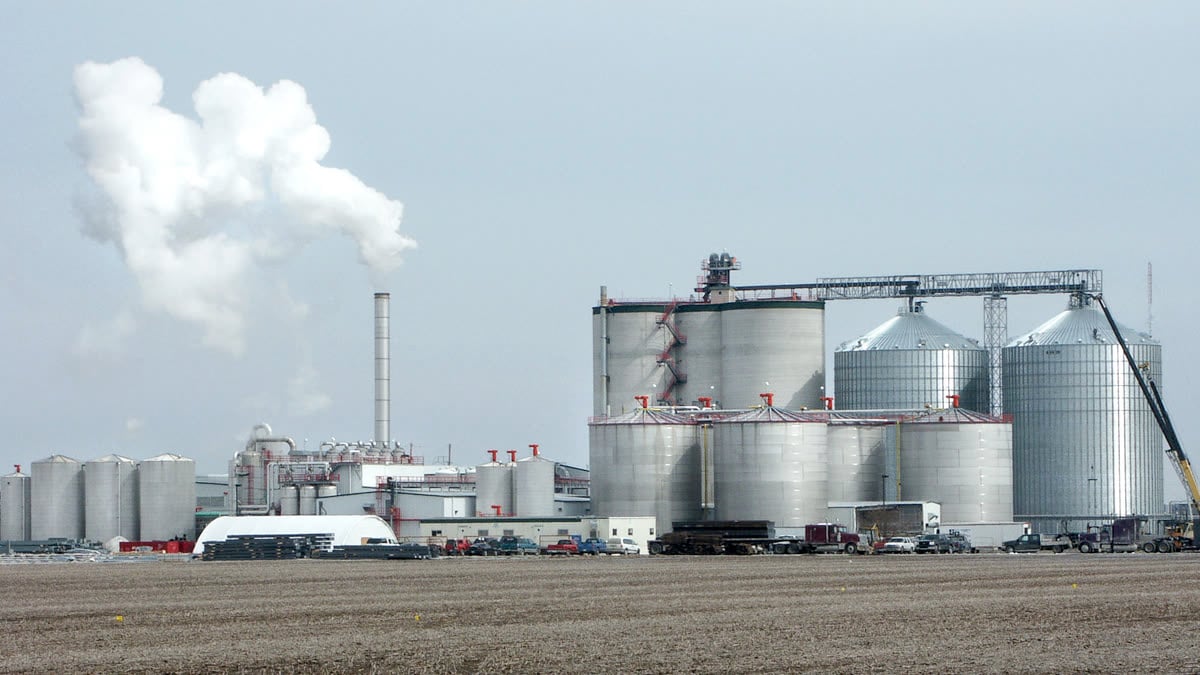
- USDA Agricultural Research Service, “A typical ethanol plant in West Burlington, Iowa” by Steven Vaughn, image source
This article is for general information only and is not financial, insurance or legal advice.