Nitin Gadkari has again defended India’s E20 petrol programme, saying critics should show evidence of vehicle damage linked to the blend. The remarks, reported from his appearances at the HT Auto Leaderboard Awards and a Bihar investor summit, do not by themselves change the fuel available at pumps; they renew a practical question for drivers: is a particular vehicle ready for E20, and how should its running cost be tracked?
Key takeaways
- Gadkari’s defence is an attributed statement, not a new notification changing vehicle compatibility requirements.
- E20 means petrol blended with up to 20% ethanol under the government’s blending programme.
- An official government Q&A describes testing and field checks, while recognising that real-world fuel economy can vary by vehicle and conditions.
- Owners should follow vehicle-specific instructions rather than assume that a claim about the wider fleet applies equally to an older car or two-wheeler.
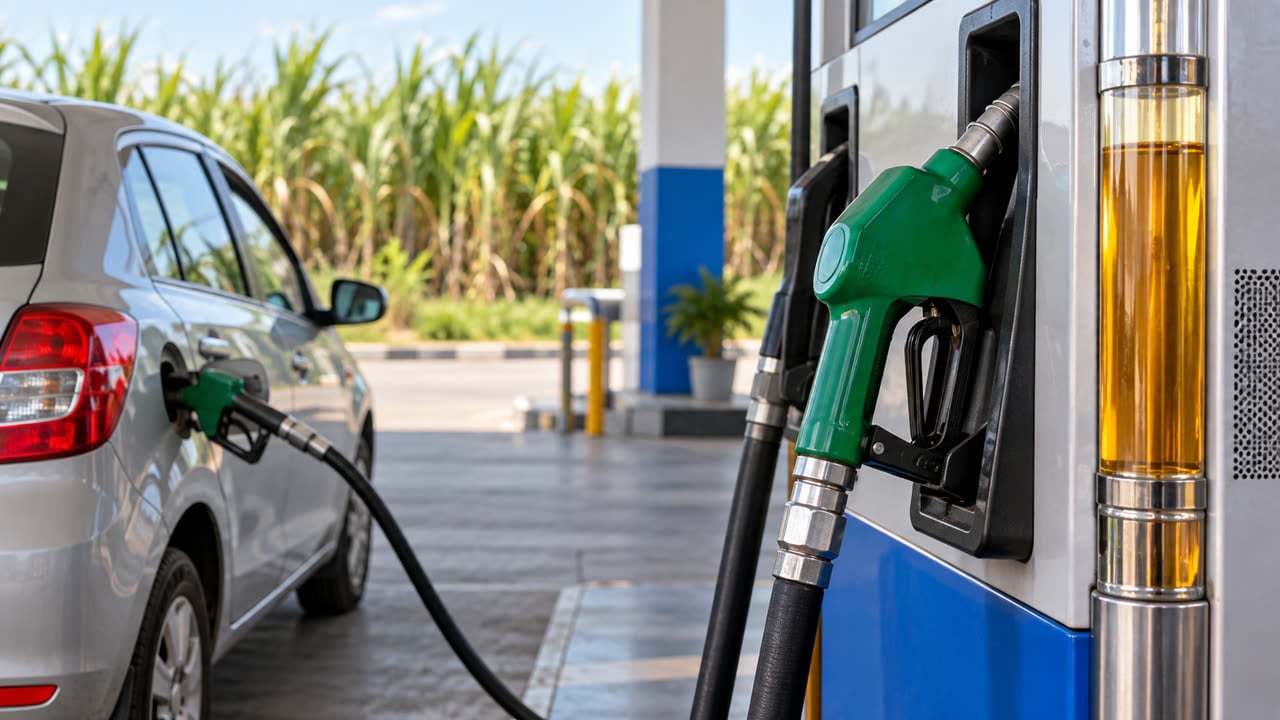
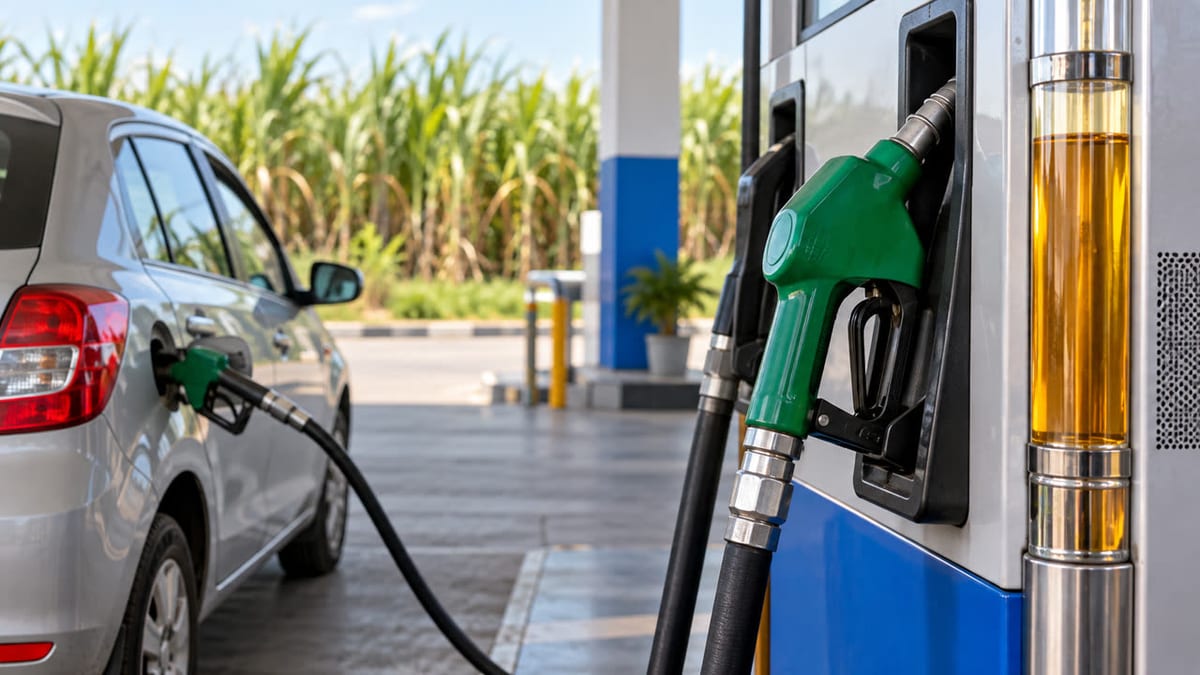 Illustrative image of E20 fuel use at a petrol station; generated for FuelPrice, not an official photograph of a specific vehicle or fuel company.
What Gadkari said about E20 petrol
Hindustan Times reported on 1 Oct 2026 that Gadkari, speaking at the HT Auto Leaderboard Awards and Summit, defended the blend and said leading automakers were preparing vehicles capable of running on higher ethanol proportions. The report described his position as a challenge to claims that E20 has broadly damaged vehicles.
Onmanorama reported the same day from a Bihar Investor Summit that Gadkari again challenged critics to show vehicles damaged by ethanol-blended petrol. Cartoq’s 3 Oct 2026 account repeated the central remarks and placed them in the continuing public discussion around E20 compatibility. Together, the reports establish what was said; they do not independently prove the condition of every vehicle using the blend.
Gadkari also cited a large installed base, saying about 4 crore four-wheelers and 20 crore two-wheelers had been using ethanol-blended petrol since 2022. Those are figures attributed to the minister in the reports, not a compatibility certificate for every model, age group or fuel system.
What E20 changes for motorists
The Ministry of Petroleum and Natural Gas’s official PIB Q&A, posted on 10 Jul 2026, describes E20 as petrol containing up to 20% ethanol. It says E20 fuel became available from Apr 2023 and records the government’s 20% blending milestone for Ethanol Supply Year 2025–26. The same document says the programme has been supported by testing and field validation, while setting out technical points that matter to vehicle owners.
For a motorist, E20 is a fuel specification, not an automatic upgrade to an older vehicle. A car or two-wheeler’s compatibility depends on its design, materials, calibration, maintenance history and the manufacturer’s guidance. A public statement that the wider fleet has not shown widespread damage cannot replace the owner’s manual, fuel-flap marking or a manufacturer’s compatibility statement.
The blend also does not fix the price paid at the pump. Drivers can check current rates on the live fuel-price pages, then compare litres consumed rather than relying only on a dashboard range estimate. For a longer journey, the fuel-cost calculator can help separate the effect of distance, mileage and the current pump price.
Why one statement cannot settle the debate
Gadkari’s argument is that the testing and experience cited by the government do not support a general claim of widespread E20-related vehicle damage. The official PIB Q&A similarly refers to compatibility checks and industry field trials. That is important context, but it should not be read as a promise that every vehicle will deliver identical mileage or have identical long-term results.
Drivers who report rough running, hard starting, an engine warning or an unexpected mileage drop should not assume that E20 is automatically the cause. Age, maintenance, fuel contamination, tyre pressure, traffic, driving style and a vehicle’s calibration can all affect performance. A proper service diagnosis, supported by the vehicle’s records and fuel receipts, is more useful than treating a ministerial statement or a social-media claim as proof.
What drivers should check now
- Confirm compatibility. Check the owner’s manual, fuel-flap marking and the latest manufacturer guidance. If the information is unclear, ask the authorised service channel for the vehicle-specific position.
- Measure mileage consistently. Record litres, odometer distance and route conditions over more than one fill. Compare like with like, because a single tank can be distorted by traffic, tyre pressure, air-conditioning use or a different pump.
- Document symptoms before making a claim. If a vehicle develops a warning light, starting problem or rough running, retain the fuel receipt and service diagnosis. The symptom needs to be assessed before its cause can be assigned.
- Do not confuse flex-fuel with ordinary petrol. A flex-fuel vehicle is designed and certified for specified ethanol blends. That does not mean an ordinary petrol vehicle should be filled with E85 or E100 unless its manufacturer explicitly approves it.
What to watch next
The useful next signals will be specific rather than rhetorical: automakers’ compatibility statements, the launch and certification details of flex-fuel models, official information on fuel availability, and documented evidence from testing or consumer complaints. Any future change to blend standards or vehicle requirements should come through an official notification, not just a speech or a headline.
For trip planning, the road-trip planner can be used alongside a vehicle’s measured mileage and the current fuel rate. That keeps the calculation tied to the car or bike actually being driven, rather than to a generic promise about E20.
Reader takeaway
Gadkari’s comments put E20 vehicle-damage claims back in the spotlight, but they do not remove the need for vehicle-specific checks. The practical test for an owner is whether the manufacturer supports the blend, what the vehicle’s measured mileage shows over time, and whether any fault is confirmed by a proper diagnosis.
Sources
- Press Information Bureau — Ethanol Blended Petrol Programme: Q&A (10 Jul 2026)
- Hindustan Times — ‘Vehicles which can run on 100% ethanol may hit roads in 2 months’: Nitin Gadkari at HT Auto Leaderboard Awards (1 Oct 2026)
- Onmanorama — Nitin Gadkari doubles down on ethanol-blended petrol, challenges critics to show damaged vehicles (1 Oct 2026)
- Cartoq — Gadkari defends E20 ethanol-blended fuel policy (3 Oct 2026)