As of November 2026, India has three different ways to budget National Highway tolls: the NHAI Annual Pass costs ₹3,075 for FY 2026–27 and covers eligible crossings for up to one year or 200 crossings, while the new Local Pass costs ₹1,500 or ₹3,000 a year for eligible residents near a participating plaza. Regular FASTag continues to charge the applicable toll each time. The right comparison depends on where you drive, how often you cross, and whether the plaza is actually covered.
This guide explains the difference, shows the break-even calculation with clear illustrative math, and gives a checklist for checking eligibility, coverage, activation and wrong deductions. Use the toll charge calculator to collect the current plaza-level rates before doing the calculation.
Key takeaways
- The Annual Pass is a nationwide-style prepaid product for eligible non-commercial cars, jeeps and vans at participating NHAI-operated National Highway and National Expressway plazas.
- The Local Pass is restricted to one fee plaza and is meant for eligible non-commercial vehicle owners who live within 20 km of that plaza.
- For the Annual Pass, divide ₹3,075 by your regular one-way toll and round up to find the approximate break-even number of covered crossings.
- A return journey can consume two crossings at a point-based plaza, while an entry-exit pair in a closed system is counted as one crossing under the Annual Pass terms.
- Neither product automatically covers every state, private, local-body or parking charge, so keep the regular FASTag wallet active.
What changed in November 2026
NHAI revised the Annual Pass fee from ₹3,000 to ₹3,075 for financial year 2026–27, with the revised fee applying from 1 April 2026. NHAI says the pass is available for eligible non-commercial vehicles with a valid FASTag and is intended for one year or 200 toll-plaza crossings, whichever comes first. The pass is activated on the existing FASTag after eligibility checks and payment through the official Rajmargyatra app or NHAI website.
A separate MoRTH rule introduced a concessional Local Pass from 1 November 2026. A qualifying non-commercial vehicle owner living within 20 km of an eligible National Highway fee plaza can pay ₹1,500 a year when the plaza is outside municipal or local-town limits, or ₹3,000 a year when the plaza falls within those limits. The pass applies only to that specific plaza and cannot be transferred to another one. The government announcement says availability at eligible plazas began on 1 November 2026, with Rajmargyatra app availability scheduled from 1 December 2026.
Annual Pass, Local Pass or regular FASTag?
| Option | Published fee | Limit or validity | Where it applies | What to verify |
|---|---|---|---|---|
| NHAI Annual Pass | ₹3,075 for FY 2026–27 | One year or 200 eligible crossings, whichever comes first | Eligible NHAI-operated National Highway and National Expressway plazas | Vehicle class, FASTag status and the eligible-plaza list |
| Local Pass outside municipal or local-town limits | ₹1,500 per year from 1 November 2026 | Annual pass for one specific eligible plaza | That plaza only, for qualifying residents within 20 km | Residence radius, plaza eligibility and whether an alternative road exists |
| Local Pass within municipal or local-town limits | ₹3,000 per year from 1 November 2026 | Annual pass for one specific eligible plaza | That plaza only, for qualifying residents within 20 km | Municipal-limit classification and the plaza’s issuance process |
| Regular FASTag | No separate pass fee | Pay the applicable user fee on each crossing | Any plaza where the linked FASTag is accepted, subject to its rules | Current rate, vehicle class, wallet balance and tag status |
Source and date note: the Annual Pass figures above come from NHAI and MoRTH material for FY 2026–27; Local Pass figures come from the MoRTH announcement dated 27 October 2026 and are effective from 1 November 2026. Rates can be revised by the Central Government annually, with the MoRTH announcement referring to revisions taking effect on 1 April.
How coverage and crossing counts work
1. Annual Pass coverage is broad, but not universal
- The current Rajmargyatra terms describe the Annual Pass as a prepaid product for non-commercial vehicles with a valid registration certificate and a functional FASTag affixed to the same vehicle’s windscreen and mapped to its registration number.
- It is valid only at the eligible NHAI-operated National Highway and National Expressway fee plazas shown by Rajmargyatra. A state-government or local-body road, a privately operated toll facility, parking charge or other excluded facility can continue to use the regular FASTag wallet.
- The pass is linked to the original vehicle registration number. It cannot be shifted between vehicles, and unused crossings do not carry forward after the validity period.
Check each toll point on a mixed route; the barrierless FASTag tolling guide explains why the operator matters.
2. A crossing is not always the same as a return trip
At a point-based plaza, a one-way passage is one crossing, so going out and returning through the same plaza normally uses two crossings. In a closed user-fee system, the terms define a valid entry-exit pair as one crossing. Check the route structure before using a round-trip assumption in your spreadsheet.
3. Local Pass eligibility is narrower
- The owner must meet the residence condition within 20 km of the participating fee plaza and use an eligible non-commercial vehicle with a valid, functional FASTag.
- The Local Pass is tied to one plaza, not a network of plazas. It is not transferable.
- The MoRTH announcement says it is not available where collection uses a closed user-fee system or where a service road or alternative road is available for local commuters.
For context on the new rule, read the Local Pass report, then confirm the exact plaza result.
How to calculate the Annual Pass break-even
Start with the regular one-way user fee for the same vehicle class at a covered plaza. The basic formula is:
Break-even crossings = ₹3,075 ÷ regular toll per crossing
Round the result up to the next whole crossing because a vehicle cannot make a fraction of a toll crossing. The result is only meaningful for crossings that the Annual Pass actually covers.
Worked example: Annual Pass
- Assume an eligible covered plaza charges a hypothetical ₹100 per one-way car crossing. This ₹100 is an illustration, not a universal or current toll quote.
- Divide the FY 2026–27 Annual Pass price by that example rate: ₹3,075 ÷ ₹100 = 30.75.
- Round up: the pass overtakes regular payments on the 31st covered crossing in this illustration.
- At 20 crossings, regular payments would be ₹2,000; at 50, they would be ₹5,000, a mathematical difference of ₹1,925 before excluded plazas or unused capacity.
Worked example: Local Pass
Suppose an eligible resident uses the same participating plaza 20 times in a year and the illustrative one-way toll is ₹75. Regular payments would be ₹1,500, exactly matching the Local Pass price outside municipal or local-town limits. A 21st crossing would move the arithmetic in favour of the pass, but only if the resident, vehicle and plaza satisfy the official conditions. If the plaza falls within the stated municipal or local-town classification, the ₹3,000 Local Pass would need a much higher usage level to break even at the same illustrative rate.
Do not treat either example as a promise of savings. Replace the illustrative rate with the current amount for your route and vehicle class. Combine the result with the road-trip planner and fuel cost calculator for a recurring trip.
Which option fits which driving pattern?
- Frequent inter-city National Highway travel: compare the Annual Pass with the covered tolls you expect to pay; state or private tolls may still be outside it.
- Daily use of one nearby plaza: check the Local Pass first, but verify the 20-km rule, alternative-road condition and municipal classification.
- Occasional or mixed-operator travel: regular FASTag may be simpler. Keep its wallet funded even after activating a pass.
Activation and pre-payment checklist
- Confirm the vehicle is a private non-commercial car, jeep or van and that the RC, registration number and FASTag match.
- Check that the tag is active, fixed to the windscreen and not blacklisted or hotlisted.
- Use the official Rajmargyatra or NHAI route and inspect the eligible-plaza list; avoid unofficial payment sites.
- For a Local Pass, verify the 20-km test, exact plaza, municipal category and alternative-road condition. Plaza availability began on 1 November 2026; app availability is scheduled from 1 December 2026.
- Record activation and expected crossings. The Annual Pass lasts 12 months or 200 crossings, whichever comes first; the Local Pass is tied to its named plaza.
- Keep regular FASTag balance for excluded tolls, check each transaction and save the receipt.
- Recalculate if the route adds a state-operated toll, private facility or closed user-fee section.
What to do after a wrong deduction or e-Notice
First compare the SMS, FASTag statement, vehicle registration number, plaza name, date and amount with the actual journey. A pass benefit does not prevent an error, and an excluded plaza can create a legitimate regular-wallet deduction even when the Annual Pass is active.
- For an unsuccessful FASTag payment that creates an e-Notice, NHAI’s 25 June 2026 release says the normal user fee is payable if settled within 72 hours; after that window, the prescribed amount can become twice the applicable fee. The same release says an incorrect notice can be challenged through the designated portal within 72 hours of issue.
- For an incorrect FASTag deduction, contact the issuing bank and use the National Highway helpline 1033 or the official grievance channel. Keep the transaction ID, vehicle number, plaza, travel date and supporting screenshot ready.
- Do not pay a suspicious message through a link in an unsolicited SMS. Open the official portal or app directly and verify the notice against the vehicle details.
FAQ
Is the FASTag Annual Pass valid at every toll plaza in India?
No. The Annual Pass terms limit the benefit to eligible NHAI-operated National Highway and National Expressway plazas. State, local-body, private, parking and other excluded charges can continue to be deducted from the regular FASTag wallet.
Does a round trip use one Annual Pass crossing?
Not always. At a point-based plaza, the outbound and return passages are separate crossings. In a closed user-fee system, a valid entry-exit pair is counted as one crossing under the Annual Pass terms.
Can I use one Annual Pass for two cars?
No. The pass is linked to the vehicle registration number and the associated FASTag. It is non-transferable, and using it on another vehicle can lead to deactivation without refund under the published terms.
Is the Local Pass the same as the Annual Pass?
No. The Local Pass is a plaza-specific concession for eligible residents within 20 km of that plaza. The Annual Pass is a separate prepaid product for eligible vehicles at the participating NHAI network, subject to its own coverage and crossing limit.
This article is for general information only and is not financial, insurance or legal advice.
Sources
- NHAI, “NHAI to Revise FASTag Annual Pass Fee from 1st April 2026 for FY 2026–27”, 15 March 2026.
- Ministry of Road Transport and Highways, “Government Introduces Concessional Local Pass for National Highway Users Living Near Fee Plazas”, 27 October 2026.
- Rajmargyatra and NHAI, “Annual Toll Pass Terms and Conditions”, accessed 2 November 2026.
- Indian Highways Management Company Limited, “FAQ – FASTag”, accessed 2 November 2026.
- Ministry of Road Transport and Highways, “NHAI Rolls Out Multi-Lane Free Flow Tolling at Gharaunda Toll Plaza on NH-44”, 25 June 2026.
- Moneycontrol, “FASTag local pass from November 1: Residents near toll plazas can pay Rs 1,500–3,000 annually”, 27 October 2026.
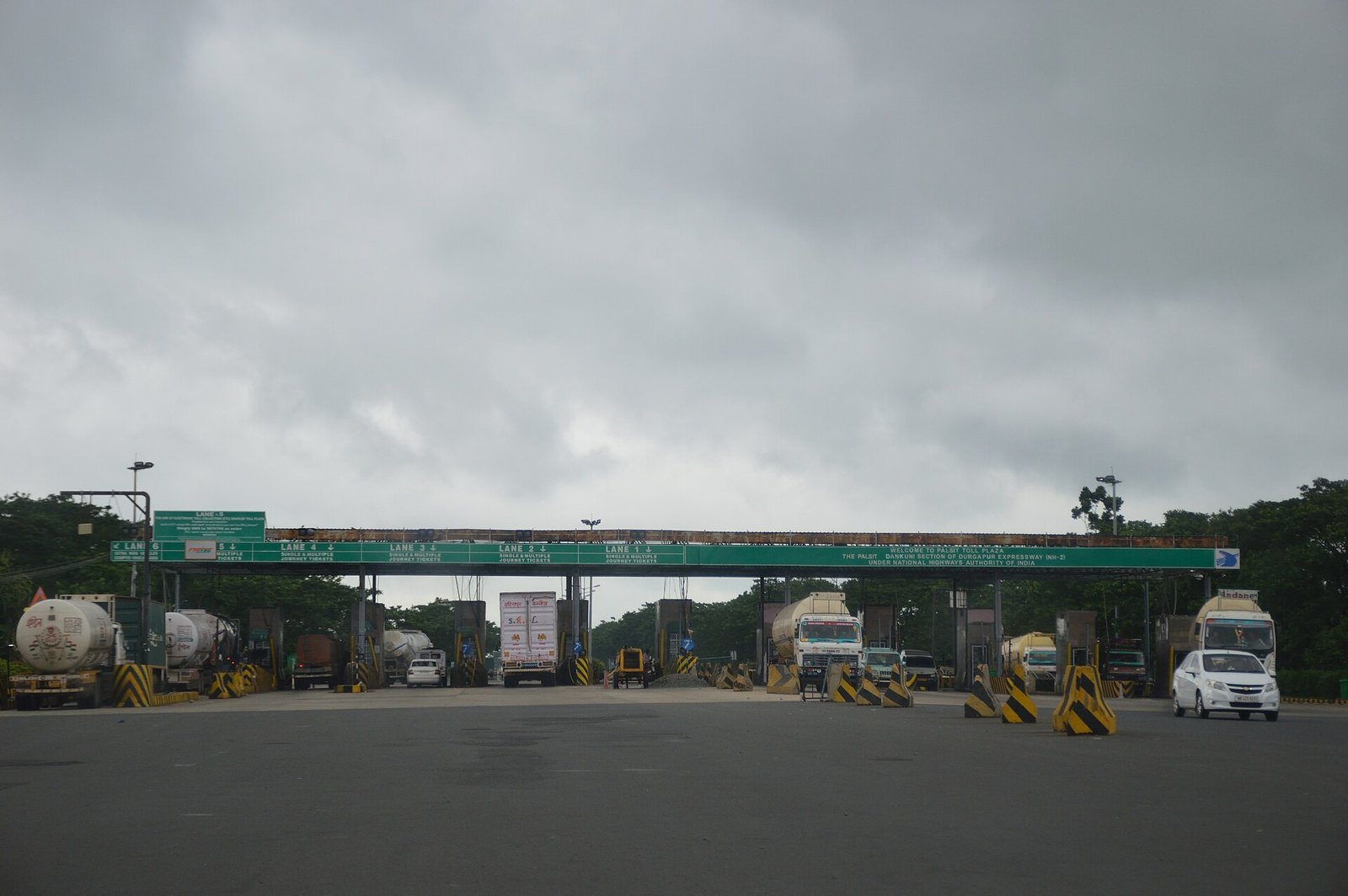
- Wikimedia Commons, “Palsit Toll Plaza – National Highway 2 – Burdwan – 2017-10-21 5065”, photograph by Biswarup Ganguly, 21 October 2017, CC BY 3.0.