A bike's monthly cost is more than the amount paid at the petrol pump. This guide shows how to turn your actual kilometres, tank-to-tank mileage, current city fuel price, insurance, servicing and repair bills into a realistic monthly running-cost budget.
The most useful number is personal: a rider covering 800 km a month at 45 km/litre and using Delhi petrol at ₹102.12 per litre as of 27 Oct 2026 spends about ₹1,816 a month on fuel alone. Add the annual costs that are easy to forget, then separate running cost from loan EMI, depreciation and the purchase price.
Key takeaways
- Start with actual monthly kilometres and observed mileage, not a brochure figure.
- Fuel cost is calculated as kilometres ÷ km/litre × price per litre.
- Spread annual insurance, scheduled service and replacement reserves across 12 months.
- For a new two-wheeler, check the separate one-year own-damage period against the longer third-party cover period.
- Keep a variable-cost view for fuel and tolls, and a fixed-cost view for insurance and maintenance.
- Use the final estimate for a route, commute or household budget; it is not a promise of future prices or repair bills.
What counts as monthly bike running cost?
Running cost is the money needed to keep using the bike. It is different from total ownership cost, which also includes the purchase price, loan interest, down payment, registration, depreciation and resale value.
- Fuel: petrol litres used for the distance you actually ride. For an electric two-wheeler, replace this with home and public charging cost.
- Insurance: the annual policy cost divided by 12. Keep third-party and own-damage components separate when the policy periods differ.
- Routine service: oil, filters, labour, chain or belt work, brake wear and other scheduled items recorded on invoices.
- Replacement reserve: a monthly amount for tyres, battery, chain-sprocket work and unscheduled repairs.
- Parking and tolls: include them when the commute or regular route makes them unavoidable. They are use-case costs, not vehicle costs in every household.
For a wider household budget, compare this method with the monthly car ownership cost guide. The categories are similar, but the distance, fuel type, insurance and maintenance pattern can be very different.
Step 1: measure the distance you really ride
Write down the odometer or trip-meter reading at the start and end of a normal month. Include office travel, errands, school runs, weekend rides and the short detours that are often missing from a rough estimate.
- Record the opening kilometre reading.
- At month-end, subtract the opening reading from the closing reading.
- Separate unusually long trips from the normal commute if you want both a monthly average and a trip budget.
- Repeat the exercise for at least two ordinary months when usage changes by season.
If the bike is shared, maintain a simple log with date, kilometres and rider. A 200-km difference in monthly use can change the fuel line more than small differences in insurance quotes.
Step 2: calculate fuel cost from tank-to-tank mileage
The basic formula is:
Monthly fuel cost = monthly kilometres ÷ actual mileage in km/litre × current petrol price per litre
Use a tank-to-tank result where possible. Note the distance travelled between refills, record the litres on the next bill and divide kilometres by litres. Repeat the test on similar routes rather than treating one unusually open highway ride as the bike's normal mileage.
As a dated price input, PPAC's IndianOil retail-price document listed Delhi petrol at ₹102.12 per litre as of 26 Oct 2026, and NDTV listed the same Delhi rate on 27 Oct 2026. Fuel prices vary by city and can change, so check the latest fuel prices by city before updating the estimate.
Worked fuel example
Assume 800 km in a month, measured mileage of 45 km/litre and a petrol price of ₹102.12 per litre as of October 2026:
- Litres used = 800 ÷ 45 = 17.78 litres.
- Fuel cost = 17.78 × ₹102.12 = about ₹1,816.
- Annualised fuel cost = ₹1,816 × 12 = about ₹21,792, if distance, mileage and price remain unchanged.
The annual figure is only a planning illustration. A price change, heavier traffic, tyre pressure, riding style or a change in monthly distance will alter it. For a particular journey, enter the route distance and your measured mileage in the FuelPrice fuel cost calculator.
Fuel-cost comparison using the same mileage assumption
The table below is a transparent model, not a claim about average Indian riding. It uses 45 km/litre and Delhi petrol at ₹102.12 per litre as of 27 Oct 2026. Replace the distance, mileage and price with your own readings.
| Monthly distance | Litres at 45 km/l | Fuel cost at ₹102.12/l | Annualised fuel cost |
|---|---|---|---|
| 500 km | 11.11 litres | ₹1,135 | ₹13,620 |
| 800 km | 17.78 litres | ₹1,816 | ₹21,792 |
| 1,200 km | 26.67 litres | ₹2,724 | ₹32,688 |
These figures are rounded to the nearest rupee. The fuel price is the dated market input; the kilometres and 45 km/litre are stated modelling assumptions. The same calculation works for another city after replacing the price with the rate shown for that city.
Step 3: add insurance without double-counting
Third-party motor insurance is mandatory for vehicles used on public roads, while own-damage cover is the part that responds to damage to the insured bike subject to the policy terms. IRDAI's motor-insurance consumer guidance says a new two-wheeler can have a bundled policy or a long-term liability-only policy: third-party cover runs for five years, while own-damage cover under a bundled policy runs for one year and needs attention at its expiry.
For a monthly budget:
- Find the policy premium and its period on the schedule or renewal document.
- Divide an annual premium by 12. For a multi-year third-party premium, divide the total only across the covered years.
- Do not assume that a first-year bundled policy means own-damage cover continues for five years.
- Keep the renewal date, registration number and policy number together. IRDAI also says a valid PUC certificate is required on the date of motor-insurance renewal.
Premiums vary by vehicle, location, claim history, cover, add-ons and insurer. Treat a quote as your own input and do not use a generic online estimate as a universal rate.
Step 4: convert service and repair bills into monthly reserves
Service costs are lumpy: a month may have no bill, followed by a month with oil, brake or tyre work. A monthly reserve smooths the budget without pretending that every month has the same repair cost.
- Add the last 12 months of scheduled-service invoices and divide by 12.
- List large replacement items separately: tyres, battery, chain and sprocket, brake pads, belts or suspension work.
- For each item, divide its actual invoice by the number of months over which you expect to use it. This is a planning reserve, not a manufacturer promise.
- Keep accident repairs and insurance deductibles in a separate emergency line; they should not be hidden inside routine mileage.
When the bike is new, use the service schedule and the first invoices. When it is older, the previous 12 to 24 months of receipts are more useful than a generic percentage of the purchase price.
A complete illustrative monthly budget
Here is a worked household model using the same 800-km month. The insurance, service, repairs and parking entries are deliberately illustrative inputs, not market quotes. Replace them with policy documents and receipts.
| Cost line | Illustrative input | Monthly amount | How to personalise it |
|---|---|---|---|
| Fuel | 800 km, 45 km/l, ₹102.12/l | ₹1,816 | Use tank-to-tank mileage and the current city rate. |
| Insurance | ₹3,600 annual premium | ₹300 | Use the exact premium and policy period. |
| Scheduled service | ₹6,000 over 12 months | ₹500 | Use paid invoices, not a showroom estimate. |
| Tyre, battery and repair reserve | ₹4,800 planned over 12 months | ₹400 | Use actual replacement history and condition. |
| Parking and tolls | ₹300 per month | ₹300 | Use regular receipts; omit if not applicable. |
| Total illustrative running cost | — | ₹3,316 | Recalculate when any input changes. |
In this model, fuel is about 55% of the monthly running-cost total (₹1,816 ÷ ₹3,316). That ratio is not a general rule; it changes with distance, fuel price, parking, service intensity and the age of the bike. A low-distance rider may have a higher fixed-cost share, while a delivery or long-distance rider may have a much higher fuel and tyre share.
How to read the result
- Compare like with like: use the same monthly kilometres and route when comparing two bikes or an ICE bike with an electric option.
- Separate fixed and variable lines: insurance and planned maintenance do not fall to zero in a month when the bike is parked, while fuel broadly follows kilometres.
- Check the city effect: a fuel price from Delhi cannot be used as the price for Mumbai, Bengaluru or a smaller town. Use the city hub for each estimate.
- Keep EMI outside running cost: add loan principal and interest only when calculating total ownership cost, alongside down payment and depreciation.
- Plan the route: fuel and tolls are easier to control when the distance and stops are known. The road-trip planner can help turn a route into a distance and stop list.
What to check before finalising your budget
- Record two normal tank-to-tank mileage readings.
- Confirm the monthly kilometres from the odometer, not memory.
- Check the current petrol rate for the city where the bike is usually filled.
- Read the policy schedule for third-party, own-damage, add-ons, expiry and deductibles.
- Gather the last year of service, tyre, battery and repair bills.
- Divide annual or multi-year expenses by the correct covered period.
- Keep EMI, parking, tolls and exceptional accident repairs as separate lines.
- Recalculate after a route change, price movement, major service or policy renewal.
Frequently asked questions
What is the simplest formula for monthly bike fuel cost?
Divide monthly kilometres by measured mileage in km/litre, then multiply by the current petrol price per litre. The result becomes more useful when both distance and mileage come from the same riding pattern.
Should bike EMI be included in monthly running cost?
Not usually. EMI is a finance and ownership cost; fuel, insurance, service, repairs, parking and tolls are use-related costs. Keep both views and combine them only when preparing a full monthly ownership budget.
How is bike mileage calculated accurately?
Record the kilometres between two comparable refills and divide by the litres added at the second refill. Repeat the measurement because traffic, load, tyre pressure, weather and riding style can change the result.
How long is third-party insurance valid for a new two-wheeler?
IRDAI's consumer guidance says third-party cover for a new two-wheeler runs for five years under a bundled or long-term liability-only arrangement. Own-damage cover under a bundled policy is for one year, so the policy schedule still needs to be checked for the renewal date and cover details.
Can the same method be used for an electric scooter?
Yes. Replace litres and petrol price with electricity consumed, the applicable home or public charging tariff and charging losses where known. Keep battery warranty, service, tyres, insurance and charging-equipment costs as separate lines.
Sources
- Society of Indian Automobile Manufacturers, “Auto Industry Sales Performance of Q2: FY2027 (July–September 2026),” 15 Oct 2026.
- Autocar India, “Motorcycle sales hit 6.92 million units in first half of FY2027,” 26 Oct 2026.
- Petroleum Planning & Analysis Cell, “RSP of Petrol in Delhi as per IOCL outlet as on 26-October-2026,” 26 Oct 2026.
- NDTV, “Petrol Price in New Delhi Today,” 27 Oct 2026.
- IRDAI, “Motor Insurance — Policy Holder,” accessed 27 Oct 2026.
- Ministry of Road Transport and Highways, “Mandating third-party insurance period of cars and two-wheelers,” 2018.
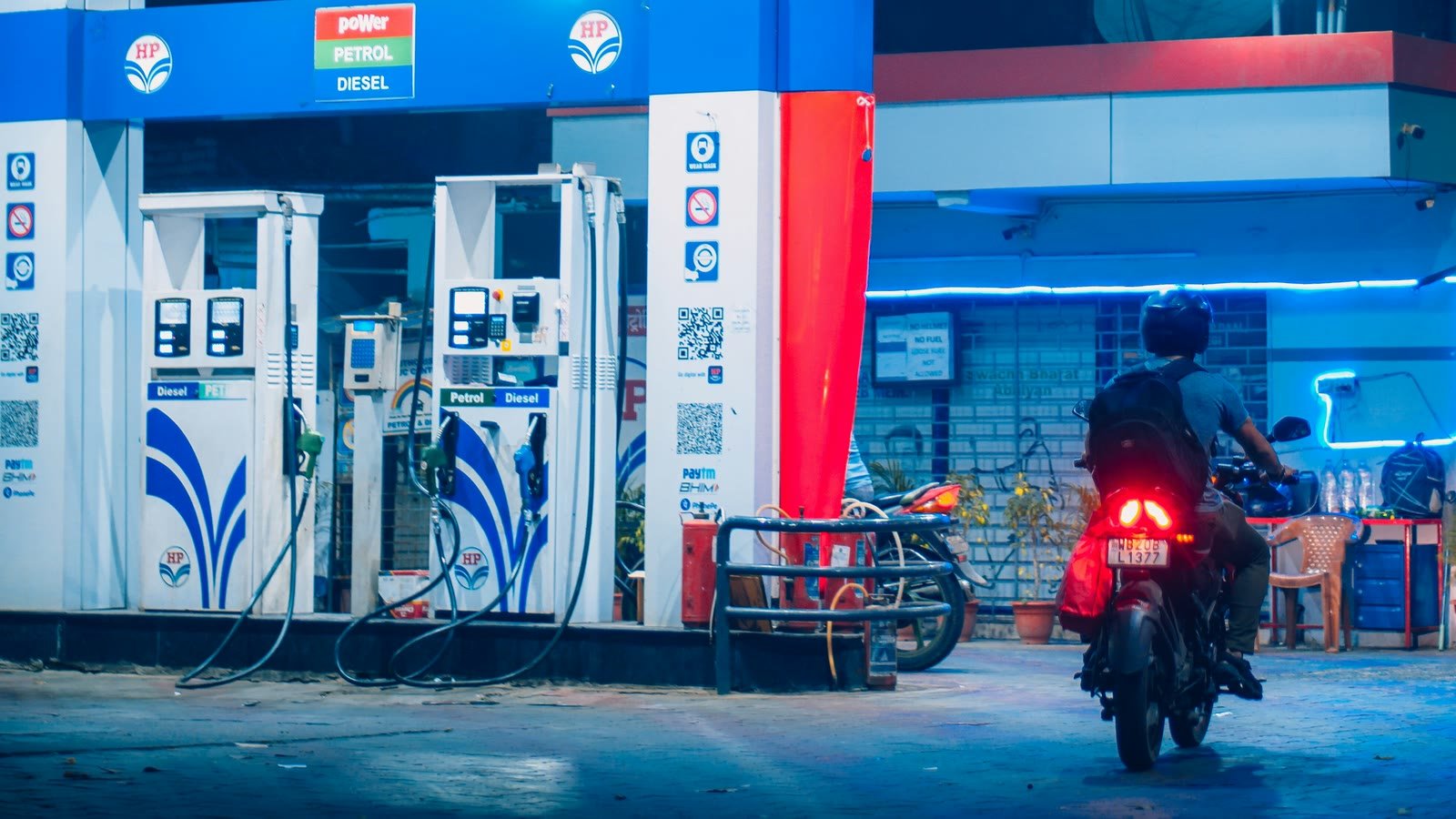
- Unsplash, Ramprasad Kansari, “A gas station with a motorcycle parked in front of it,” 30 May 2023; hero image source.
This article is for general information only and is not financial, insurance or legal advice.